Anthropic's Massive Losses and Trillion-Dollar IPO: AI Safety Risk Takes Center Stage in Prospectus

Anthropic's planned IPO could value it at over $1 trillion, with its prospectus unusually disclosing AI existential risks and over $80 billion in half-year losses.
According to a financial journalist's analysis, Anthropic's IPO could become one of the largest in history, potentially valued at over $1 trillion. The most unusual aspect of the prospectus is its extensive warnings about AI's existential risks to humanity, embedding safety into the capital narrative. Net losses exceeded $80 billion in H1 2026, yet some months saw growth above 1000%, creating a classic growth paradox. The key question is how investors will digest this risk list and whether traditional models can price existential risk.
An Unprecedented IPO and an "Unusual" Prospectus
According to a financial journalist's analysis shared by a Bilibili creator, Anthropic's IPO could become one of the largest in history, with a valuation potentially exceeding $1 trillion. But what truly struck the journalist as "extraordinary" wasn't the valuation figure—it was the sheer volume of space devoted to "Risk Factors" in the prospectus. The company used extensive pages to warn about "catastrophic" and "existential" risks facing humanity.
For a company to so solemnly list existential risks in its IPO filing is extremely rare in business history.
This detail reflects how AI safety has become deeply embedded in the capital narrative of top AI companies. For a lab whose brand identity is built around "safety," disclosing existential risks to public markets is both a compliance requirement and a continuation of its stance. The signal to potential investors is clear: this company's business logic is inseparably bound to long-term human risk.
The "Risk Factors" section is a mandatory disclosure in SEC registration filings, requiring companies to enumerate risks that could materially adversely affect their business, finances, or stock price. Typically, tech companies list operational risks such as market competition, regulatory compliance, talent attrition, and technological iteration. Including "existential risk"—catastrophic consequences at the level of human civilization—as a formal disclosure item is highly unusual. Such disclosure could trigger liability discussions under securities law and influence institutional investors' risk models and ESG assessment frameworks.
Over $80 Billion in Net Losses for Half a Year: A Two-Sided Narrative of Growth and Cash Burn
For the financial journalist, the most eye-catching number was the loss. The prospectus shows that in the first half of 2026, Anthropic recorded a net loss exceeding $80 billion. A loss of this magnitude makes one thing clear: maintaining technological leadership requires sustained, massive investment.
But the loss isn't the whole story. The same filing disclosed that in some months this year, the company's growth rate exceeded 1000%. Such a steep growth curve explains why investors are willing to tolerate astronomical losses. When evaluating a high-growth tech company, the core variable in investment decisions isn't current profit—it's how large the company can grow in the future.
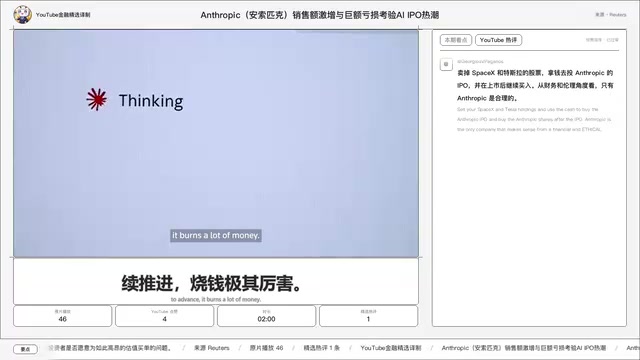
This creates a classic "growth company" paradox: the larger the loss, the more growth is needed to justify the valuation; the faster the growth, the more capital is needed to sustain expansion. Anthropic's prospectus places this paradox squarely before all public market investors.
In valuing growth-stage tech companies, investors commonly use metrics such as price-to-sales (P/S) and the Rule of 40 (the sum of growth rate and profit margin should exceed 40%). For a company with growth exceeding 1000%, traditional price-to-earnings (P/E) ratios become meaningless due to negative profits, and the market instead prices based on discounted future revenue expectations. A net loss of $80 billion means the company must continuously raise capital to sustain compute, talent, and data investments. Its burn rate and financing cadence become key variables for measuring sustainability, rather than current-period profit.
How Will Investors Digest This "Risk List"?
Now all the information is public—financial data, risk disclosures, and growth metrics are all available. The key question that follows is: how will investors digest this information, and how will they translate it into actual investment decisions?
According to the analysis, the IPO's size could exceed $1 trillion. What's truly worth watching is whether anyone is willing to write a check for that price tag.

From a public market perspective, Anthropic faces not only the universal question of "how do AI companies make money" but also a more distinctive problem: when a company itself warns of existential risks in its prospectus, how should investors price that risk? Traditional valuation models struggle to handle such a variable.
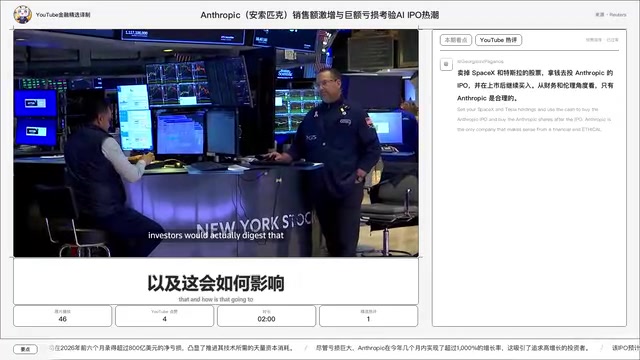
Pricing "existential risk" falls under the category of "Knightian uncertainty" in finance—where the probability distribution itself is unknown and expected losses cannot be estimated from historical data as with ordinary risks. Traditional DCF models therefore struggle to incorporate this variable directly, and investors typically turn to scenario analysis, stress testing, or demanding higher risk premiums. Some institutions may treat it as tail risk, managing it indirectly through reduced positions or ESG exclusion lists rather than precise quantification.
Conclusion
Anthropic's IPO filing presents two pictures simultaneously: on one side, explosive growth exceeding 1000% and trillion-dollar valuation ambitions; on the other, over $80 billion in losses for half a year and blunt existential risk warnings. The discussion surrounding this company's IPO is essentially asking: is the public market ready to pay for an AI company that is both high-growth and highly uncertain? The answer isn't in the prospectus—it's in investors' checkbooks.
One-line Summary
Anthropic's planned IPO could value it at over $1 trillion, with its prospectus unusually disclosing AI existential risks and over $80 billion in half-year losses.
Paragraph Summary
According to a financial journalist's analysis, Anthropic's IPO could become one of the largest in history, with a valuation potentially exceeding $1 trillion. What's most unusual about the prospectus is the extensive space devoted to warning about AI's existential risks to humanity, embedding safety issues into the capital narrative. Financially, net losses exceeded $80 billion in the first half of 2026, yet some months saw growth rates above 1000%, creating a classic growth-company paradox: the larger the loss, the more growth is needed to justify the valuation; the faster the growth, the more capital is needed to sustain expansion. The core question is how investors will digest this risk list and whether traditional valuation models can price existential risk—the answer depends on whether public markets are willing to pay for an AI company that combines high growth with high uncertainty.
Related articles

AI Detection False Positive Controversy: Writer Accused of Using AI, Who Should Bear the Burden of Proof?
A 2026 Commonwealth Short Story Prize regional winner was flagged by Pangram as 100% AI-generated but cleared after drafts were reviewed. The case exposes AI detection false positives and the burden-of-proof dilemma facing creators.

How Stanford Teaches AI-Native Engineering: Inside CS146S
Stanford's CS146S course confronts AI one-click assignment generation, exploring AI-native engineering education. Mihail Eric shares how to treat AI as an engineering partner and build system design and code review skills, offering a new model for engineering education.

Stanford's AI-Native Engineering Course: How to Teach Programming in the Age of Agents
Stanford CS146S course reform: Mihail Eric brings open-source maintainers into the classroom, having students propose changes in unfamiliar real codebases, exploring AI-native engineering teaching in the age of agents, shifting from writing code to cultivating engineering decision-making skills.