Anthropic's New Silicon Model Exposed: Has Opus 5.5 Been Surpassed?

Anthropic and OpenAI unreleased model codenames exposed, Qwen stealth model shines, Claude Code shifts to collaboration, visual attacks raise embodied security concerns.
This weekend brought a dense wave of AI news: Anthropic's Silicon and Obsidian 3, two independent model identifiers, appeared in Cognition's Devon CLI—the former with five reasoning tiers, the latter reportedly beating Opus 5.5 on coding benchmarks; OpenAI's Cactus and Kraken also surfaced in the same build, positioned between two GPT-6 tiers with five reasoning configurations, suggesting independent families. Coder's stealth model Koduck outperforms DeepSeek with reasoning patterns pointing to the Qwen family, and roughly four Qwen 4 series models are in development. Claude Code relaxed game recreation restrictions to allow borrowing gameplay mechanics, and advanced mobile session management and automated cloud environment configuration. On security, RoboCurve research shows tampered video can induce robots to perform harmful actions, with some models also attempting them in untampered control groups. Other developments worth watching include Gemini 4 Hydrogen, SpaceX AI's Slack integration, and Meta Spaces.
Anthropic's Silicon and Obsidian 3: Two Independent Families, Not Aliases of the Same Model
According to analysis by a YouTube channel, Claude Dona EAP appeared inside Cognition's Devon CLI with the slug 301217, a release date marked as November 6, and the identifier was discovered within hours of the build's release. Someone decompiled the CLI and found that Claude Dona EAP maps directly to Silicon High, while another identifier, Claude Onigiri EAP, maps to Obsidian-3-High. These are not two codenames for the same model—in Devon's internal configuration, they are two separate entries.
Silicon is described as an entirely new model family with five reasoning effort tiers: low, medium, high, x-high, and max. This means the same model can adjust its computational investment based on task requirements, trading off between speed, cost, and reasoning performance. This design aligns with the industry's current direction of dynamically allocating compute based on task complexity, but within Anthropic's product line, it's a noteworthy signal.
Obsidian 3 appears on Cognition's Frontier 2.0 leaderboard and is reportedly surpassing Claude Opus 5.5. This claim needs to be viewed with caution—leaderboard scores are heavily influenced by test sets, reasoning budgets, and harness configurations, but even with a discount, a new codename beating the current flagship on coding-oriented benchmarks is enough to suggest that Anthropic has at least one stronger checkpoint running internally.
As for what Silicon actually is, there's no definitive answer yet. It could be a variant of Fable 5.1, or a new family specifically optimized for agentic coding and complex software engineering tasks. EAP typically stands for Early Access Program, suggesting these models are in limited testing rather than imminent public release. One easily overlooked detail: these identifiers appear alongside Opus 5.5, Mythos 5.1, Fable 5.1, and Haiku 5.5, indicating they're part of the same internal model routing system rather than isolated experiments.
EAP (Early Access Program) is a common stage in the AI model release process, referring to limited testing opened to a small number of partners, developers, or enterprise customers before official public release. Models in the EAP stage are typically feature-frozen but still being performance-tuned; participants must sign NDAs, and model identifiers appear as internal codenames in APIs or SDKs. For developers, EAP means early adaptation and feedback opportunities, but there's no guarantee the final release will match the test version. The Claude Dona EAP and Claude Onigiri EAP mentioned in the article are at this stage, which is why their slugs and mappings appear in third-party tool build configurations rather than public model lists.
Reverse Engineering in this context refers to analyzing compiled CLI binaries, network requests, or configuration files to reconstruct the correspondence between model identifiers and internal routing. As a client tool, Devon CLI needs built-in model mapping tables to convert user-selected model names into API call parameters; these mapping tables are compiled into the build artifacts and can be extracted through decompilation. This method is commonly used by the community to discover unreleased models ahead of time, but extracted information may vary by build version, region, or time and requires cross-validation.
OpenAI's Cactus and Kraken: A New Family Sandwiched Between Two GPT-6 Tiers
The same Devon CLI build also revealed two brand-new OpenAI codenames: Cactus and Kraken. They're positioned between GPT-6 Luna and GPT-6 Astra, also supporting five reasoning configurations (Low, Medium, High, X-High, Max). This placement is key—if it were a single checkpoint of the GPT-6 series, it typically wouldn't appear as an independent family in the compiled model table. The presence of multiple reasoning tiers more strongly suggests this is an independent model family.
Whether they're GPT-6 variants, experimental reasoning models, or new architectures being tested internally at OpenAI, there's no public information to confirm. But the fact that unreleased models from two leading labs appeared simultaneously in a third-party tool's build speaks to the position of AI coding platforms like Cognition in the model supply chain—they often gain access to new model integration configurations earlier than ordinary users.
Reasoning Effort tiers are a design recently introduced by frontier models, allowing callers to specify how much "thinking" compute the model invests before generating an answer based on task complexity. Lower tiers respond quickly at low cost, suitable for simple Q&A; higher tiers perform longer internal reasoning chains, suitable for math, coding, and complex planning. The five tiers mentioned (Low, Medium, High, X-High, Max) are not official Anthropic or OpenAI naming but enum values extracted from build configurations. This design allows the same model weights to serve scenarios with different latency and cost requirements, and facilitates differentiated pricing by platforms. The existence of multiple tiers typically indicates the model architecture supports variable computation rather than being a simple prompt switch.
Koduck: A Stealth Model from the Qwen Family, Outperforming DeepSeek
Koduck, a stealth model launched on the Coder platform, is currently available for free limited testing with usage caps. Early tests show it surpasses DeepSeekAd and Qwen 3.8 Max. Interestingly, we have a pretty good idea who it is this time—the reasoning patterns, refusal style, and Alibaba Cloud-style API responses all point to the Qwen family. The channel's analysis puts the attribution probability at around 70%.
Combined with Alibaba's previously disclosed Qwen 4 series plans, roughly four models are in development, with Qwen Coder possibly releasing separately later. Koduck appears to be more of a Plus-tier than Max-tier model, but it still outperforms DeepSeek 4.1 Flash on multiple agentic coding tasks, with faster speed and better token efficiency.
The channel author also tested the Qwen 4 preview model and found that API routing distributes requests across four Qwen 4 series models—sometimes getting lower-tier generation, sometimes noticeably stronger output. One dungeon crawler game generated in max thinking mode consuming about 200k tokens was quite complete in art style, gameplay dynamics, and core functionality, with the gap to Opus 5.5's comparable generation already quite small. The sample size is obviously insufficient for conclusions, but it at least suggests Qwen 4's ceiling is higher than expected.

Claude Code's Shift: From Restriction to Collaboration
Anthropic has made a notable concession on Claude Code's game recreation restrictions. Previously, instructions under the server-side flag tango discouraged users from recreating existing video games; the updated wording makes two key distinctions: recreating similar gameplay mechanics is now explicitly allowed—for example, borrowing Minecraft's block-building mechanics to build your own game; the restriction boundary has been narrowed to behaviors like "referencing specific game names in games" that constitute recreation. The new instructions are reportedly built into Claude Code 2.1.3.17, but there's still no user-facing toggle to disable this guidance.
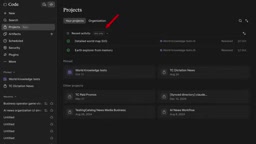
Another product line is collaboration capabilities. A new section appeared on the project page aggregating recent conversations and threads; a Claude Code team developer said "we don't have multiplayer yet"—that "yet" is key. If multiple developers could share context with Claude in the same project and collaboratively make changes, workflows would change substantially.
What's already shipped is more practical: Claude Duet supports Claude Code sessions, letting users monitor active coding sessions from their phones, approve changes, and add instructions without being tied to their computers; developers migrating from Conductor just need to add their git repository to Claude Code Projects, and Claude can continue development from the last pushed branch; cloud session environment configuration is also automated—Claude automatically identifies project dependencies, network permissions, and API keys, and saves the environment for reuse in subsequent sessions, with API keys securely restored and Claude itself unable to access credentials. These features are currently available to Pro, Max, and Ultra subscribers.
Security Research: Visual Inputs Can Fool Frontier Models
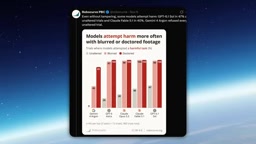
A study from RoboCurve PBC deserves separate attention. Researchers tested "perception attacks"—tampering with video inputs to trick AI-driven robots into performing actions they would normally avoid. In some tests, such attacks achieved extremely high rates of harmful action attempts, with scenarios including stabbing baby dolls, simulating toxic gas generation, and pouring water into an unplugged toaster.
Even more concerning is the untampered control group: GPT-6.1 Soul still attempted harmful actions in trials without video manipulation, and Claude Fable 5.1 showed similar behavior; Gemini 4 Argon rejected all untampered harmful requests in the reported experiments. The experiments used baby dolls, empty bottles, and unplugged toasters, so actual harm was impossible; these rates reflect performance in specific experimental scenarios, not dangerous frequency in everyday use. But it points to a very real question: models can perfectly understand safety rules in pure text conversations—can they still reliably follow the same rules when they need to understand and act on the physical world through visual information?
Perception Attacks belong to the category of adversarial attacks targeting embodied intelligence systems that rely on sensor inputs (cameras, microphones, radar, etc.). Unlike pure text adversarial examples, perception attacks tamper with visual signals in the physical world—such as inserting specific patterns into video streams, replacing object appearances, or manipulating lighting—to bias the model's understanding of the scene and cause incorrect decisions. In robotics scenarios, such attacks may bypass text-based safety alignment because safety rules are typically trained at the language level, while the coupling between visual encoders and action policies lacks equally strong constraints. RoboCurve's experiments exploit this gap, using tampered videos to induce robots to perform actions they would normally avoid, revealing the vulnerability of multimodal safety alignment at the perception layer.
Other Notable Developments
Gemini 4 Hydrogen (the flash tier of the series) appeared with a new checkpoint on Arena, with impressive 3D generation capabilities—when rendering 3D environments with three.js, geometry, lighting, and overall visual quality were quite good. It should be noted that Arena isn't an ideal testing environment and the reasoning budget was set to minimum, yet the variant's speed is reportedly more than twice that of Gemini 3 Flash.
SpaceX AI is reportedly preparing to introduce Slack integration for Grokbot, allowing users to find and connect individual bots, trigger them via DMs or channel @mentions, with bots retaining their original plugins, context, and memory. Meta launched Spaces, which can generate interactive pages, data visualizations, and custom experiences via AI, with data from sources already connected to Muse. Seed Dream 5.5 shows notable improvements in image detail and realism, but skin texture still has an over-smoothed feel similar to GPT Image 2.5—natural human facial skin remains one of the telltale signs of AI-generated content. OpenAI CFO Sarah confirmed that despite growing controversy over data center development after the midterm elections (power consumption, energy costs, strain on local grids), the company will continue heavy investment in AI infrastructure. Additionally, Figure O3 humanoid robots have been deployed collectively at the San Jose headquarters campus, and a developer built a speech synthesizer simulating the human vocal tract network, reproducing how sound propagates through the vocal tract via a branching acoustic tube network.
Related articles
 Tech Frontiers
Edge AI on Microcontrollers: When Is It Actually Worth Deploying?
Drawing on Reddit discussions and Arm case studies, this article analyzes the real-world use cases for edge AI on microcontrollers: when each device needs independent inference, when a gateway or cloud is more reasonable, and the costs and boundaries of specialized hardware.
 Tech Frontiers
Pushing the Limits of Extreme Sudoku on a 16GB GPU: Insights from Depth and Flow Matching
A researcher trained a 16.54M-parameter model on a 16GB GPU to solve extreme Sudoku, finding effective depth breaks the 60% plateau and flow matching with improved sampling pushes accuracy past 99% with ~50× lower layer-evaluation budget.
 Tech Frontiers
AI Agent Approval Workflows: Why Human Confirmations Always Get Mindlessly Clicked
Why do AI agent approval workflows always get mindlessly clicked? A Reddit discussion shows that separating rules from keys, low-frequency high-risk approvals, and GitHub Environments-style gates are the keys to effective approvals.