Anthropic Skills Mechanism Explained: An Open Standard for Giving AI Installable Skill Packs

Anthropic Skills lets you give AI reusable skill packs via simple Markdown files and an open standard.
Anthropic Skills is a near-150K-star GitHub project that turns AI into a domain expert by installing structured skill packs. Each skill is just a folder with a skill.md file containing YAML metadata and Markdown instructions. Its progressive loading mechanism efficiently manages context tokens, and the project has evolved into an open standard (agentskills.io) compatible with Claude Code, Cursor, and Codex.
Same AI, So Why Are Others Getting 10x Better Results Than You?
Have you noticed something strange? Everyone's using Claude, yet some people can make it produce presentations that perfectly match their company's brand guidelines, others can automate web testing and generate MCP servers, while you're stuck having basic conversations. Where does the gap come from?
The answer lies in an explosively popular repository on GitHub — Anthropic Skills. This project has accumulated nearly 150,000 stars in just over a month, making it one of the hottest projects on the AI tools chart. Its core concept is dead simple: give AI installable skill packs.
Large models normally behave like generalists who know a little about everything. But once you install a Skill, they instantly become experts in a specific domain — knowing your company's brand colors, your team's workflow, and exactly how to execute a task step by step. In other words, a Skill is an instruction manual that "teaches AI how to do this thing right" — install it and go, and reuse it again and again. The underlying logic is actually a natural evolution of structured prompt engineering. Traditional prompt engineering requires users to manually write detailed instructions, role definitions, and constraints in every conversation — not only inefficient but also hard to keep consistent. Anthropic Skills crystallizes prompt engineering best practices into reusable files, essentially upgrading "one-off conversation tricks" into "version-controlled, team-shareable knowledge assets." From this perspective, Skills represent an important milestone in prompt engineering's journey from artisanal craft to industrialization.
What Does an Anthropic Skills File Look Like?
The structure of a skill is almost absurdly simple: just a folder containing a skill.md file.
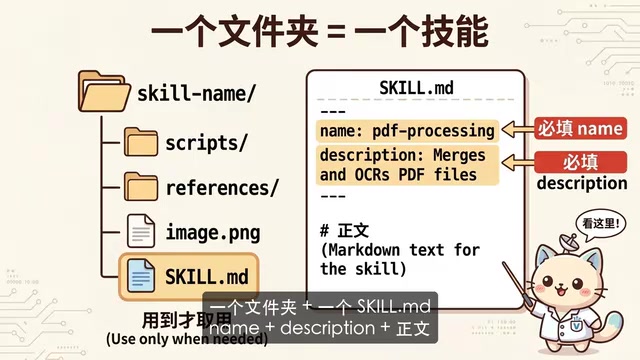
The skill.md file has two parts:
- The top section is YAML metadata, with two required fields:
name(the skill's name) anddescription(tells the AI what this skill does and when to use it) - The bottom section is Markdown body text, spelling out the specific steps and rules
The YAML (YAML Ain't Markup Language) used here is a human-readable data serialization format widely used for configuration files and metadata descriptions. Compared to JSON's curly braces and quotation marks, YAML uses indentation and colons to represent hierarchical relationships, making it much closer to natural language. In skill.md files, the YAML section is typically wrapped between triple dashes (---), known as Front Matter. This "metadata + body" structure is extremely common in technical documentation — static site generators like Hugo and Jekyll use the same design pattern. Choosing YAML as the metadata format dramatically lowers the barrier for non-programmers to create skills.
The folder can also contain other resources as needed:
- Scripts: Executable script files
- References: Reference documentation
- Assets: Template materials
No complex configuration, no black magic — just that simple. The benefit of this design is obvious — anyone can create their first AI skill pack in just a few minutes.
Progressive Loading: The Smartest Design in Anthropic Skills
The most elegant design in Skills is its progressive loading mechanism. The AI doesn't stuff all skills into the context window at once — that would burn through too many tokens. It loads in three layers progressively:

To understand why this design matters, you first need to understand a fundamental limitation of large language models. When processing each conversation, LLMs have a "context window" limit — there's a ceiling on the total amount of text they can "see" and "remember" simultaneously. This limit is measured in tokens, where one token corresponds roughly to one English word or one to two Chinese characters. Take Claude as an example: its context window can reach 200,000 tokens, but even so, if you cram in massive amounts of skill instructions, reference documents, and conversation history all at once, the token budget depletes rapidly, causing the model to forget earlier information or become unable to accept new input. Therefore, how to efficiently utilize limited context space is one of the core challenges in all LLM application architecture design.
Progressive loading is an elegant solution to this challenge, unfolding in three layers:
- Layer 1: Index Scan — Only reads each skill's name and description, roughly 100 tokens, super economical
- Layer 2: Body Loading — Only when the AI determines the current task could use a particular skill does it load that skill's
skill.mdbody - Layer 3: Resource Invocation — Only when it actually needs to run scripts or check reference docs does it read the specific files in the folder
Load only what you need — not a single context token wasted. This design solves a core pain point in LLM applications: the context window is finite, so how do you maximize AI capability expansion within a limited token budget? Progressive loading provides an elegant answer.
A Ready-to-Use AI Skill Ecosystem
The repository itself comes with over a dozen example skills ready for immediate use, covering developers' most common needs:
| Skill Name | Function |
|---|---|
| Docs / PPTX / XLSX / PDF | Let AI generate Word, PPT, Excel, and PDF documents |
| MCP Builder | Build MCP servers |
| Skill Creator | Teach AI to write skills (a meta-skill) |
MCP Builder deserves a brief explanation. MCP (Model Context Protocol) is an open protocol launched by Anthropic in late 2024, designed to provide AI models with a standardized way to connect to external data sources and tools. Think of MCP as the "USB port" of the AI world — with it, large models can invoke databases, APIs, file systems, and other external resources in a unified way, without needing to write custom integration code for each tool. The MCP Builder skill enables AI to automatically set up MCP servers, meaning users can quickly create standardized AI access points for their own data and services, dramatically expanding AI's capability boundaries.
Skill Creator is particularly worth highlighting — it's a "skill that teaches AI to create skills," essentially bootstrapping the skill system. Bootstrapping is a classic concept in computer science, originally referring to a compiler written in a programming language that compiles that same language — like a C compiler written in C compiling C code. The concept has since been broadly extended to mean "a system using its own capabilities to build or extend itself." Skill Creator embodies this bootstrapping philosophy: the skill system itself possesses the ability to create new skills, forming a self-expanding loop. You simply describe what kind of skill you want, and the AI generates a complete skill folder in the standard format. This means the skill ecosystem can grow exponentially, without relying entirely on manual one-by-one authoring.
From Project to Open Standard: A Universal Skill Specification Across AI Tools
What's even more noteworthy is that Anthropic Skills is no longer just a GitHub repository.
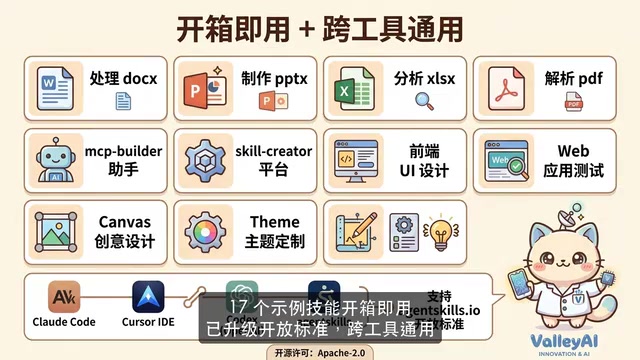
It has been upgraded to an open standard, hosted at agentskills.io. This means it's not just for Claude Code — mainstream AI coding tools like Cursor and Codex can also be compatible with this skill format.
Some background on these tools is helpful here. Cursor is an AI code editor deeply rebuilt on VS Code, with built-in code completion, conversational programming, and codebase understanding capabilities — it has rapidly become a hot favorite in the developer community since 2024. Codex is OpenAI's AI programming agent, capable of autonomously completing code writing, testing, and debugging tasks in a sandboxed environment. These tools each have different skill/rule configuration mechanisms (for example, Cursor has .cursor/rules, Codex has AGENTS.md), but if they all support the same skill format standard, developers won't need to rewrite workflow configurations for each tool, dramatically reducing tool migration costs.
Anthropic clearly has bigger ambitions — making Skills an industry-wide universal AI skill description specification. If this trend holds, it means a skill you write in the future can seamlessly migrate between different AI tools. Workflows you've built up in Claude Code will work just as well when you switch to Cursor. For enterprise users, this is enormously valuable — it avoids the risk of vendor lock-in and turns your team's accumulated AI workflows into truly portable digital assets.
How Can Regular Users Get Started with Anthropic Skills?
The onboarding path is crystal clear:
Option 1: Use Existing Skills
If you're using Claude Code, add the repository like a plugin marketplace with a single command, then pick the skills you need and install them.
Option 2: Create Custom Skills
- Create a new folder
- Create a
skill.mdfile - Fill in the YAML metadata (name + description)
- Write out the operational steps in the Markdown body
- Add scripts, templates, and other resource files as needed
Next time the AI encounters a similar task, it automatically invokes the skill and reliably reproduces the result. No more retyping your requirements from scratch every time.
A Reality Check: AI Skill Packs Aren't a Silver Bullet

Let's be fair — Skills aren't here to replace engineers or replace your own thinking. At their core, they're instruction manuals, and how well they're written and how clearly their boundaries are defined is entirely up to the person writing them.
In practice, there are several common pitfalls:
- Skills written too broadly: The AI can't pinpoint when to use them, leading to false triggers or no triggers at all. This is because during the index scan phase, the AI relies on the description field to judge a skill's applicable scenarios — if the description is too vague (like "help with documents"), the AI struggles to make precise matches when facing specific tasks.
- Missing key terms in the description: The AI might never think to invoke the skill at all. A large model's skill matching is essentially a semantic retrieval process — if the description lacks keywords related to user intent, the model can't establish effective semantic associations.
- Steps not specific enough: The AI will "improvise" during execution, producing uncontrollable results. Large models have powerful generative capabilities, and when instructions leave ambiguous space, they fill in the blanks based on statistical patterns from training data — and that gap-filling often diverges from your actual expectations.
So Skills are more like a tool for crystallizing your experience so AI can reuse it. The core logic is: humans set the rules, AI executes — collaboration is what makes it work.
Conclusion
The explosive popularity of Anthropic Skills is no accident. It addresses a core need in current AI applications: how to make general-purpose large models reliably and consistently complete tasks in specific scenarios. One folder plus one skill.md equals one skill, progressive loading conserves context, over a dozen examples work out of the box, and it's been upgraded to a cross-tool open standard — those nearly 150,000 stars are well-earned.
From a broader perspective, Anthropic Skills represents an important direction in AI application development: moving from "conversational interaction" to "knowledge asset management." In the past, every interaction with AI was one-off; now, through mechanisms like Skills, we can crystallize best practices, domain knowledge, and workflows into reusable, shareable, iterable digital assets. This not only boosts individual efficiency but also provides infrastructure for AI capability accumulation at the team and organizational level.
If you're using AI to assist your work, I strongly recommend searching "anthropic skills" on GitHub and giving it a try. Instead of repeatedly describing your requirements in prompts every time, write your experience into a skill — once and for all.
Related articles

Should U.S. College Fraternities Be Banned? A Researcher's Incisive Observations
Why not just ban U.S. college fraternities? A researcher finds the key resistance comes from decision-makers' own fraternity identities and schools' "willful ignorance."

Microsoft Discovery: Accelerating Scientific Discovery with AI Agents
Microsoft's Discovery platform runs specialized AI agents to help researchers screen and prioritize the most promising compounds and experimental paths, reducing experiments and accelerating scientific discovery.

Cambridge Heavy Industries Secretly Develops Desktop-Scale Nuclear Fusion Device
Cambridge Heavy Industries is secretly developing a desktop-scale laser-driven nuclear fusion device, targeting the equipment supply market for fusion power plants. This article analyzes its miniaturization technology path, commercialization logic, and unique positioning in the fusion startup wave.