Anti-Slop: Putting a "No-Cliché" Leash on AI Coding Agents
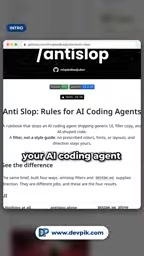
Anti-Slop uses 38 rules and a delivery gate to constrain AI coding agents and reduce template-like UIs and AI-flavored code.
Anti-Slop is an open-source rulebook that stops AI coding agents from producing cookie-cutter interfaces, filler copy, and AI-flavored code. It has 38 mandatory rules layered across UI, copy, and code, loaded on demand via 6 independent skills to save context. A delivery gate issues pass/fail reports before output, and it supports both fresh builds and audits of existing code. Compatible with Claude Code, Cursor, and Codex under the MIT license (4,201 GitHub stars), it describes itself as a filter, not a style guide, and cannot replace your own design judgment.
When AI Coding Agents Only Produce "Template Pages"
Anyone who has used AI to write frontend code has probably run into this scenario: you ask the agent to build a landing page, and what comes out always looks eerily familiar—a gradient-purple Sparkle logo, fabricated user statistics, and a little "Next-Gen Beta" tag tucked in the corner. According to a YouTube channel introduction, an open-source project called Anti-Slop is aimed squarely at this pain point. It is defined as a "rulebook" specifically designed to stop AI coding agents from outputting cookie-cutter UIs, filler copy, and "AI-flavored" code.
The project is compatible with mainstream AI coding tools such as Claude Code, Cursor, and Codex. It has earned 4,201 stars on GitHub, is freely available under the MIT license, and is written in JavaScript. In terms of positioning, it is not a generator but a constraint mechanism deployed before the agent's output.
A Three-Tier Rule System: UI, Copy, and Code
At the core of Anti-Slop are 38 mandatory rules, organized across three tiers that constrain the interface, copy, and code dimensions respectively. The intent behind this layered design is clear: the "cheapness" of AI-generated output is often not a single-point problem but a simultaneous failure across visual, linguistic, and engineering practices.
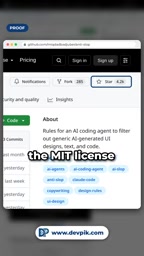
Beyond the rules, there is a modular design—6 independent skills, with each task loading only the parts it needs. This means that when handling a form page, the agent does not have to swallow the entire rulebook into context, which both saves tokens and reduces the probability of rules interfering with one another. For toolchains sensitive to context windows, this on-demand loading is a pragmatic approach.
Mandatory rules and skill partitioning: Here, "rules" refer to natural-language instruction items that the agent can parse; each rule contains trigger conditions and expected behavior rather than adjustable parameters. "Mandatory" means the agent must satisfy every rule item when generating the corresponding type of content, otherwise the delivery gate marks it as failed. Skills are logical groupings of rule sets; each skill contains only the subset of rules relevant to a particular task type. The underlying assumption of this design is that as the number of rules grows, the weight of any single rule in context is diluted; on-demand loading lets the agent focus only on the most relevant constraints in each task, thereby improving rule compliance and reducing token overhead.
Delivery Gate and Dual Modes
The project designs a "delivery gate": before content is formally produced, it issues a pass or fail report. In other words, the agent cannot directly dump a half-finished product on the user—it must first pass a self-check.
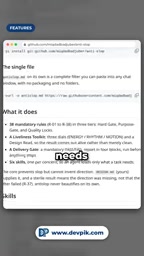
There are two usage modes: one guides a brand-new build, embedding the rules into the generation process from scratch; the other audits existing code, performing compliance checks on legacy projects. Installation takes just one command; the installer asks which skills and agents you use, then saves your preferred mode. After that, the agent reloads these rules in every session—the rules persist and do not rely on the memory of a single prompt.
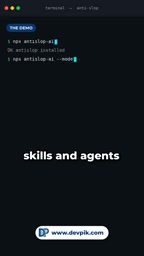
Delivery gate: this is essentially a checkpoint mechanism—after completing code generation and before returning results to the user, the agent must self-check its output against the loaded rule set and produce a structured pass/fail report. The report lists the satisfaction status of each rule; failed items must include specific locations or reasons. This design moves quality verification from the user's after-the-fact manual review into the agent's generation process, reducing back-and-forth correction cycles. Its effectiveness depends on the decidability of the rules themselves—overly subjective rules (such as "design should have taste") are difficult for the agent to evaluate reliably, so the gate is better at catching violations that are formalizable or pattern-recognizable.
It Is a Filter, Not a Style Guide
A bucket of cold water is in order: Anti-Slop explicitly states that it is a filter, not a style guide. It can block obviously formulaic output, but it cannot replace your own design direction. If the team itself lacks aesthetic judgment and a design language, the filter can only guarantee "not too bad"—not "good."
From an engineering perspective, the value of such projects lies in making implicit quality expectations explicit as an executable rule set. It suits developers who already know what they do not want but are tired of manually correcting the agent every time. As for the specific content and thresholds of the 38 rules, it is best to check the repository directly and trim them to your own tech stack.
Tools are always just tools. The generic feel of AI output often stems from default tendencies beyond the prompt, and what Anti-Slop provides is a very low-cost starting point for course correction.
One-line Summary
Anti-Slop uses 38 rules and a delivery gate to constrain AI coding agents and reduce template-like UIs and AI-flavored code.
Paragraph Summary
Anti-Slop is an open-source rulebook project aimed at stopping AI coding agents from outputting cookie-cutter interfaces, filler copy, and AI-flavored code. It contains 38 mandatory rules layered across the UI, copy, and code dimensions, and loads them on demand through 6 independent skills to save context. The project introduces a delivery gate mechanism that issues a pass or fail report before content is produced, and supports both brand-new builds and audits of existing code. It is compatible with mainstream tools such as Claude Code, Cursor, and Codex, uses the MIT license, and has earned 4,201 stars on GitHub. The project explicitly describes itself as a filter rather than a style guide; it cannot replace the user's own design judgment and is suited to developers who want to make implicit quality expectations explicit.
Related articles

Samsung Tests Recompose Feature: Change the Viewing Angle After Taking a Photo
Samsung One UI 9.5 beta code reveals a Recompose feature based on the existing Move tool that may let users adjust a photo's viewpoint after capture. We analyze its technical logic, user value, and launch prospects.

Nimble's Detachable Power Bank Drops $20 — Is It Worth Buying?
Nimble SharePower 10,000mAh detachable power bank drops to $59.96, a $20 discount and all-time low. We analyze its detachable design, pricing, and buying advice across all four colors.

An Author Under a Gag Order: Sarah Wynn-Williams on 'Careless People'
Sarah Wynn-Williams, author of Careless People, discusses living under a gag order in a Guardian interview, exploring its impact on writers and platform power.