Antigravity + Jules: How Autonomous AI Orchestration Enables Hands-Free Development Workflows
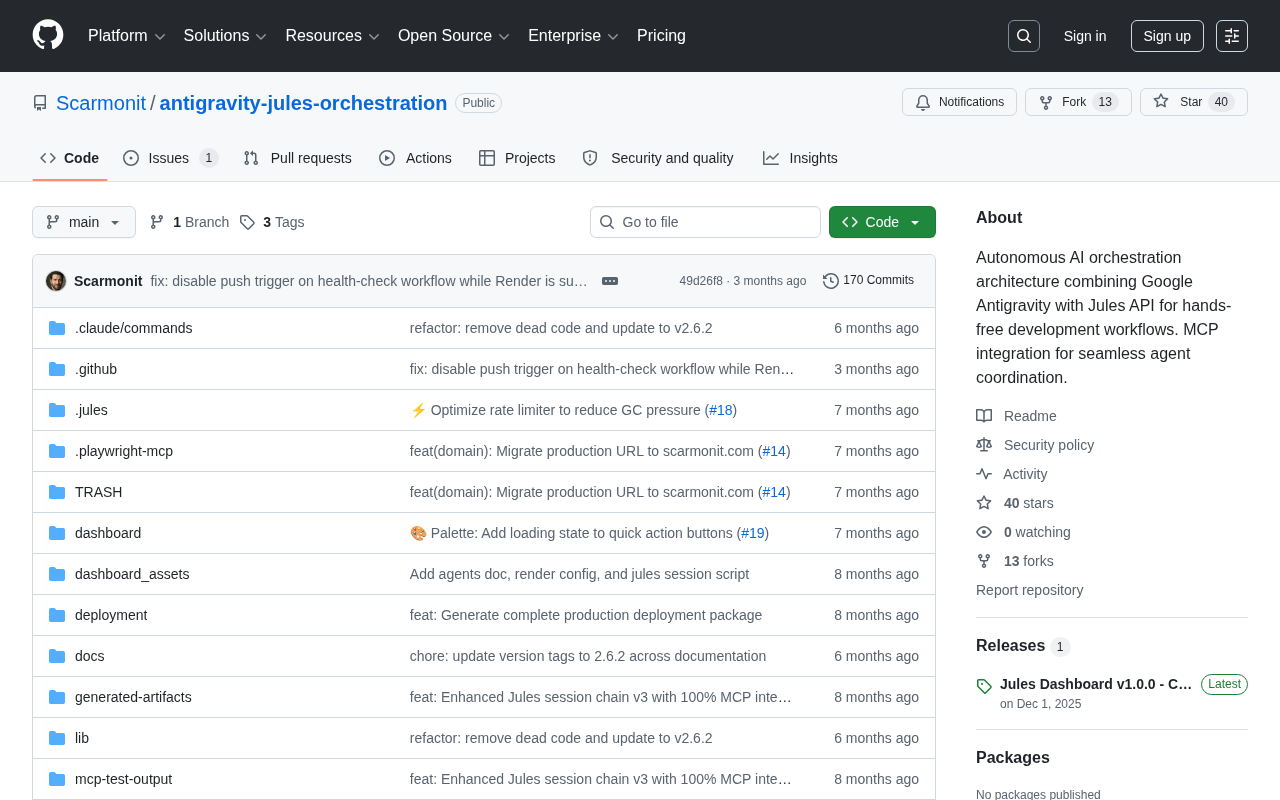
An open-source project connecting Google Antigravity and Jules API via MCP to explore hands-free autonomous AI development workflows.
antigravity-jules-orchestration is an experimental open-source JavaScript project that combines Google Antigravity (an orchestration platform) with the Jules API (an async coding agent) using the Model Context Protocol (MCP) to standardize agent communication and build a hands-free autonomous development pipeline. Antigravity handles task scheduling and decomposition, Jules handles code output, and MCP ensures context passes reliably between them. The project represents the evolution of AI coding tools from "assisted completion" toward "autonomous execution," but with only 38 stars and 13 forks, it remains a proof of concept rather than a production-ready solution — most valuable as a reference architecture for multi-agent orchestration.
An Experimental Project That Connects Two Major AI Tools
The open-source project antigravity-jules-orchestration puts forward an ambitious idea: combining Google Antigravity with the Jules API to build an autonomous development workflow that runs entirely hands-free. Written in JavaScript, the project has earned 38 stars and 13 forks — modest in scale, but representative of an important direction. It attempts to answer one of the hottest questions in AI-assisted programming today: how can multiple AI agents collaborate without requiring constant human intervention?
Based on the project description, its core value proposition has two parts: an autonomous AI orchestration architecture, and seamless agent coordination achieved through MCP (Model Context Protocol) integration. Together, these two elements sketch out a developer's ideal scenario — hand off a task to the system, let the AIs divide responsibilities, pass context between themselves, and drive development forward, with humans only stepping in at key checkpoints.
What Roles Do Antigravity and Jules Each Play?
To understand this project, you first need to clarify the distinct roles of the two components it combines. Google Antigravity is an orchestration platform for AI-driven development, focused on enabling agents to execute tasks within real development environments. Jules, also from Google, is an asynchronous coding agent designed to independently complete code changes, run tests, and handle similar tasks after receiving instructions — all exposed through an API.
The logic behind combining the two is straightforward: Antigravity handles scheduling and orchestration, deciding what needs to be done, by whom, and in what order; the Jules API acts as the execution unit, doing the actual coding work. At its core, this project builds a bridge between the two, allowing the orchestration layer to invoke the execution layer and form a closed loop from task decomposition to code output.
This layered "orchestrator + executor" approach is exactly the mainstream paradigm in recent AI agent system design. It breaks down complex autonomous development into manageable modules, rather than expecting a single model to handle everything end-to-end.
Why MCP Integration Is the Key
The project places particular emphasis on MCP integration, which deserves a closer look. The Model Context Protocol is designed to standardize communication between agents, tools, and data sources. In multi-agent systems, the biggest challenge is often not that individual models are insufficiently capable — it's that context needs to be reliably passed between different components. Who knows the current progress? Who holds the state of the codebase? Who's responsible for the next step?
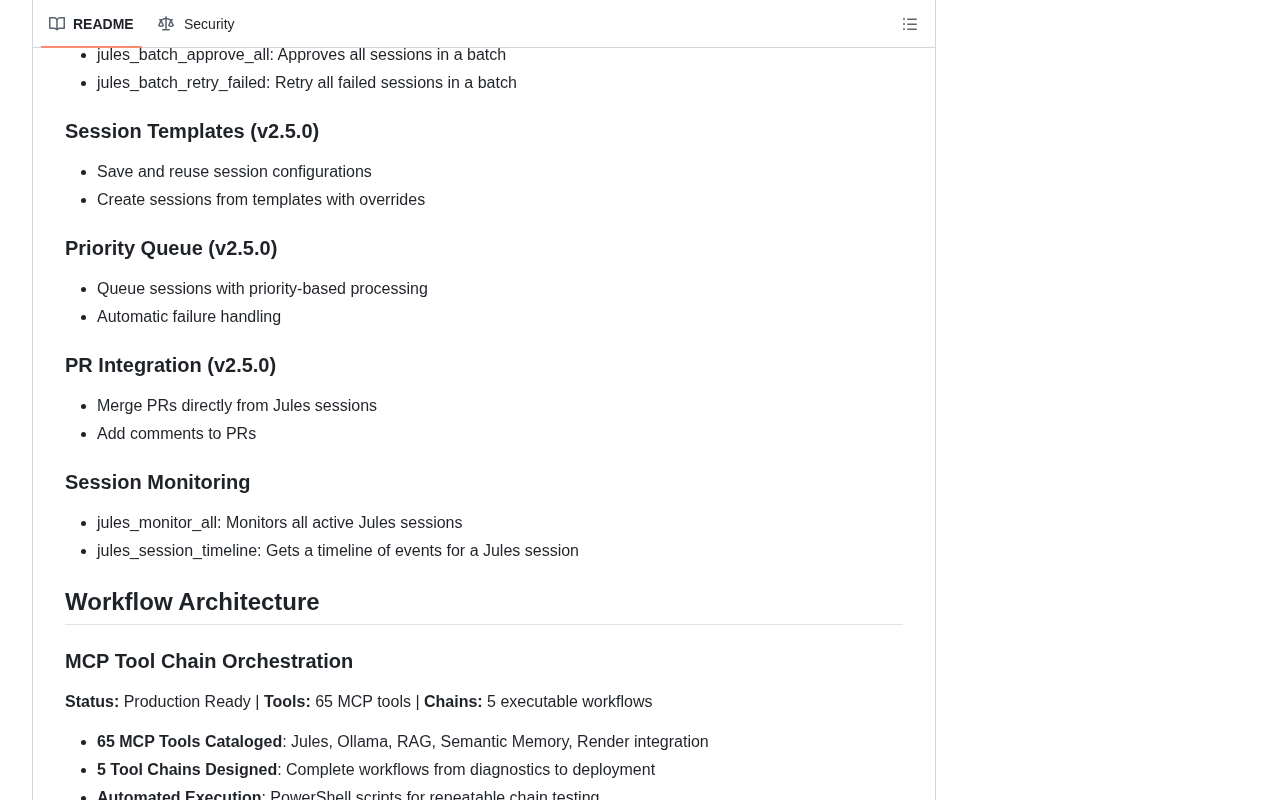
Through MCP, this project aims to standardize coordination between Antigravity and Jules, reducing the need for custom glue code. In theory, this means that integrating additional agents or tools in the future won't require rewriting communication logic — as long as everything follows the same protocol. For developers looking to build scalable agent orchestration systems, this is a pragmatic technical choice.
A Step From "Assisted Coding" to "Autonomous Development"
Zooming out to the broader industry context, this project reflects the direction AI programming tools are evolving. Over the past two years, mainstream tools have stayed in the "assistance" phase — completing code, explaining errors, generating snippets — with humans remaining in control. The "hands-free development workflow" described by this project points toward a new paradigm: AI takes the lead on execution, while humans step back into a supervisory role.
The value of this shift lies in freeing up developer time: repetitive, process-driven development tasks can be handed off to an orchestration system to run automatically. But the risks are just as real — the more autonomous the system, the more critical it becomes that errors are controllable and traceable. A truly production-ready autonomous orchestration system must strike a balance between "letting go" and "staying in control," for example by preserving human approval checkpoints, maintaining complete execution logs, and implementing failure rollback mechanisms.
A Realistic Assessment: Proof of Concept, Not Production-Ready
To be honest, this is still an early-stage project. With 38 stars and 13 forks, it sits much closer to a proof of concept than a mature product. Its value lies more in demonstrating an architectural approach — how to assemble existing orchestration platforms and coding agents into an automated pipeline — rather than delivering an enterprise-ready, out-of-the-box solution.
For developers, the significance of projects like this is as a reference and source of inspiration. If you're exploring multi-agent collaboration or want to understand how MCP works in practice within an orchestration context, this is a useful sample to dissect and learn from. But for real production use, you'd need to independently validate its stability, security boundaries, and error handling capabilities.
Overall, antigravity-jules-orchestration is a small slice of the broader AI agent orchestration wave. It combines two of Google's tools with an open protocol and points toward "autonomous development" — a direction full of potential, but still very much a work in progress.
Related articles
Altman: Taking OpenAI Public This Year Would Be 'Ill-Advised'
OpenAI CEO Sam Altman says going public this year would be 'ill-advised,' even as the company has confidentially filed IPO paperwork. Here's what it means for AI.
An Open Letter to Dario: If AI Safety Is Real, Open the Model Weights
Developer Jacob's open letter to Anthropic CEO Dario Amodei went viral on Hacker News, challenging the contradiction between AI safety rhetoric and closed-source models: if safety truly matters, why not open the weights?
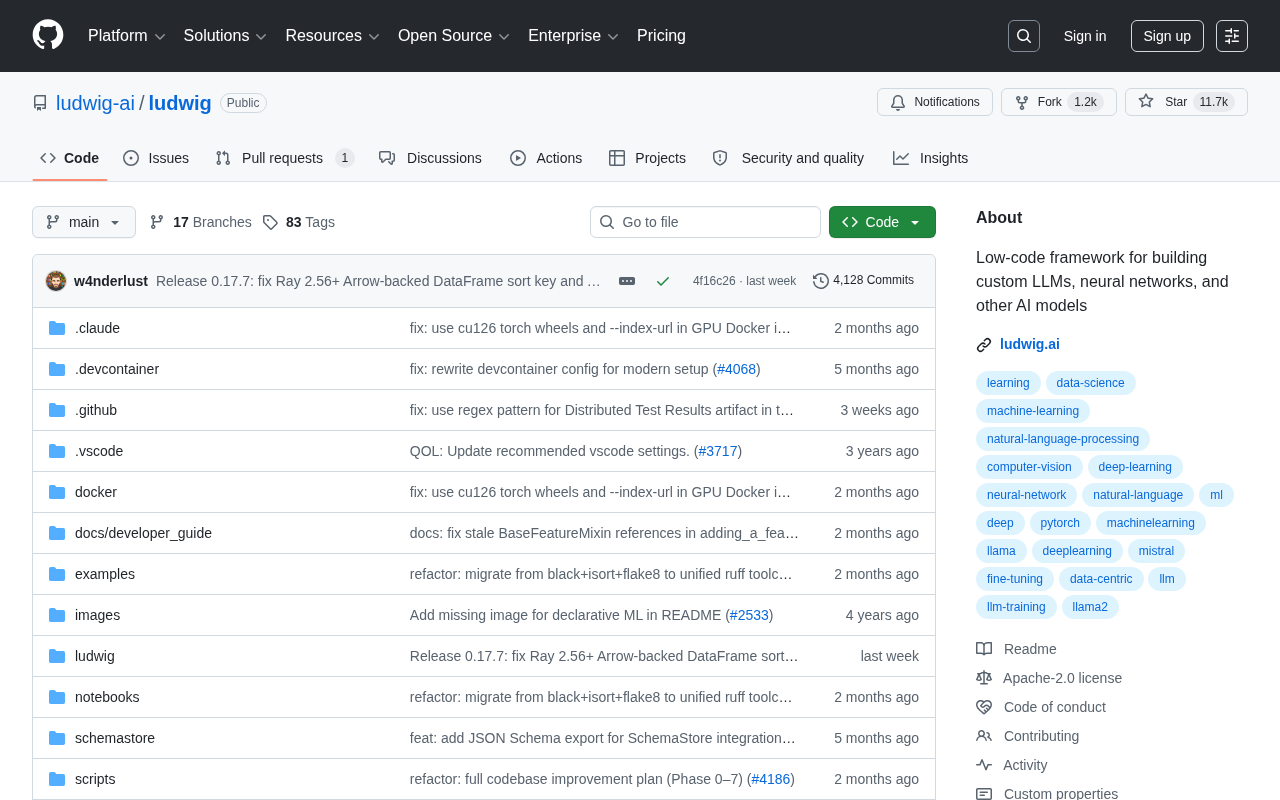
Ludwig: Building Custom LLMs and Neural Networks with Declarative Low-Code Configuration
Ludwig is an open-source low-code ML framework that builds custom LLMs and neural networks via declarative YAML config — no boilerplate training code required.