AnyProfile: A Free Open-Source Antidetect Browser for Mac and Windows
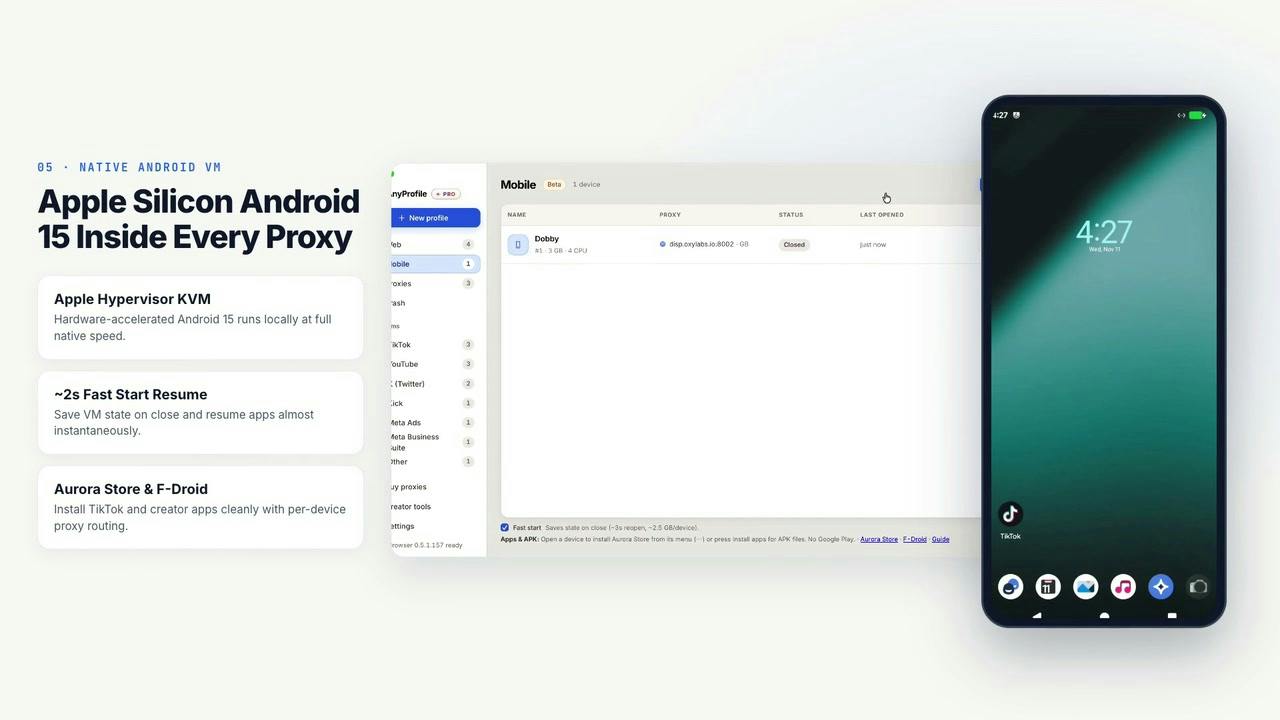
AnyProfile is a free open-source antidetect browser focused on local isolation and an Android VM.
AnyProfile is a free open-source antidetect browser on Product Hunt, supporting Mac and Windows with zero monthly fees. It isolates cookies and proxies per profile, includes an Android 15 virtual machine, and offers a local AI MCP integration with details still undisclosed. It targets privacy-conscious users with transparent code and local isolation, though its early traction is limited.
In the privacy tools space, a free open-source antidetect browser called AnyProfile recently debuted on Product Hunt. It focuses on locally isolated cookies, proxies, an Android 15 virtual machine, and AI MCP, all with a promise of zero monthly fees. For users who need multi-account management or privacy protection, this may be a new option worth watching.
What Is an Antidetect Browser?
The core capability of an antidetect browser is to keep multiple browsing environments on the same device isolated from one another and prevent websites from identifying them as the same user. Common use cases include managing multiple social media accounts, running cross-border e-commerce stores, and verifying ad performance. Traditional commercial solutions such as Multilogin and Dolphin Anty typically charge monthly fees, while AnyProfile attempts to enter this market as an open-source, free alternative.
Browser fingerprinting is a device "profile" that websites generate by combining hundreds of signals—JavaScript, HTTP headers, Canvas rendering, font lists, WebGL parameters, and more. Even if you clear cookies or change your IP, an identical fingerprint can still link multiple accounts to the same device. The key technology behind antidetect browsers is fingerprint spoofing: generating a set of plausible but distinct fingerprint parameters for each profile (such as User-Agent, screen resolution, time zone, language, and hardware concurrency) while keeping those parameters internally consistent—avoiding contradictory signals like "a Windows system reporting Mac fonts" that would give it away.
WebRTC leaks are another common vulnerability: when establishing real-time communication, WebRTC may bypass the proxy and directly expose the real local IP and public IP. That's why mature antidetect browsers all block or spoof WebRTC. In addition, cookie isolation is only the foundational layer of account isolation—what truly determines anti-association effectiveness is the coordinated isolation of fingerprints, proxies, and storage (localStorage, IndexedDB). When evaluating an antidetect browser, focus on whether it passes tests from fingerprint detection sites like CreepJS and Pixelscan.
AnyProfile's Core Features
According to the official description, AnyProfile integrates multiple capabilities and runs locally:
- Cookie and proxy isolation: Each profile has independent cookie and proxy settings to prevent account association.
- Android 15 virtual machine: A built-in virtualization environment that can run Android apps within the browser, further expanding the isolation dimension.
- Local AI MCP integration: The inclusion of MCP (Model Context Protocol) suggests possible local connectivity with AI toolchains, but implementation details have not yet been disclosed.
- Cross-platform support: Both Mac and Windows versions are available.
- Zero monthly fees: Completely free and open source, with no subscription costs.
MCP (Model Context Protocol) is an open protocol proposed by Anthropic in late 2024 to let large language model applications connect to external data sources and tools in a standardized way. It uses a client-server architecture: the AI application acts as the client and communicates with local or remote MCP servers via JSON-RPC, while servers expose capabilities such as file systems, databases, and browser operations to the model in the form of "tools," "resources," and "prompt templates." Because servers can run entirely locally, MCP is naturally suited to privacy-sensitive scenarios.
AnyProfile's claimed "local AI MCP integration" most likely means providing an MCP server that allows local AI assistants to read or control browser profiles (for example, batch-creating profiles, switching proxies, or querying environment status), thereby automating multi-account management workflows. However, the official specific interfaces and permission model have not yet been published, so actual capabilities should be judged by the documentation. For ordinary users, it can be understood as a reserved extension point for "letting AI tools drive this browser via a standard protocol."
The Balance Between Open Source and Privacy
Open source means transparent code, allowing users to audit whether its privacy promises hold true. For an antidetect browser, this is especially important—after all, users are entrusting sensitive account and proxy information to the tool. AnyProfile's choice of local isolation rather than cloud sync also reduces the risk of data leaks. However, open-source projects often rely on the community for maintenance and update frequency, so long-term stability remains to be seen.
Differences in open-source licenses directly affect the boundaries of a project's use. Permissive licenses like MIT or Apache 2.0 allow free commercial use and redistribution; GPL-family licenses require derivative works to be open source as well. For tools like antidetect browsers, it's also worth checking whether the project includes closed-source components or bundles third-party SDKs, since "open source" usually covers only the code in the repository—not necessarily the distributed binary packages.
In addition, while a local-first architecture reduces the risk of cloud data leaks, it also means users must handle configuration backups and multi-device sync themselves. If the local disk is damaged or files are accidentally deleted, configuration files may be difficult to recover. Before use, it's advisable to confirm whether the project offers configuration export/import and to back up manually on a regular basis. For tools that hold real account assets, also pay attention to whether update logs and security advisory channels are accessible.
Market Positioning and Potential Challenges
On Product Hunt, AnyProfile received 66 votes and 1 comment, ranking 13th, categorized under open source, privacy, and developer tools. This shows some early interest, but compared with mature commercial products, its visibility still lags. The challenge: antidetect browser effectiveness depends heavily on continuous updates to fingerprint spoofing technology, and whether the open-source community can keep pace with commercial companies' iteration cycles is key to retaining users.
Who Should Use AnyProfile?
If you need to manage a small number of multiple accounts, have a limited budget, and possess some technical ability (such as configuring proxies yourself and understanding virtual machine concepts), AnyProfile offers a zero-cost starting point. But if you have high requirements for stability and technical support, or need large-scale account matrix management, commercial solutions may still be the safer choice.
Currently, AnyProfile's official website link points to its Product Hunt page, and more technical details and documentation have yet to be released. Open-source projects grow through community contributions, so interested users can follow its GitHub repository (if available) and participate in testing and feedback.
One-line Summary
AnyProfile is a free open-source antidetect browser focused on local isolation and an Android virtual machine.
Paragraph Summary
AnyProfile is a free open-source antidetect browser that debuted on Product Hunt, supporting Mac and Windows with a promise of zero monthly fees. Its core capabilities include isolating cookies and proxies for each profile, a built-in Android 15 virtual machine for running mobile apps, and a local AI MCP integration whose details are yet to be disclosed. Compared with commercial solutions like Multilogin and Dolphin Anty that charge monthly, AnyProfile attracts privacy-conscious users through transparent code and local rather than cloud-based isolation. The article notes that the product received only 66 votes and ranked 13th on Product Hunt, indicating limited early interest, and its long-term effectiveness depends on whether the community can keep up with fingerprint spoofing technology iterations. It is better suited to budget-conscious, technically capable users managing a small number of multiple accounts, while large-scale commercial use still requires careful evaluation of stability.
Related articles

Meta Abandons 2030 Net Zero Target, Tech Industry Climate Pledges Face a Reckoning
Meta withdraws its 2030 net zero target in its 2026 sustainability report, triggering a chain reaction in tech climate pledges. This analysis examines the impact on competitive dynamics, ESG investment strategies, and industry self-regulation.

Philosopher Rejects Anthropic's AI Consciousness Argument: A Dangerous Business Narrative
Anthropic listed AI consciousness as a risk factor ahead of its IPO, prompting a prominent philosopher to publicly reject its consciousness argument. This article analyzes the business motives, scientific honesty, and AI industry narrative strategies behind the debate.

Amazon Acquires Decart's AI Optimization Tech for $7.5B to Pave the Way for Trainium Chips
Amazon reportedly acquires Decart's AI optimization tech and research team for $7.5B to strengthen Trainium's software ecosystem and pave the way for selling its custom AI chips externally. This article analyzes the deal logic, the critical role of optimization technology in chip competition, and its impact on the AI chip market.