API Automation Testing Framework Design: From Principles to Practice
Core design principles and key modules for building an API automation testing framework
Starting from the limitations of manual API testing, this article explains why building an automation testing framework is essential. It covers the fundamentals of API testing (HTTP request-response model), emerging AI-assisted testing trends, and focuses on framework design principles built on top of Pytest, including three core modules: unified parameter management (data-driven testing), API correlation and Token passing, and flexible assertion mechanisms.
From Manual Testing to Automation: Why You Need a Framework
API testing is a critical part of software quality assurance. Starting from the most basic manual testing, we typically use tools like Postman or Apifox — enter a URL, fill in parameters, set up pre/post actions, and we can verify a single API endpoint. But when the number of APIs in a project reaches hundreds or even thousands, the manual approach quickly becomes unsustainable.
This is exactly why API automation testing frameworks exist — to systematically manage repetitive testing work through code-based, modular approaches.
The AI-Driven Trend in Modern API Testing Tools
Pain Points of Traditional Tools
Mainstream API testing tools like Postman often present login difficulties for users in China, which has driven many test engineers toward domestic alternatives like Apifox. Regardless of which tool you choose, the core workflow remains the same:
- Enter the API endpoint and request method
- Fill in the request parameters
- Configure pre-request actions (e.g., encryption/decryption handling)
- Configure post-request actions (e.g., data extraction, assertion validation)
AI-Assisted API Testing: A New Paradigm
The new generation of API testing tools has integrated AI capabilities. For example, you can simply tell the tool in natural language, "Write me a parameter decryption script," or in the post-processing step say, "Extract the token field from the response," and the AI will automatically generate the corresponding script code. You can even copy and paste API documentation directly, and the tool will automatically create the corresponding request configuration — dramatically boosting testing efficiency.
Fundamental Principles of API Automation Testing
The essence of API automation is actually quite simple: write code to call APIs and verify the returned results. To truly understand this process, you first need to grasp the underlying mechanism of the HTTP request-response model.
The HTTP request-response model is the foundational communication protocol for API testing. Every API call is essentially a client sending a structured request message to a server, which processes it and returns a response message. A request message consists of three parts: the request line (method + URL + protocol version), headers, and body. GET requests typically append parameters in the URL's query string, while POST requests place data in the request body, with common formats including application/json, application/x-www-form-urlencoded, and multipart/form-data. The response message contains a status code (e.g., 200 for success, 401 for unauthorized, 500 for server error), response headers, and response body. Understanding this model is the key leap from "knowing how to click buttons" to "truly understanding testing."
Using Python as an example, the core workflow is as follows:
- Use the
requestslibrary to send HTTP requests - Specify the URL, request method (GET/POST, etc.), and request parameters
- Capture the response data
- Write assertions to verify whether the results match expectations
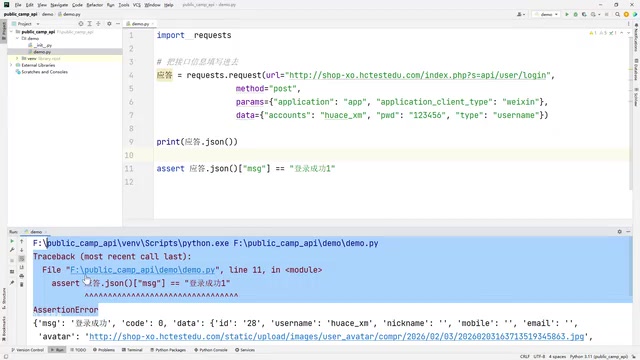
For example, when testing a login API, after sending the request, we check whether the returned message field equals "Login successful." If the assertion fails, the program immediately raises an assertion error. This is the most basic form of API automation testing.
Why Simple Scripts Can't Meet Real-World Needs
Although automating a single API test is straightforward, this "one script per API" approach has serious problems in practice:
- Not reusable: You have to write repetitive request code for every API
- Hard to maintain: When APIs change, you need to modify each script individually
- Lacks structure: No unified data management, logging, or report generation
This is the fundamental reason why many people feel that "API automation looks simple but is hard to implement at work." To truly put it into practice in a project, you need to build a complete automation testing framework.
Design Philosophy for a Custom API Automation Framework
Pytest: Strengths and Limitations
Pytest is the most popular testing framework in the Python ecosystem, and its core advantages are reflected in three mechanisms: The fixture mechanism allows you to provide pre-configured data or environments to test cases through dependency injection, supporting four scopes — session, module, class, and function — making it ideal for managing shared resources like database connections and login sessions. The parametrize decorator lets you drive multiple data sets with a single test logic, eliminating duplicate code. In terms of plugin ecosystem, pytest-html generates HTML reports, pytest-xdist supports parallel execution, and allure-pytest integrates with the Allure reporting platform. These capabilities make Pytest an ideal foundation for API automation frameworks. However, Pytest doesn't have built-in HTTP request capabilities — it needs to work with libraries like requests to complete the full API testing loop. This is why most companies take the approach of leveraging Pytest's core capabilities and building a secondary encapsulation layer on top of it.
Three Core Modules of Framework Encapsulation
A complete API automation testing framework needs to solve at least these three problems:
1. Unified Parameter Management
Different APIs have different parameter requirements, and the framework needs to provide a unified parameter management mechanism. This involves the core design pattern of Data-Driven Testing (DDT) — completely separating test logic from test data. In practice, YAML has become the preferred format for storing API test data due to its clean syntax, comment support, and native support for nested structures; Excel is often used for collaborative test case maintenance since business stakeholders are more familiar with it. A typical YAML test data file includes fields such as API path, request method, request parameters, and expected assertions. The framework reads these files and dynamically generates test cases through Pytest's parametrize mechanism. The greatest value of this approach is that when request parameters or expected results change, test engineers only need to modify the data files without touching the test code at all, significantly reducing maintenance costs.
2. API Correlation and Data Extraction
In real business scenarios, APIs often have dependencies on each other. The most typical case is Token passing — the vast majority of APIs require authentication information, most commonly JWT (JSON Web Token). JWT consists of three parts — Header, Payload, and Signature — Base64-encoded and concatenated. The server verifies the Signature to confirm request legitimacy without needing to store session state server-side, making it particularly well-suited for distributed systems.
In an API automation framework, there are typically two approaches for handling Token correlation: The first is using Pytest's session-level fixture to perform login once at the beginning of the entire test session, cache the Token, and let all subsequent test cases obtain it through dependency injection. The second is using a global variable pool (such as a singleton dictionary object) — after the login test case executes, the Token is written to the pool, and subsequent APIs read from it and inject it into request headers. The former aligns better with Pytest's design philosophy, while the latter offers more flexibility in complex scenarios involving cross-file and cross-module interactions.
3. Flexible Assertion Mechanism
Assertions are not simply about "whether two values are equal." Real-world scenarios require support for multiple assertion types:
- Equal / Not equal
- Greater than / Less than
- Contains / Does not contain
- Regular expression matching
- JSON Schema validation
Among these, JSON Schema validation deserves special attention. JSON Schema is a specification for describing and validating JSON data structures. It allows you to define a "contract": specifying which fields must be present in the response, what data type each field should have, and what the valid value ranges are. Compared to simple field-value assertions, JSON Schema validation is better suited for "structural assertions."
Related articles
 Tutorials
ChatGPT Plus Subscription Guide: Are GPT-5.5, image-2, and Codex Worth the Upgrade?
A detailed look at ChatGPT Plus features — GPT-5.5, image-2, and Codex — with a Plus vs Pro comparison and a complete step-by-step subscription guide for users outside the US.
 Tutorials
Harness AI Engineering in Practice: Using Claude Code to Master Enterprise-Level E-Commerce Development
Deep dive into Harness AI Engineering: master enterprise e-commerce development with Claude Code using the Rules, Skills, Wiki, and Changes framework.
 Tutorials
Cursor + Codex Dual-IDE Collaboration: A Practical Methodology for Open-Source Project Customization
A complete methodology for open-source project customization based on real-world experience, detailing the Cursor+Codex dual-IDE workflow, seven-stage process, MVP validation, and AI source code reading techniques.