ApiFlow Challenge: AI Generates Automation Workflows from a Single Sentence — Submit Your Use Case to Win $100 Computing Credits

ApiFlow generates integration workflows via AI conversation and launches a real-world scenario challenge for cold start
ApiFlow, a Chinese-made AI-native integration platform, has officially debuted. Its core differentiator is generating complete integration workflows directly through natural language conversation rather than traditional drag-and-drop operations. The team has launched a challenge seeking 10 real business scenarios from across the internet, offering computing credits, shopping cards, and founding member rewards. They employ a demand-driven access cold start strategy to filter high-intent seed users, with plans to open-source and fully open access in the future.
AI Generates Integration Workflows from a Single Sentence — ApiFlow Aims to Redefine Automation Platforms
The low-code and AI programming wave is reshaping how developers work. A Chinese-made AI-native integration platform — ApiFlow — has recently stepped into the public spotlight. The team has simultaneously launched a "Real-World Scenario Challenge" open to everyone: users simply submit a real need, and the ApiFlow team will leverage AI capabilities to implement it, with generous rewards up for grabs.
Low-code and no-code platforms have experienced explosive growth over the past five years. Gartner predicts that by 2025, 70% of new applications globally will be built using low-code/no-code technologies. The core driver of this trend is the severe shortage of development talent in enterprise digital transformation — the global developer gap is estimated to exceed 4 million. The addition of AI programming has further accelerated this process: from GitHub Copilot's code completion to Cursor's AI-assisted development, and now products like ApiFlow that "generate workflows directly from natural language," the abstraction layer of development continues to rise.
At the same time, the evolution of enterprise IT architecture is driving development in this space. With the proliferation of microservices architecture and SaaS applications, the average number of SaaS tools used by enterprises has surged from about 8 in 2015 to over 130 in 2024. This "SaaS sprawl" phenomenon has created enormous system integration demand. The iPaaS (Integration Platform as a Service) market has consequently grown rapidly — Grand View Research predicts the market will reach approximately $34 billion by 2030. The flourishing API economy is the foundation of all this — currently, the number of publicly available APIs worldwide exceeds 50,000, growing at approximately 30% annually. It's against this backdrop that ApiFlow has chosen to enter this arena.
This product, which the team describes as having been "nurtured for a year," what makes it different? How does it compare to currently popular workflow automation platforms like Coze, N8N, and Dify? This article takes you on a deep dive.
What Is ApiFlow? How Does It Differ from Coze and N8N?
ApiFlow positions itself as an AI-native integration platform, functionally similar to workflow automation tools like Coze, N8N, and Dify. Its core capability is connecting various APIs and services to implement complex automation workflows.
To understand the value of such platforms, it's important to understand the technical evolution of workflow automation platforms. This field has gone through three generations: the first, represented by Zapier, adopted a linear Trigger-Action model where users connect different services through simple "if A happens, then do B" logic; the second, represented by N8N and Make, introduced visual node orchestration supporting conditional branches, loops, error handling, and other complex logic; the third is AI-native platforms like Coze and Dify, which use Large Language Models (LLMs) as the core orchestration engine. N8N, as an open-source project, has over 50,000 stars on GitHub, and its self-hosting capability is especially popular among privacy-conscious enterprises. Coze is an AI application development platform launched by ByteDance, rapidly expanding by leveraging its powerful model resources and ecosystem advantages.
However, ApiFlow emphasizes a key differentiator: Rather than following the traditional drag-and-drop approach, it generates complete integration workflows through AI conversation — from a single sentence.
The "natural language to workflow" interaction paradigm behind this relies on breakthroughs in structured output capabilities of large language models. Specifically, this involves decomposing a user's natural language description into three layers — intent recognition (what the user wants to do), entity extraction (which services and data are involved), and logical reasoning (dependencies between steps) — ultimately mapping to an executable DAG (Directed Acyclic Graph) workflow structure. This is fundamentally different from traditional RPA (Robotic Process Automation) — RPA achieves automation by recording and replaying user operations, while AI-native platforms attempt to understand business intent at the semantic level and generate entirely new execution logic.
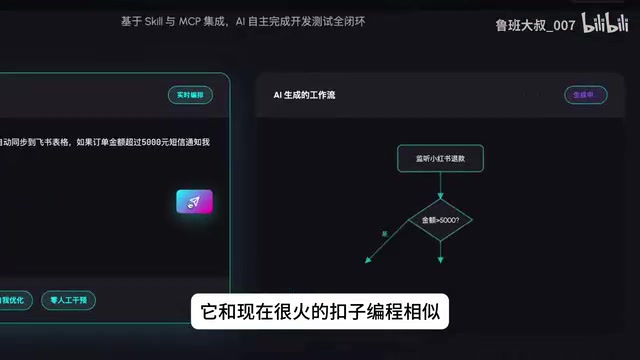
This concept is somewhat similar to Coze's programming approach, but the team believes that users who have experienced both products will tend to prefer ApiFlow. Its core advantage lies not only in being open-source and free but also in what the team calls its "unique taste" — an admittedly abstract expression that perhaps requires hands-on experience to appreciate.
From a product design philosophy perspective, ApiFlow targets a clear pain point: traditional integration platforms, while powerful, have steep learning curves, and users often don't know where to start when facing mountains of documentation and configuration. The underlying technical complexity is significant — API (Application Programming Interface) integration may seem simple but actually involves numerous technical details: different services use different authentication methods (OAuth 2.0, API Key, JWT, etc.), data formats need conversion (JSON, XML, CSV), and you must handle rate limiting, retry mechanisms, error callbacks, and more.
It's worth elaborating that these authentication methods represent different technical approaches in API security. OAuth 2.0 is currently the most mainstream authorization framework, allowing third-party applications to access protected resources without obtaining user passwords — it's adopted by virtually all major platforms including Google, Microsoft, and GitHub. JWT (JSON Web Token) is a compact, self-contained token format commonly used for authentication between microservices. Integration platforms need to uniformly manage these heterogeneous authentication mechanisms while ensuring secure storage and transmission of credentials — this is why enterprises are particularly sensitive about data security when choosing integration tools.
In the traditional approach, a moderately complex integration workflow might take developers days or even weeks to write and debug code. The AI-native interaction approach makes "describing requirements" the sole entry point, attempting to fully encapsulate these technical complexities beneath the AI understanding layer, dramatically lowering the barrier to use.
Seeking 10 Real-World Scenarios: Challenge Rules and Reward Details
The ApiFlow team has announced they're seeking 10 real business scenarios from across the internet, inviting users to implement them using ApiFlow, Coze programming, N8N, or their own code for side-by-side comparison.
How to Participate (Three Simple Steps)
- Visit the ApiFlow website and click "Early Access"
- Follow the instructions to submit your real automation need
- The team will add you to a group chat and provide the ApiFlow download link

Notably, even if you have zero technical knowledge and have never used any AI programming tool, you can still participate. As long as your submitted need is real and reasonable, the team will assign a developer to help you implement it, and you can still receive rewards.
Three-Tier Reward System
The team has prepared three tiers of rewards for participants:
- Reward One: AI computing credits worth $100
- Reward Two: Eligibility for a 500 RMB JD.com shopping card lottery
- Reward Three: Outstanding submissions receive the "ApiFlow Founding Member" honorary title with lifetime free access

Why Must You Bring a Use Case? An Early-Stage Cold Start Strategy
An interesting design choice: ApiFlow currently doesn't offer open registration — it requires users to submit a use case first before gaining access. This is uncommon in product promotion, but the team offers a candid explanation.
ApiFlow is still at a very early stage. If users come without a specific need, facing a pile of documentation and programs, their tolerance will be very low — they won't know where to start. But with a clear need, even if they encounter bugs during use, they'll be willing to spend time overcoming them.

This is actually a very pragmatic early-stage product operations strategy. Cold Start is a classic challenge in product operations, referring to how a product acquires its first batch of high-quality users when it has no user base. ApiFlow's "demand-driven access" strategy has successful precedents in the SaaS industry: Notion accumulated seed users through an invitation system in its early days, and Superhuman email client required users to fill out detailed questionnaires before gaining access.
In product management theory, this strategy is called "Constrained Access," which complements the broader PLG (Product-Led Growth) strategy. Traditional PLG emphasizes lowering barriers to use and letting the product speak for itself, while constrained access filters for high-quality users by deliberately setting barriers. This approach is particularly effective in early product stages because it helps teams quickly establish "Design Partner" relationships — these early users are not just users but product co-creators whose real scenarios and deep feedback directly shape the product's evolution. Y Combinator founder Paul Graham's famous advice to "Do Things That Don't Scale" is the classic articulation of this philosophy.
The core logic of this strategy is "filtering high-intent users" — users willing to spend time submitting requirements typically have real use cases and higher tolerance. The feedback they provide is far more valuable for product iteration than the generalized users brought by random traffic. For tools that haven't been fully polished, "users who come with a goal" are far more valuable than "users who are just browsing" — the former provide real feedback and use cases, while the latter might be lost forever due to a single minor bug.
The team also promises that once the Beta version is released and officially open-sourced, access will be completely open, and they'll welcome any form of criticism, questioning, or praise.
The AI-Native Integration Track: Market Landscape and ApiFlow's Opportunity
The automation integration space is already quite crowded. Internationally, there are mature products like Zapier, Make, and N8N; domestically, AI-native platforms like Coze and Dify are rapidly emerging. ApiFlow's entry at this point faces significant competitive pressure.
But from another angle, "AI generates workflows from a single sentence" as an interaction paradigm genuinely represents the next evolutionary step for integration platforms. Traditional drag-and-drop workflow orchestration, while intuitive, still requires extensive manual configuration for complex scenarios. If ApiFlow can truly achieve "describe your need and development is done," its value proposition will be extremely compelling.
Whether it can break through depends on several core questions:
-
AI generation accuracy: Can a single sentence accurately understand user intent and generate directly usable integration workflows? This involves intent recognition and slot-filling techniques in Natural Language Processing (NLP), as well as deep understanding of API semantics. Current large language models have demonstrated powerful capabilities in code generation, but mapping from natural language to executable workflows is more complex than pure code generation — it requires simultaneously understanding business logic, API specifications, and data flow relationships. Notably, technological progress in this area is very rapid. OpenAI's Function Calling mechanism, Anthropic's Tool Use capability, and the maturation of various Agent frameworks (such as LangChain and AutoGen) are all providing a more solid technical foundation for the "natural language to workflow" conversion. ApiFlow's AI generation accuracy will directly determine first-time user experience and retention rates.
-
Ecosystem richness: How many APIs and third-party services does it support? Are there enough connectors? For reference, Zapier currently supports connections to over 7,000 applications, and the N8N community has contributed over 400 integration nodes. The quantity and quality of connectors directly determine the platform's practical boundaries. In the Chinese market, this challenge is particularly acute — the API openness and standardization of commonly used domestic enterprise systems like Feishu, DingTalk, WeCom, Yonyou, and Kingdee vary widely, and the adaptation workload far exceeds that of international markets. If ApiFlow, as a domestic platform, can establish an advantage in connector coverage for the Chinese SaaS ecosystem, it will form differentiated competitiveness.
-
Fulfillment of the open-source promise: Open source has special strategic value in the integration platform space. When enterprises choose integration tools, data security and vendor lock-in are two core concerns — integration platforms naturally access core business data and system credentials. Open source means users can audit the code themselves and deploy privately, fundamentally eliminating these concerns. N8N carved out its space between Zapier and Make precisely through its open-source strategy, building an active community contribution ecosystem. It's worth noting that N8N uses a "Fair Code" license model that allows free use and modification but restricts commercial redistribution, striking a balance between open-source spirit and commercial sustainability. Similarly, projects like GitLab, Grafana, and Supabase have proven the effectiveness of the "Open Source Flywheel": open-source code attracts developer trials → community contributions expand functionality → more users are attracted by rich features → enterprise users generate paid demand. If ApiFlow can fulfill its open-source promise and build an active connector contribution community, it will have the opportunity to catch up rapidly in ecosystem richness.
The answers to these questions are perhaps exactly what this challenge aims to validate.
Summary: A Zero-Cost Trial Opportunity — Worth a Try If You Have a Need
ApiFlow's challenge is essentially a carefully designed product cold start — using real needs to drive product iteration, reward mechanisms to attract seed users, and side-by-side comparisons with competitors like Coze and N8N to establish market awareness.
For users with real automation needs, this is a zero-cost opportunity to try a new tool. Regardless of the final outcome, having one more option is never a bad thing. If you happen to have a scenario that you "want to automate but don't know how to implement," why not visit the ApiFlow website and submit it?
Key Takeaways
- ApiFlow is an AI-native integration platform that generates integration workflows from a single sentence via AI conversation, distinguishing itself from traditional drag-and-drop approaches
- The team is seeking 10 real-world scenarios from across the internet, offering rewards including $100 computing credits, 500 RMB JD.com cards, and lifetime free access as a Founding Member
- The product is currently in its early stage, using a demand-driven access strategy that requires users to submit a use case before gaining access
- ApiFlow is positioned as open-source and free, with plans to release a Beta version and officially open-source in the future
- Non-technical users can also participate — simply submit a real need, and the team will assign a developer to help implement it
Related articles
 Tech Frontiers
A Rare Quiet Day in AI: Recursive Self-Improvement Stirs Beneath the Surface
A rare quiet day in AI sees multiple sources go silent simultaneously. Behind the calm, Recursive Self-Improvement (RSI) research continues. What this means for the industry.
 Tech Frontiers
Reve 2 vs. Ideogram 4: A Deep Dive into Layout Control in AI Image Generation
A deep comparison of Reve 2 and Ideogram 4's layout control capabilities, covering technical approaches, real-world use cases, and industry trends for designers and creators.
 Tech Frontiers
In the Weights: Check Your Influence Score in the AI World
In the Weights is an AI influence search engine that quantifies your presence in the AI world with a score. Explore how it evaluates practitioners and what it means for digital identity.