Apple AI Finally Enters China: iOS 27.3 Brings Apple Intelligence to the Chinese Market
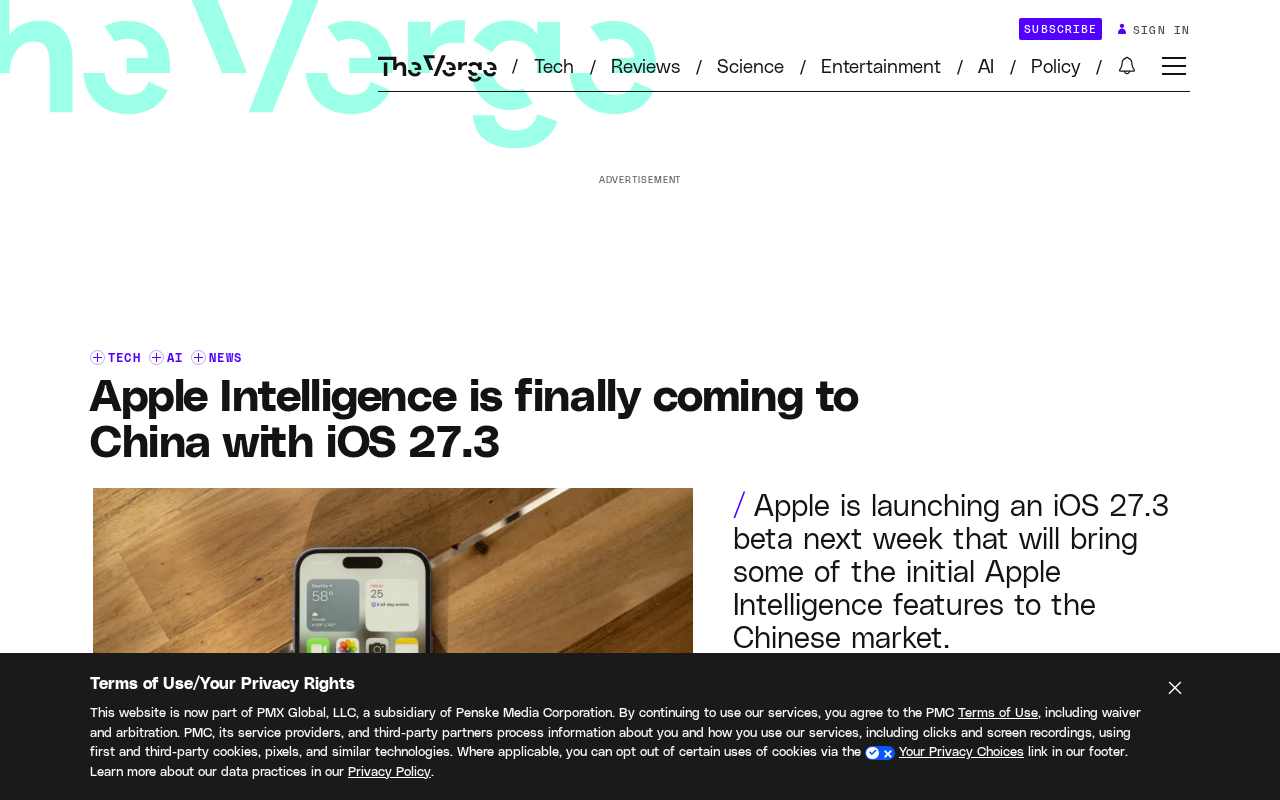
Apple Intelligence will enter China with iOS 27.3, but it may be a feature-limited version.
Apple has announced that Apple Intelligence will enter the Chinese market with iOS 27.3, with a beta rolling out on November 4 and an official release in December. The news was announced via Apple's China newsroom rather than a global press release, indicating that the Chinese market is taking a relatively independent path. Reports indicate that this release will not bring all features, and the Chinese version is very likely a feature-limited edition, with the specific missing items not yet disclosed. Apple chose a point release for a progressive rollout, leaving room for compliance adaptation and experience adjustments, while not disclosing local partners or the technology foundation. For users, whether the core AI scenarios can fully make it into the Chinese version will determine the quality of the experience; for developers, they need to watch how the beta performs and assess the coverage limitations brought by device compatibility.
Apple's generative AI service is finally landing in the Chinese market. According to a newsroom announcement on Apple's China website, Apple Intelligence will officially enter China with iOS 27.3, with the first beta slated for rollout on November 4 and the official release planned for December. The news was first reported by MacRumors, marking a key step in Apple's global AI strategy—but this "entry into China" is not a simple feature port; the trade-offs involved are worth examining closely.
A Long-Delayed Apple Intelligence China Launch
Since its debut, Apple Intelligence has rolled out in multiple markets, but its absence from China has remained a focal point of outside attention. The fact that Apple chose to announce this via its China newsroom rather than a global press release is itself a signal: AI services in the Chinese market need to follow a relatively independent path.
Looking at the timeline, the iOS 27.3 beta on November 4 is the first step, and the official release in December will be the large-scale rollout for ordinary users. This cadence is consistent with Apple's usual system update strategy—small-scale testing first, then full release. But given the particular nature of AI services, the gap of just over a month between beta and official release suggests Apple is fairly confident about the progress of its localization work.
According to MacRumors, this release "will not" bring all features. The original text cuts off there, but the phrasing alone is telling enough: the Chinese version of Apple Intelligence is very likely a feature-limited edition rather than a full copy of the global version. As for exactly which capabilities will be missing, there are no official details yet.
A point release (such as the ".3" in iOS 27.3) refers to a system update that keeps the major version number unchanged and only iterates on a small scale, typically used to fix bugs, patch security vulnerabilities, or introduce small-scale new features. Compared with the once-a-year major version (such as iOS 27 → iOS 28), point releases have shorter cycles and a more controllable scope of change, allowing Apple to roll out new capabilities in batches and quickly roll back or adjust if compliance or experience issues arise. For AI services subject to regulatory approval, point releases are a more prudent vehicle for launch: they can reach users early without binding unverified features to the major version release cadence all at once, thus preserving flexibility for subsequent iterations.
The Localization Logic Behind the Feature Trade-offs
Apple has consistently been cautious about bringing AI services into China. Generative AI involves data processing, content generation, and model deployment, each of which must comply with local regulatory requirements. This explains why Apple chose to introduce Apple Intelligence in a point release like iOS 27.3 rather than waiting for the next major version—point updates are more flexible, making it easier to release features in stages and gradually observe user feedback.
From a product strategy perspective, the approach of launching a beta first and then a full rollout also gives Apple room to adjust. If certain features encounter compliance or experience issues during the beta phase, Apple can defer or replace them in the official release. This "progressive rollout" approach mirrors Apple's approach to privacy features.
It is worth noting that Apple has not disclosed the specific partners or technology foundation for the Chinese version of its AI features. In other global markets, Apple Intelligence partially relies on external models, and whether the approach for the Chinese market will differ remains unknown.
Providing generative AI services within China typically requires compliance with regulations such as the Interim Measures for the Administration of Generative Artificial Intelligence Services, covering the legality of training data sources, content security review, algorithm filing, and security assessment before offering services to the public. If the service involves transmitting personal information overseas, it must also meet relevant compliance requirements for cross-border data transfer. Together, these rules determine that who provides the model, where data is processed, and how generated content is filtered may all differ from overseas versions. Part of the reason Apple has not disclosed its partners and technology foundation is that the localization plan is still being aligned with regulatory requirements, and premature disclosure would limit room for adjustment.
The Practical Impact on Users and Developers
After the official iOS 27.3 release, eligible Chinese users will for the first time be able to use Apple's AI capabilities at the system level. Based on experience from markets where it has already launched, Apple Intelligence's core scenarios center on writing assistance, notification summaries, and image processing. Whether these features can fully make it into the Chinese version will directly determine the quality of the user experience.
For developers, Apple Intelligence's entry into China means new system-level APIs and interaction paradigms. If Apple opens up the relevant interfaces, the app ecosystem around writing, summarization, and image generation could see a round of adjustments. However, until the official full feature list is announced, the safer approach for developers is to watch how the beta actually performs.
Another variable that cannot be ignored is device compatibility. Apple Intelligence has clear hardware requirements, and among the existing devices in the Chinese market, the proportion of eligible products will affect the actual coverage of this feature. Apple typically publishes the list of supported models before the official rollout.
Apple Intelligence has a relatively high hardware threshold, mainly because its on-device model requires sufficient Neural Engine compute and unified memory. Globally, the feature only supports devices with the A17 Pro and newer chips or M-series chips. This means that among the existing iPhone installed base in China, earlier models cannot use system-level AI capabilities, and actual coverage depends on the installed base of the last two generations of high-end models. If developers plan to build features around the relevant APIs, they should first assess user scale based on the supported model list to avoid investing too much adaptation cost in capabilities with limited reach.
A Rollout That Requires Patience
Apple Intelligence's entry into China is more symbolic than immediately disruptive. It means Apple has finally completed its AI puzzle in one of the world's most important markets, but it also means a starting point that is "not the full version." Feature trade-offs, compliance adaptation, and ecosystem readiness—these three threads will together determine what kind of AI experience Chinese users ultimately get.
The official release in December will be a window for observation. By then, the feature list, supported models, and actual performance will all become clear, and the true quality of Apple's AI entry into China will face market scrutiny. For Chinese users who have waited a long time, this is only a beginning, not the end.
One-line Summary
Apple Intelligence will enter China with iOS 27.3, but it may be a feature-limited version.
Paragraph Summary
Apple has announced that Apple Intelligence will enter the Chinese market with iOS 27.3, with a beta rolling out on November 4 and an official release in December. The news was announced via Apple's China newsroom rather than a global press release, indicating that the Chinese market is taking a relatively independent path. Reports indicate that this release will not bring all features, and the Chinese version is very likely a feature-limited edition, with the specific missing items not yet disclosed. Apple chose a point release for a progressive rollout, leaving room for compliance adaptation and experience adjustments, while not disclosing local partners or the technology foundation. For users, whether the core AI scenarios can fully make it into the Chinese version will determine the quality of the experience; for developers, they need to watch how the beta performs and assess the coverage limitations brought by device compatibility.
Related articles

Salesforce Acquires Rune for $375M: AI Logistics Tech Bolsters Defense Business
Salesforce reportedly acquires defense tech startup Rune for $375M. Rune's AI logistics tech will strengthen Salesforce's Missionforce defense platform, continuing its M&A spree.

Why Fair Use Benefits Everyone in the AI Era
Starting from a Hacker News discussion, this article analyzes the legal logic and controversies of the fair use principle in AI training and content creation, and its dual impact on creators and the tech ecosystem.

Mistral Large 4 Open-Sources a Trillion Parameters, Microsoft Offers Voluntary Severance to 60,000 Employees
Mistral Large 4 open-sources a trillion-parameter multimodal model with a coding agent score of 48; SanDisk earnings show AI inference reshaping NAND demand; Google Gemini adds in-app file editing, OpenAI raises Codex quotas, and Microsoft offers voluntary severance to 60,000 employees.