Apple Home Smart Home Lineup Leaked: LG and Schneider Team Up, UWB Door Lock on Board

Apple Home ecosystem welcomes new LG and Schneider devices, with UWB door lock and seamless pairing as highlights.
A hands-on video showcased multiple smart home devices LG and Schneider built for Apple Home, including thermostats, indoor/outdoor cameras, a video doorbell, a UWB smart lock, and a floodlight camera. The UWB lock supports proximity auto-unlock, the indoor camera tilts down when users come home to protect privacy, and setup features an AirPods-like proximity pop-up one-tap connection. All devices are third-party, Apple Home-certified hardware, reflecting Apple's role as a platform provider rather than hardware maker. Pricing and launch dates remain undisclosed, and questions about ecosystem openness and user willingness to switch remain unanswered.
Apple Home Ecosystem Welcomes New Hardware from LG and Schneider
The Apple Home ecosystem is getting a batch of new hardware. A hands-on video on YouTube showcased several smart home devices designed specifically for Apple Home, covering thermostats, indoor and outdoor cameras, video doorbells, smart locks, and floodlight cameras. These products come from LG and Schneider Electric (Schneider Home), marking a rare concentrated showing for Apple's smart home ecosystem.
From Thermostats to Door Locks: A Complete Product Matrix
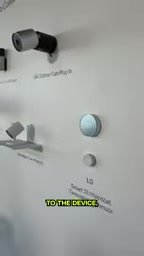
These devices form a fairly complete smart home suite. The thermostat can control temperature and works with a separate temperature sensor for more precise zone-based climate control. Schneider Home also brings its own thermostat, which likewise supports temperature control and can be linked with door sensors for coordinated operation.
Security products are the focus of this batch. The outdoor camera is a plug-in design, while the indoor camera has an interesting privacy mechanism — when you come home, it can automatically tilt its lens downward and stop filming faces. This design clearly responds to longstanding consumer concerns about indoor camera privacy.
The video doorbell needs to be wired into the home's existing doorbell circuit for power. It features two 2.5K resolution cameras, one of which is positioned at the bottom, alongside a light and a call button.
Smart Lock and Floodlight: UWB Steals the Show
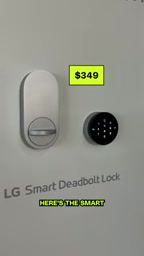
The smart lock is one of the more technically impressive products in this lineup. It's a UWB (Ultra-Wideband) enabled smart lock that supports proximity-based auto-unlock, as well as PIN code entry. UWB previously appeared mainly in Apple's AirTag and the iPhone's Precision Finding feature. Using it for a door lock means more precise distance sensing — the lock opens automatically as you approach the door, without needing to pull out your phone or press a fingerprint sensor.
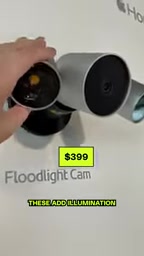
The floodlight camera automatically provides illumination when motion is detected, and also supports up to 2.5K video resolution.
UWB (Ultra-Wideband) is a short-range wireless communication technology that transmits data by sending extremely short nanosecond-level pulses, occupying a very wide frequency band (typically over 500MHz). Unlike Bluetooth or Wi-Fi, which estimate distance based on signal strength, UWB calculates distance by measuring the round-trip time of radio waves (ToF), achieving centimeter-level accuracy — which is why it's often called a "spatial awareness" technology. Apple has included the U1 chip since iPhone 11, initially used for AirDrop direction sensing and AirTag Precision Finding. In the smart lock scenario, UWB's core value lies in determining whether a user is genuinely approaching the door or just passing nearby — Bluetooth solutions are prone to false triggers, while UWB can set more precise unlock distance thresholds. However, for a UWB door lock to deliver full functionality, the phone side typically also needs a UWB chip, meaning users with non-Apple devices or older models may have a limited experience.
Setup Experience: As Easy as Connecting AirPods
Apple's key differentiator for these devices is the setup experience. According to the video, when you bring your device close, the system automatically pops up a pairing graphical interface, and you simply tap to complete pairing — the whole process is similar to connecting AirPods or a HomePod.
This detail is worth noting. Smart home pairing has long been a user pain point, with compatibility issues across different brands and protocols deterring many people. If Apple can replicate the AirPods-level seamless pairing experience for smart home devices, it would have real significance for lowering the barrier to entry.
However, these devices are not Apple's own branded products — they are hardware manufactured by third-party companies like LG and Schneider, certified through Apple Home. Apple's role here is closer to that of an ecosystem platform provider rather than a hardware manufacturer.
The "proximity pop-up pairing" mentioned in the article relies on the Matter smart home standard, which Apple introduced with iOS 15 in 2021, as well as the earlier HomeKit Accessory Protocol (HAP). Matter is jointly promoted by Apple, Google, Amazon, and Samsung, with the goal of enabling devices from different brands to use unified onboarding and application-layer protocols, thereby breaking down ecosystem barriers. When a Matter-enabled device approaches an iPhone, the system discovers it via Bluetooth Low Energy and pops up a pairing card — users can scan a code or tap to add the device to the Home App. This process can be "AirPods-like" because Apple pushed the onboarding logic down to the operating system level, rather than relying on each manufacturer's own app. However, it's worth noting that Matter currently mainly unifies basic connectivity and onboarding, while advanced features (such as adaptive lighting and complex automations) still depend on each ecosystem's proprietary extensions — which explains why the same device may not offer exactly the same functional experience across different platforms.
Open Ecosystem or Closed?
The video ends with a thought-provoking question: Would you be willing to switch your existing smart home products for these devices, or start building a smart home because of Apple's entry?
Behind this question lies a core tension in the smart home industry. The Apple Home ecosystem is known for privacy and experience, but its device selection has always been less extensive than Amazon Alexa or Google Home. The addition of LG and Schneider expands the product line, but whether these devices also work on other platforms is a question the video doesn't answer.
For users deeply invested in Apple devices, the proximity auto-unlock UWB door lock and seamless pairing experience are appealing. But if you already have a well-functioning smart home system, the replacement cost remains a practical concern.
The Apple Home certification system (formerly HomeKit) has clear admission requirements for third-party hardware: devices must pass MFi certification, carry Apple-designated security chips or software authentication modules, and comply with the HAP protocol. This ensures privacy and stability, but it also means manufacturers need to invest extra costs, and product features are constrained by Apple's framework. Compared to Amazon Alexa and Google Home, Apple Home has long had fewer devices, partly for this reason. LG and Schneider's entry this time shows that the Matter standard has lowered the barrier to entry on one hand, and reflects manufacturers' desire to capture a share of Apple's user base on the other. As for whether these devices can simultaneously connect to Alexa or Google Home, it typically depends on whether the manufacturer implements support for multiple ecosystems in the hardware — this is becoming increasingly common in the Matter era, but still needs to be confirmed on a product-by-product basis.
Summary
The highlights of this batch of Apple Home products center on three things: the real-world experience of the UWB smart lock, the privacy-protecting design of the indoor camera, and whether the AirPods-like pairing process can truly deliver. Specific pricing and launch dates have not yet been disclosed, but these devices represent a substantive push by Apple into the smart home space.
Related articles

A Single Prompt Triggers a Global PHP Security Storm: Is AI a Savior or a Hidden Risk?
A single AI prompt triggered a global PHP security crisis affecting Wikipedia and the Internet Archive. This article reviews the incident, analyzes the OpenAI-Amazon controversy, and explores the security paradox of lowered vulnerability discovery barriers in the AI era and developer response strategies.

When AI Is Taken Away: How Reliance on Shortcuts Undermines Your Problem-Solving Resilience
A study of 1,222 people found that after using AI to answer questions, once AI was removed, people gave up on more problems than a control group that never used AI. The article analyzes the impact of AI reliance on learning resilience and metacognition, and explores design implications for AI learning tools.

Carta and NewView Partner to Let Startup Employees Cash Out Equity Early
Carta and NewView Capital partner to simplify startup tender offers, helping employees sell equity early. Analysis of the mechanism, liquidity pain points, and impact.