Apple in Talks to Acquire PrismML: Can Extreme Quantization Really Run AI on an iPhone?

Apple eyes PrismML's 1-bit quantization tech to run AI models locally on iPhone.
Apple is reportedly in talks with AI startup PrismML, whose extreme quantization technology compresses large language models to run directly on iPhone. While the 1-bit 'bonsai' model shows promise, community testing reveals frequent tool-calling failures and elevated hallucination rates, raising questions about whether extreme compression can deliver reliable, production-ready on-device AI.
Apple's On-Device AI Ambitions and PrismML
According to reports circulating on Reddit, Apple is in talks with an AI startup called PrismML, whose core technology compresses large AI models down to a size that can run directly on an iPhone. This move further confirms Apple's relentless pursuit of on-device AI — driven by both privacy protection and response speed, Apple has long preferred to keep AI computation local rather than relying on cloud servers.
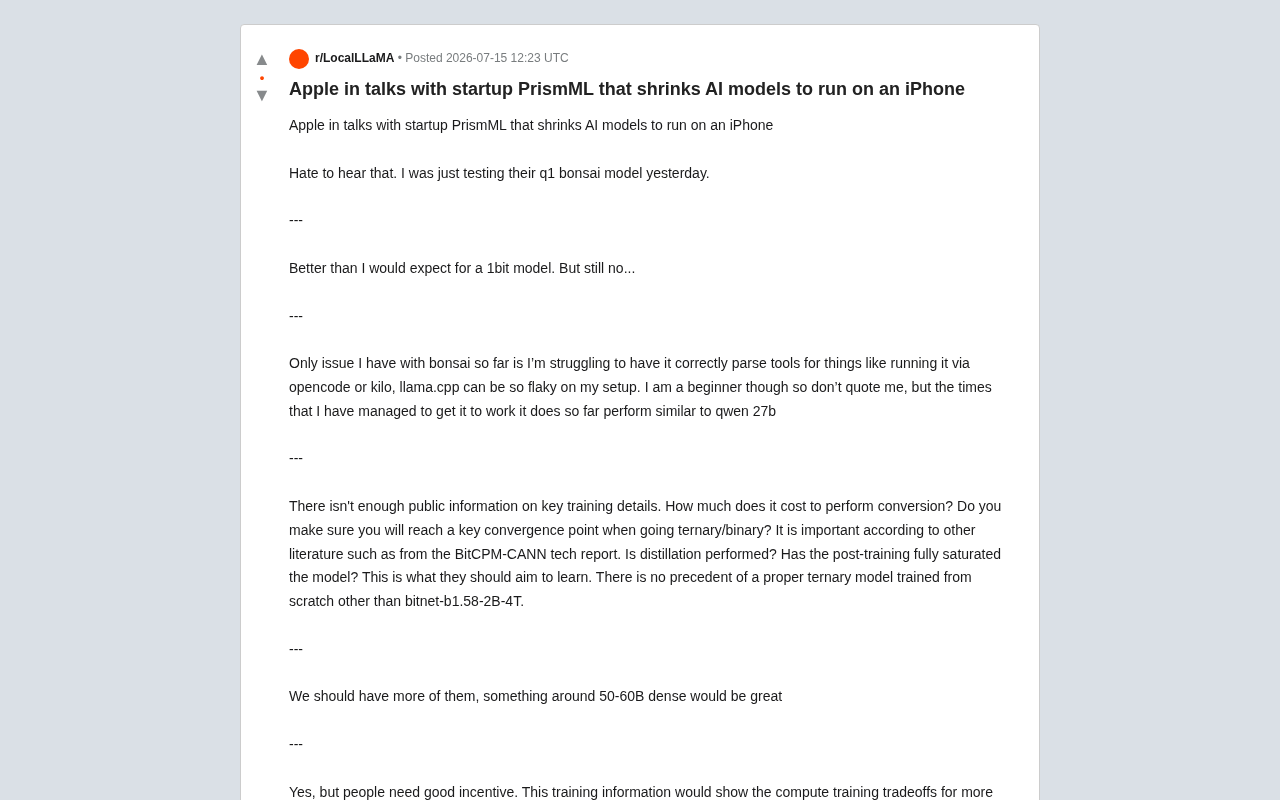
PrismML's signature technology is extreme quantization, with its flagship product being a 1-bit (more precisely, ternary) model called "bonsai." The 1-bit or ternary approach compresses model weights from the typical 16-bit or 32-bit floating-point numbers down to just a handful of states (e.g., -1, 0, +1), dramatically reducing model size and memory footprint.
Quantization Background: Traditional neural networks store weight parameters as 32-bit (FP32) or 16-bit (FP16/BF16) floating-point numbers. Quantization maps these parameters to lower-precision representations — from 8-bit integers (INT8) to 4-bit (INT4), all the way down to 1-bit/ternary. Each reduction in precision means a smaller model and lower memory bandwidth requirements. Microsoft Research's BitNet b1.58 architecture, proposed in 2023, is a major milestone in the ternary space. It constrains all weights to {-1, 0, +1}, theoretically compressing model size by more than 16×, while converting matrix multiplications into addition and subtraction operations via specialized hardware instructions — significantly reducing computational power consumption.
If this technology matures, it could theoretically allow models that normally require data centers to fit inside a smartphone.
Community Testing: Impressive or Overhyped?
The news sparked not universal praise but a remarkably measured — even skeptical — discussion in the community. A developer who had tested PrismML's "q1 bonsai" model just the day before said bluntly: "For a 1-bit model, it's better than I expected, but still not good enough."
The Reality of Tool Calling
A self-described beginner shared more concrete experience: when trying to run bonsai through toolchains like opencode or kilo, he ran into difficulties with tool parsing. He mentioned that llama.cpp was "often unstable" in his environment, but in the few cases where it ran successfully, the model performed "comparably to Qwen 27B."
This feedback is noteworthy — if an extremely compressed small model can genuinely approach the performance of a 27-billion-parameter Qwen model, that would be a significant breakthrough. But the reality of "rare successful cases" and frequent tool-calling failures exposes serious reliability gaps for production use.
"No Free Lunch"
A top-voted comment in the community neatly captured the prevailing skepticism: "I keep hearing how small their models are, but I haven't seen anyone say whether they can actually get things done."
Another user offered a particularly insightful take: "I've seen two common claims here — 'Wow, incredible, played with it for 10 minutes and noticed zero performance degradation,' and 'Looks okay, but lots of hallucinations and tool calls fail constantly.' I suspect the truth is closer to the second. There's no free lunch when you eliminate 90% of a model's weights."
This cuts to the core tension in extreme quantization: there is an unavoidable fundamental trade-off between compression ratio and capability retention.
Deeper Technical Skepticism
Beyond user experience, more technically sophisticated voices in the community raised questions about PrismML's technical transparency. One commenter listed a series of critical questions:
- Conversion cost: How much compute does it take to perform the quantization conversion?
- Convergence guarantees: How is convergence ensured at critical points when performing ternary or binary quantization?
- Distillation and post-training: Was knowledge distillation applied? Did post-training truly saturate the model?
Quantization-Aware Training (QAT) and Knowledge Distillation: Model quantization falls into two main camps: post-training quantization (PTQ) and quantization-aware training (QAT). PTQ compresses weights after training is complete — simple to execute but with greater accuracy loss. QAT simulates quantization error during training, teaching the model to adapt to low-precision representations from the start. The "extreme QAT" referenced here pushes this to the limit — constraining weights to the ternary space from the very beginning of training, which poses enormous challenges for convergence stability. As for knowledge distillation (a technique introduced by Hinton et al.), it allows a compressed "student model" to inherit implicit knowledge by learning from the soft probability distributions output by a larger "teacher model" — a critical tool for recovering the accuracy lost through extreme quantization. The community's questions about whether PrismML fully leveraged distillation and whether post-training was truly "saturated" are fundamentally asking whether the compression process involved sufficiently rigorous knowledge transfer.
The commenter cited technical reports such as BitCPM-CANN, emphasizing the importance of convergence points and noting a sharp observation: "Aside from bitnet-b1.58-2B-4T, there is currently no precedent for a formally trained ternary model from scratch."
This means that if PrismML claims a unique breakthrough, the field urgently needs more publicly available training details to verify it — rather than settling for marketing language about how "small" the model is.
An Industry Perspective on Model Architecture
The discussion also branched into broader trends in model architecture. Some users called for more large dense models in the 50–60B range, while another responded from the perspective of training economics:
"People need good incentives. Training data can demonstrate compute-training trade-offs for more extreme QAT. Where's the incentive for MoE? Building a 10B-activate-1B (10B1A) model costs 10× less to train than a 10B dense model and is faster at inference too."
The Economics of Mixture of Experts (MoE): MoE (Mixture of Experts) is a major architectural advancement in recent large model development, adopted by well-known models including GPT-4, Mixtral, and DeepSeekAd. The core idea is to split a model into multiple "expert" sub-networks, with a gating network activating only a few experts per inference pass rather than using all parameters. For example, a MoE model with 56B total parameters might activate only ~8B parameters per inference, with computational cost comparable to an 8B dense model but knowledge capacity approaching a much larger one. The economic advantage: training costs are dramatically lower than an equivalently capable dense model, inference is faster, and hardware requirements are reduced — which is the underlying logic behind "10B1A costs 10× less to train than a 10B dense model."
This discussion reveals the real trade-offs in current AI model development: MoE architectures are highly favored for their training cost and inference efficiency advantages, while dense models retain irreplaceable value in certain scenarios requiring precise computation. The economic logic behind these architectural choices will also factor into Apple's ultimate evaluation of PrismML's technology.
Why Is Apple Interested in This Approach?
Despite community doubts about PrismML's technical maturity, Apple's strategic interest remains significant in its own right. Apple's A-series and M-series chips feature powerful Neural Engines, but running large language models on mobile devices remains a serious challenge due to memory and power constraints.
The Hardware Reality of Apple's Neural Engine: Apple's investment in on-device AI began with the A11 Bionic chip in the iPhone X in 2017, which first integrated a dedicated neural network acceleration unit called the Neural Engine. Each subsequent chip generation has strengthened this module: the A17 Pro's Neural Engine delivers 35 TOPS (trillion operations per second), and the M4 pushes further to 38 TOPS. Yet the physical limitations of mobile devices remain severe — iPhones typically have only 6–8GB of unified memory, while running a 70B-parameter quantized model (INT4) still requires around 35GB of memory. This is precisely why extreme quantization matters so much to Apple: only by compressing models to within a few gigabytes can they run smoothly under iPhone's memory constraints — giving that powerful Neural Engine something to actually work with.
If extreme quantization can genuinely compress model size while preserving usability, Apple could bring more powerful AI capabilities to the iPhone without sacrificing user privacy — perfectly aligned with Apple's longstanding brand commitment to "privacy as a fundamental human right."
However, the community's measured response is also a reminder: between a technical demo and a production-ready product lies a series of real-world gaps — hallucination rates, tool-calling reliability, and task generalization. An acquisition or partnership is only the first step. The real test is whether PrismML's technology can withstand rigorous scrutiny at scale, in real-world scenarios.
Summary
Apple's talks with PrismML are another notable signal in the on-device AI race. Extreme quantization represents an appealing vision for bringing AI "down" to consumer devices — but the community's rational discussion is a reminder to the entire industry: genuine breakthroughs require transparent technical details, verifiable performance data, and an honest reckoning with the engineering reality that there is no free lunch. Before Apple makes any final decision, PrismML still has a lot to prove — to the public and to the technical community alike.
Key Takeaways
Related articles

Why Does the Tesla Roadster Need to Fly? A Deep Dive into Musk's Wild Demo
Tesla's Roadster launch showed wall-climbing, upside-down driving, and flying stunts—but The Vergecast notes the demo car may lack a battery, the Rocket version is invite-only and not street-legal, and the website terms don't guarantee delivery. After nine years of delays, why does this car still need to exist?

AI Is Not a Replacement: Human-AI Collaboration Through the Lens of Factory Root Cause Analysis
Starting from factory root cause analysis, this article explains how AI accelerates evidence chain construction rather than replacing human experts, exploring the pragmatic implementation logic and business value of 'AI supporting people rather than replacing them.'

AI Agent Decision Auditing: Building an Evidence Chain in Regulated Workflows
Starting from a Reddit discussion, this article analyzes three core issues in AI agent decision auditing within regulated workflows: what fields audit records should contain, how to handle feedback latency for erroneous decisions, and how to continuously calibrate LLM judge consistency with human judgment.