Apple iPhone Duo Foldable Developer Guide: Full Breakdown of the October 2026 Event

Apple's Hello Developer newsletter releases the iPhone Duo foldable app submission guide and developer support program.
Apple's latest Hello Developer newsletter focuses on the foldable iPhone Duo, announcing an app submission guide and adaptation resources. The device supports tent, book, and flip postures, and Apple urges developers to redesign their layouts rather than simply stretch them. It also launches iPhone Duo Group Labs, a speed-and-efficiency developer event, expanded localization docs, and new App Store creative assets.
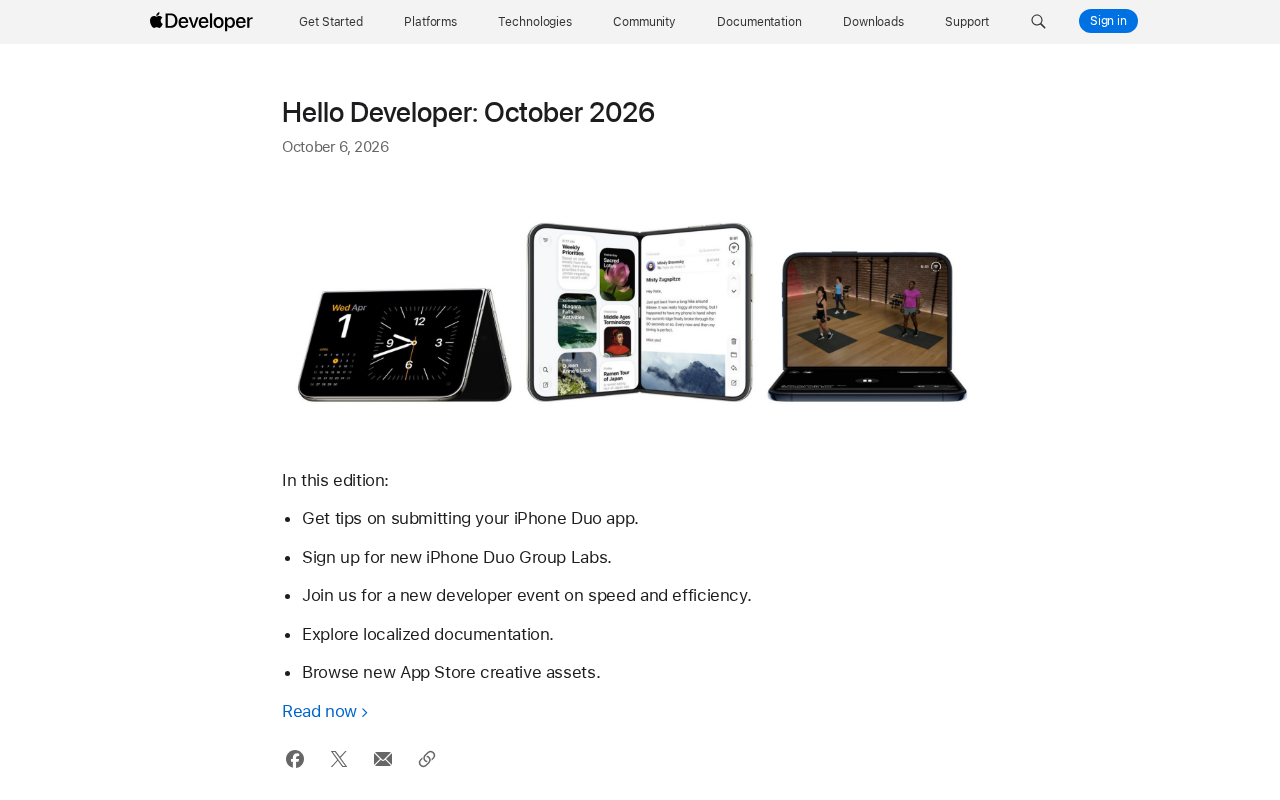
Apple's Developer Relations team has released the latest issue of its Hello Developer newsletter, centering on the long-rumored foldable device, the iPhone Duo. This newsletter not only announced adaptation resources and event schedules for developers, but also revealed Apple's approach to building out the foldable ecosystem.
iPhone Duo App Submission Guide and Developer Resources
According to Apple's official newsletter, the core topic of this issue of Hello Developer is helping developers submit iPhone Duo apps. As Apple's first foldable phone, the iPhone Duo offers three typical usage postures: tent mode can display a clock and calendar, book mode supports a split-screen notes-and-messages interface, and flip mode is suited to content like fitness videos.
Apple recommends that developers fully leverage the interaction differences between these three forms when adapting their apps, rather than simply stretching existing interfaces. This means apps need to rethink their information hierarchy and interaction logic for different folding angles. Apple has also launched iPhone Duo Group Labs, which developers can register for to get the chance to exchange adaptation experience directly with Apple engineers. Specific submission details and the Labs registration portal can be found on the Hello Developer October page of Apple's developer website.
The Hello Developer newsletter is an official email briefing Apple regularly publishes for developers worldwide. Its content covers new OS version features, development tool updates, review policy changes, adaptation guides, and online/offline event schedules. It usually aligns with major release moments such as WWDC, but also puts out themed issues for specific devices or frameworks—this issue, for example, focuses on foldables. Developers receive it after subscribing on Apple's developer website, and past issues are archived on the News or Hello Developer pages of the developer site. Because many adaptation details from Apple aren't announced in standalone press releases but conveyed directly through this kind of newsletter, it is often seen as an important bellwether for gauging platform direction.
The three typical foldable postures generally correspond at the system level to different window size classes and lifecycle states. Tent mode (half-folded and standing) typically exposes only the upper half of the screen for lightweight information display, suitable for read-only content such as clocks, calendars, and notifications. Book mode (fully unfolded) is close to a small tablet, suited to split-screen multitasking with notes and messages side by side. Flip mode (closed outer screen or half-folded upright) is closer to a traditional bar phone, though it may feature an outer screen as an auxiliary display. When adapting, developers need to listen for fold-state change events and dynamically adjust the layout rather than relying on a fixed screen aspect ratio, and must consider preserving data and restoring state at the moment of folding—otherwise interface misalignment or content loss can easily occur.
Speed and Efficiency Developer Event
In addition to foldable-specific support, Apple also announced it will hold a developer event themed around "speed and efficiency." Although the newsletter did not disclose the event's specific agenda, based on the theme, the content likely touches on areas such as app launch optimization, rendering performance tuning, and energy consumption management. Events like this typically target teams with some development experience, helping them improve product performance in the highly competitive App Store environment.
Apple's developer events around performance and efficiency typically cover the practical use of toolchains such as Instruments, MetricKit, and Xcode Organizer, as well as optimization methods for metrics including launch time, scroll frame rate, memory footprint, and background energy consumption. In recent years, Apple has also introduced system-level capabilities such as launch-time attribution, hang detection, and energy logs to help developers pinpoint stuttering and battery-drain issues. These events are mostly held as online lectures or lab sessions, and some content is tied to App Store recommendation mechanisms—apps with strong performance are more likely to earn editorial recommendations and visibility.
Localization Documentation and App Store Creative Assets
Apple has also made updates at the developer resource level. The expansion of localization documentation means developers in non-English markets can get official guidance better suited to their own language environments, which is especially important for teams looking to expand their global user base. At the same time, the App Store creative asset library has added design resources developers can use directly, lowering the barrier to producing marketing materials.
Developer Opportunities in the Foldable Ecosystem
Judging from the signals this newsletter sends, Apple is steadily building a developer support system for foldable devices—first providing design guidelines and testing labs, then driving performance optimization through events, and finally using localization documentation and creative assets to lower the cost of participation for developers worldwide. For developers watching the Apple ecosystem, getting familiar with the iPhone Duo's multi-form interactions early could be the key to capturing a new wave of device dividends.
For more details, visit the Hello Developer October page on Apple's developer website.
One-line Summary
Apple's Hello Developer newsletter releases the iPhone Duo foldable app submission guide and developer support program.
Paragraph Summary
Apple's Developer Relations team's latest Hello Developer newsletter focuses on the foldable device iPhone Duo, announcing an app submission guide and adaptation resources. The iPhone Duo supports tent, book, and flip postures, and Apple recommends developers redesign their information hierarchy and interaction logic for different folding angles rather than simply stretching interfaces. Apple has also launched iPhone Duo Group Labs for developers to register and exchange adaptation experience with Apple engineers. The newsletter also announced a developer event themed around speed and efficiency, along with expanded localization documentation and a new App Store creative asset library. Overall, the signal is that Apple is steadily building a foldable developer support system, and getting familiar early with multi-form interactions may be the key to a new wave of device dividends.
Related articles

Why Does the Tesla Roadster Need to Fly? A Deep Dive into Musk's Wild Demo
Tesla's Roadster launch showed wall-climbing, upside-down driving, and flying stunts—but The Vergecast notes the demo car may lack a battery, the Rocket version is invite-only and not street-legal, and the website terms don't guarantee delivery. After nine years of delays, why does this car still need to exist?

AI Is Not a Replacement: Human-AI Collaboration Through the Lens of Factory Root Cause Analysis
Starting from factory root cause analysis, this article explains how AI accelerates evidence chain construction rather than replacing human experts, exploring the pragmatic implementation logic and business value of 'AI supporting people rather than replacing them.'

AI Agent Decision Auditing: Building an Evidence Chain in Regulated Workflows
Starting from a Reddit discussion, this article analyzes three core issues in AI agent decision auditing within regulated workflows: what fields audit records should contain, how to handle feedback latency for erroneous decisions, and how to continuously calibrate LLM judge consistency with human judgment.