Apple Launches Exclusive Badge for iPhone Duo, Opening a New Track for Foldable App Ecosystem

Apple launches an app badge for the foldable iPhone Duo, using a label system to guide developer adaptation and set experience standards.
Apple plans to launch a "Made for iPhone Duo" badge on the App Store to designate apps and games optimized for the foldable's additional screen space. This continues Apple's "Made for" label strategy from Made for iPod to MFi certification, using visible marks to reduce user decision costs and send adaptation signals to developers. The core of foldable adaptation is responsive layout restructuring, involving split views in the unfolded state, state preservation during form factor switching, and touch hotspot adjustment on large screens. The badge may become an implicit threshold for featured traffic allocation, with early adapters expected to gain exposure dividends; however, Apple's use of soft guidance rather than mandatory specifications means uneven adaptation quality and cross-platform costs remain potential risks.
Title
Apple Launches Exclusive Badge for iPhone Duo, Opening a New Track for Foldable App Ecosystem
Meta Description
Apple's App Store will introduce a "Made for iPhone Duo" badge to highlight apps and games optimized for foldable screens. This article analyzes the ecosystem logic behind the badge strategy, key developer adaptation points, and the new competitive landscape for foldable app distribution.
Article Content
Apple is building a dedicated app identification system for its first foldable device, the iPhone Duo. According to foreign media reports, the App Store will launch a "Made for iPhone Duo" badge to designate apps and games that have been optimized for the foldable's additional screen space. This move signals that Apple not only aims to enter the foldable form factor on the hardware side, but also seeks to set experience standards in advance from the distribution end.
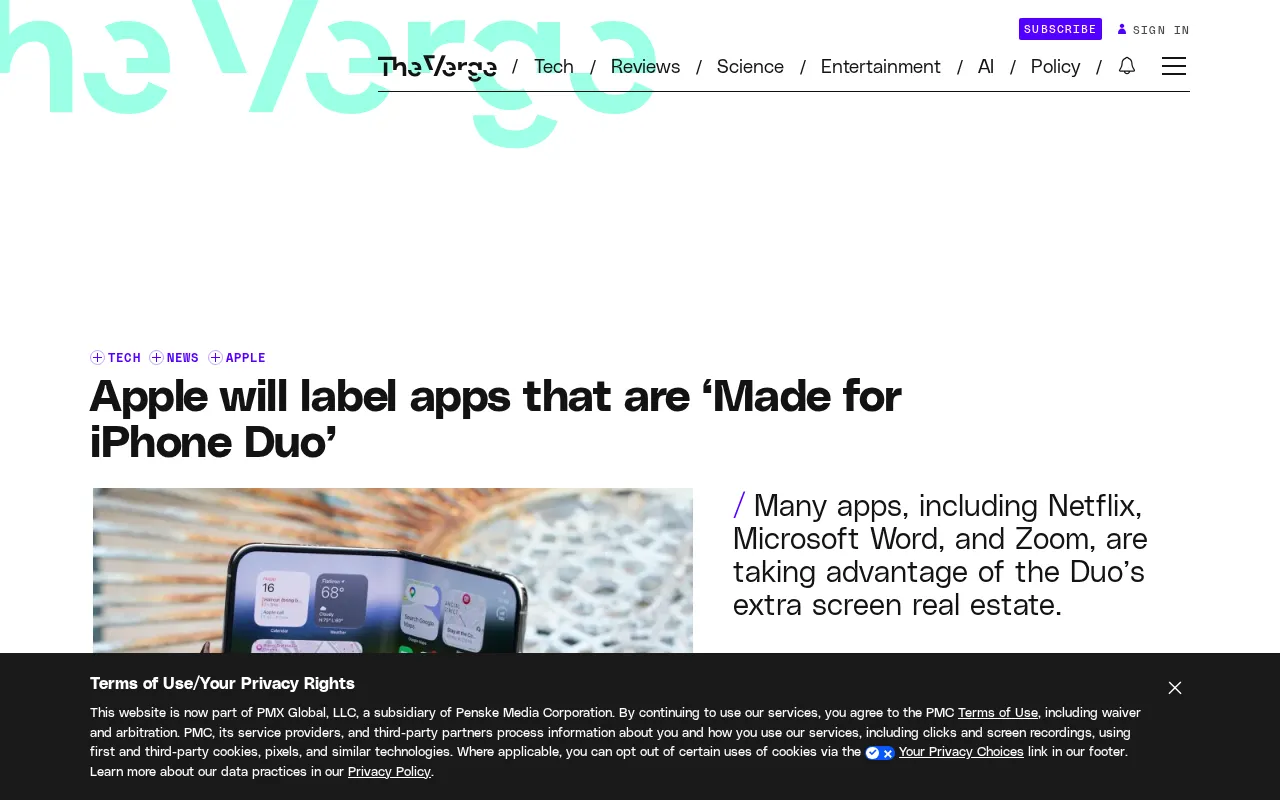
Behind the Badge: Apple Replicates the "Made for" Strategy on Foldables
The "Made for iPhone Duo" badge is not the first time Apple has used a badge system to guide its ecosystem. From the early Made for iPod to MFi accessory certification, Apple has always excelled at using labels to reduce user decision costs while sending clear adaptation signals to developers. The uniqueness of foldables lies in the screen form factor changing with the unfolded state; if an app hasn't adapted its layout, unfolding can easily lead to stretching, blank areas, or interaction misalignment. The badge essentially turns "adaptation quality" into a visible indicator that users can recognize at a glance.
The report mentions that the badge will cover apps and games that can utilize the device's additional screen space. Apple has not yet revealed the specific visual style of the badge, leaving room for developer speculation—it may appear on app detail pages, search results, or even influence recommendation weights.
The MFi certification system is an accessory authorization mechanism (Made for iPod/iPhone/iPad) that Apple gradually established around 2005. By licensing interface specifications such as Lightning and USB-C, along with certification chips, to third-party manufacturers, it ensures accessories are compatible with Apple devices at the electrical and protocol levels. Products with MFi certification can use the official logo, while uncertified accessories may trigger a "This accessory is not supported" prompt. The significance of this system goes beyond quality endorsement—it allows Apple to control access to the accessory ecosystem and licensing revenue. Understanding this helps assess the nature of the "Made for iPhone Duo" badge: it is likely not a hardware certification but an experience label for the app layer, yet its underlying logic of "using official marks to set entry barriers" is in line with MFi.
What Developers Need to Adapt
The core of foldable adaptation is not simply scaling up the interface, but restructuring responsive layouts. Developers need to handle at least three scenarios: split-view layout in the unfolded state, state preservation when switching between folded and unfolded states, and adjustment of touch hotspots for multitasking interactions on large screens. Game apps also need to consider the impact of aspect ratio changes on rendering and control areas.
From a business perspective, the badge is likely to become an implicit threshold for traffic allocation. Referring to Apple's past approach with new form factor devices like Apple Watch and Vision Pro, apps that complete adaptation early often gain featured placements and dedicated exposure. For small and medium developers, completing adaptation before the badge system becomes widespread is a window to gain exposure at low cost.
Responsive Layout refers to an interface that automatically rearranges content based on available window size, aspect ratio, and orientation, rather than scaling proportionally. In foldable scenarios, common implementation methods include: breakpoint switching based on Size Class, split-view containers (such as iOS's UISplitViewController or SwiftUI's NavigationSplitView), and fluid grid layouts. In contrast, "fixed layout" hardcodes coordinates based on a baseline resolution, which can easily cause content stretching or large blank areas when unfolded. Responsive layout also requires handling "size change events"—when the window changes from folded to unfolded, the view needs to recalculate layout and preserve states such as scroll position and input focus. This is precisely the key difficulty that distinguishes foldable adaptation from traditional tablet adaptation.
The "Standards Battle" in the Foldable Ecosystem
Apple's choice to use a badge rather than mandatory specifications to drive adaptation continues its consistent soft-guidance strategy. This approach reduces developer resistance but may also lead to uneven adaptation quality—the badge can only prove that "adaptation was done," not quantify "how well it was done."
On the other hand, if the iPhone Duo's foldable form factor differs from the Android camp in aspect ratio and hinge design, the adaptation cost for cross-platform developers will further increase. Whether the badge system can generate ecosystem appeal similar to "Designed for iPad" depends on whether device shipments can support the return on developers' investment.
Currently disclosed information is still limited; the badge's specific style, review criteria, and whether it is linked to search rankings are yet to be announced by Apple. But what is certain is that foldable competition has extended from hardware specs to the distribution rules of app experience, and the badge is just the first card in this ecosystem battle.
Designed for iPad is a label used by Apple on the Mac App Store to identify apps originally designed for iPad that run on Apple Silicon Macs with developer permission. Its comparability with "Made for iPhone Duo" lies in the fact that both are label systems used by Apple to signal to users that "this app has been validated for a certain device form factor," thereby incentivizing developers to follow new platforms. The difference is that Designed for iPad is closer to a compatibility statement, while Made for iPhone Duo emphasizes experience optimization quality. Observing the implementation results of Designed for iPad shows that the appeal of such labels is highly dependent on the installed base of the target device—when device ownership is insufficient, developers lack motivation to invest, and the label can easily become a formality.
One-line Summary
Apple launches an app badge for the foldable iPhone Duo, using a label system to guide developer adaptation and set experience standards.
Paragraph Summary
Apple plans to launch a "Made for iPhone Duo" badge on the App Store to designate apps and games optimized for the foldable's additional screen space. This continues Apple's "Made for" label strategy from Made for iPod to MFi certification, using visible marks to reduce user decision costs and send adaptation signals to developers. The core of foldable adaptation is responsive layout restructuring, involving split views in the unfolded state, state preservation during form factor switching, and touch hotspot adjustment on large screens. The badge may become an implicit threshold for featured traffic allocation, with early adapters expected to gain exposure dividends; however, Apple's use of soft guidance rather than mandatory specifications means uneven adaptation quality and cross-platform costs remain potential risks.
Related articles

Will GitHub Die? Open Source Maintainer Burnout and the Collaboration Crisis in the AI Era
Lex Fridman podcast discussion on open source maintainer burnout and GitHub's predicament: massive pull requests overwhelm core maintainers, and AI worsens code bloat. Using math journal peer review and Poincaré conjecture verification as analogies, the article analyzes why verification in knowledge production must be deliberately slow, and how open source communities can avoid the failure mode of maintainers exiting.

Stop Building Cookie-Cutter AI Websites: 3 Tools That Transform Your Coding Agent
Three tools that boost AI coding agents: FFmpeg skill for local video editing in Claude Code and Cursor, Hallmark's 50 design themes to fix cookie-cutter AI sites, and Jailbreaks' 25+ model prompts.

How America's Gerontocracy Squeezes the Younger Generation
Americans over 55 hold nearly three-quarters of national wealth, alongside an 80-year-old president and elderly congressional leaders. The Atlantic's Idrees Kahloon explains how gerontocracy drives up housing costs, squeezes opportunities for the young, and explores zoning reform and child poverty reduction as practical fixes.