Apple Launches Health AI Research App to Explore AI Medical Q&A

Apple launches a research app to observe how ordinary people use AI to answer everyday medical questions, positioned as a research tool rather than a medical product.
Apple has launched a new research app to study how people use AI to handle everyday medical questions. Positioned as a research tool that does not provide diagnostic or therapeutic advice, it focuses on observing and recording health Q&A interactions between users and AI to accumulate real-world data. This continues Apple's research-first strategy in health, expanding from hardware sensor data to language interactions. Health Q&A is a sensitive, high-risk AI scenario. If Apple accumulates real interaction data at scale, it could inform evaluation standards for AI health Q&A. No diagnostic features are mentioned in public information, and data privacy handling remains undisclosed—a key point to watch.
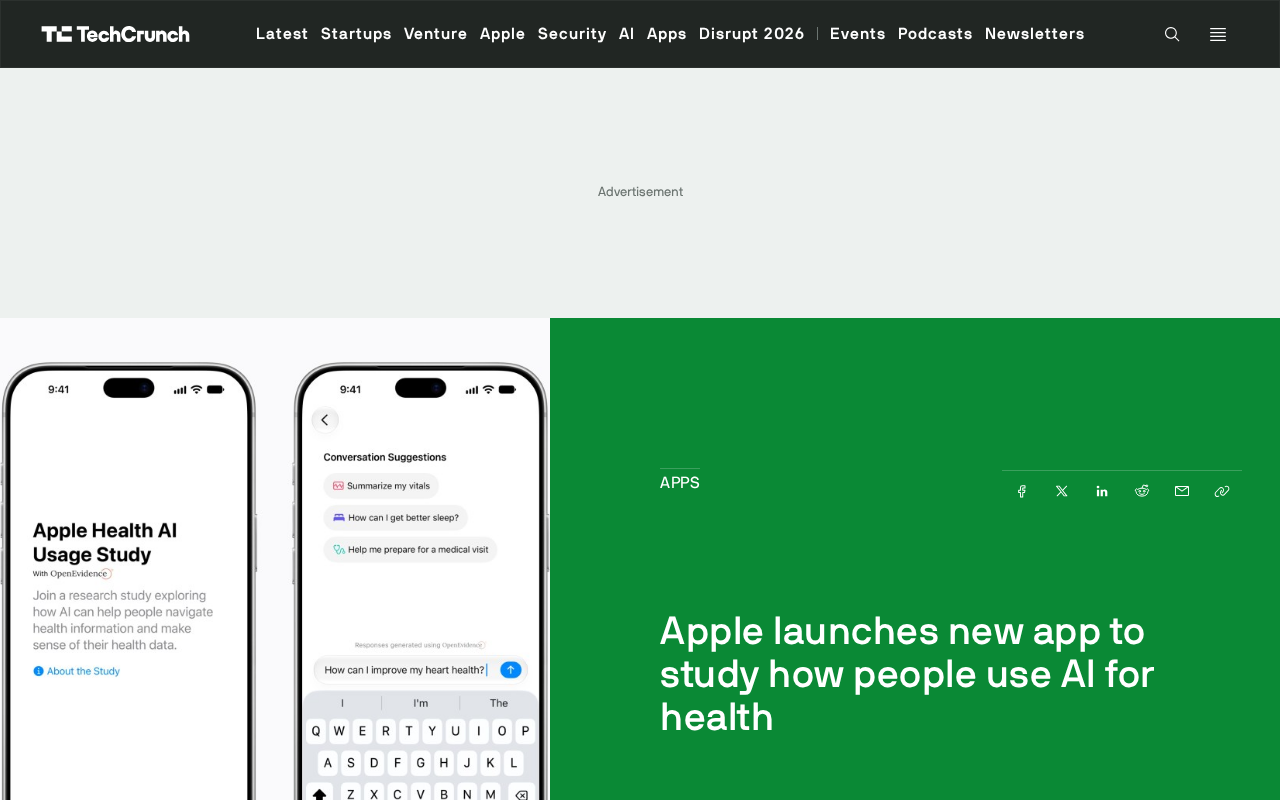
Apple is turning its AI health research toward a more everyday scenario: how ordinary people use AI to answer their medical questions. According to RSS sources, Apple has launched a new research app specifically designed to study how people use AI to handle health-related questions. The app's core mission is not to provide diagnostic advice, but to observe and record health Q&A interactions between users and AI, accumulating real-world data for subsequent research.
What Apple's New Research App Does
According to the original material, this app serves a research study aimed directly at "everyday medical questions." The health questions users pose during use, the responses AI provides, and the patterns of interaction between the two may all become subjects of study. Apple has not positioned this app as a medical product, but rather framed it as a research tool—meaning its focus is on understanding behavior, not replacing doctors.
This approach continues Apple's consistent practice in the health space: first collecting real-world data through research projects, then considering productization. Features on Apple Watch such as heart rate, ECG, and fall detection have all gone through similar research validation paths. Now, the research subject has expanded from physiological signals collected by hardware sensors to language interactions between users and AI.
Why AI Health Q&A Deserves Dedicated Research
Health questions are among the most common—and most sensitive—categories when users ask AI. People ask about symptoms, medications, diet, exercise recovery, and even emergency judgment. The special nature of these questions lies in the fact that wrong answers carry high costs, while overly conservative answers may make users feel the tool is useless. Apple's choice to start with research indicates it wants to first understand how users actually ask questions in real scenarios, what kind of answers they expect, and where AI responses are prone to problems.
From an industry perspective, this is also a question that has not yet been adequately answered. Large models have become quite mature in general Q&A, but in the health domain, accuracy, explainability, and risk boundaries are all more blurred. If Apple's research app can accumulate real interaction data at scale, it may provide reference points for evaluation standards in AI health Q&A.
Real-World Evidence (RWE) in the medical and digital health fields refers to data derived from everyday clinical practice and real user environments, rather than strictly controlled randomized controlled trials. The health Q&A interactions between users and AI collected by Apple's research app fall squarely into this category. The value of RWE lies in its ability to reflect behavioral patterns, language habits, and risk points in real usage scenarios, helping researchers discover issues that controlled experiments struggle to capture. But RWE also has limitations: inconsistent data quality, lack of control groups, and user self-selection bias. Therefore, how Apple designs its research protocols and how it combines RWE with rigorous evaluation will determine the credibility of its findings.
The Boundary Between Research Tools and Medical Products
It should be clear that currently public information only involves a research app, with no mention of any diagnostic or therapeutic functionality. Apple typically remains cautious with such projects: data collected by research apps is used to understand user behavior, not to directly output medical conclusions. This positioning both reduces regulatory risk and aligns with Apple's brand image emphasizing privacy and safety in the health space.
For users, participating in such research means their health questions may be used for analysis. How Apple handles data privacy in research scenarios will be key to whether the project earns trust. The source material does not disclose specific data handling methods, which is also an information point worth watching going forward.
Regulatory classification is key to understanding Apple's positioning. In the United States, the FDA has a clear device regulatory pathway for medical products (such as diagnostic software), while pure research tools are typically not used for clinical decision-making and therefore face lower regulatory thresholds. By positioning the app as a research tool, Apple means it does not claim to provide diagnostic or therapeutic advice, thereby avoiding triggering medical device approval. But the boundary is not absolute: if research results are used to support product feature claims, or if the app begins outputting personalized medical advice, the regulatory stance could change. Apple's cautious positioning is both a compliance consideration and a protection of brand trust.
Data privacy and informed consent are particularly sensitive in research scenarios. Health questions may contain sensitive information such as symptoms, medications, and lifestyle habits. If Apple intends to use this data for analysis, it must clearly inform users of data purposes, storage methods, and sharing scope, and obtain informed consent. Apple has consistently emphasized privacy protection technologies such as differential privacy and on-device processing, but research apps involving language interaction data are more difficult to handle. The source material does not disclose specific data handling methods, which is precisely the core question that needs attention: whether users clearly understand how their questions will be used, and whether Apple can strike a balance between research and privacy.
Signal Significance for the AI Health Sector
Apple's entry into AI health Q&A research sends a clear signal: the value of AI in health scenarios lies not only in model capabilities themselves, but also in understanding how real users actually use it. Rather than directly launching a health assistant, doing research first and discussing products later is a slower but more stable path. For teams exploring AI medical applications, Apple's approach provides a reference—in the health domain where both regulatory and trust thresholds are high, research-first may be a more pragmatic starting point.
What research results this app will ultimately produce and whether it will influence Apple's future health features—there is no further information at present. But what is certain is that AI health Q&A has moved from the technology demonstration stage to a stage requiring real data and rigorous evaluation.
One-line Summary
Apple launches a research app to observe how ordinary people use AI to answer everyday medical questions, positioned as a research tool rather than a medical product.
Paragraph Summary
Apple has launched a new research app specifically studying how people use AI to handle everyday medical questions. The app is positioned as a research tool that does not provide diagnostic or therapeutic advice, focusing on observing and recording health Q&A interactions between users and AI to accumulate real-world data for subsequent research. This continues Apple's research-first strategy in the health space, expanding from physiological signals collected by hardware sensors to language interactions. Health Q&A is a sensitive and high-risk scenario in AI applications, where wrong answers carry high costs and conservative answers may be useless. If Apple's research can accumulate real interaction data at scale, it may provide reference points for evaluation standards in AI health Q&A. Currently public information does not involve diagnostic functionality, and data privacy handling methods have not been disclosed—these are points to watch going forward.
Related articles

Gemini 4 Neon Leak: A Potential Strong Contender Against Opus 5.5
A Hacker News thread suggests Gemini 4 Neon looks like an Opus 5.5 competitor. This article unpacks the product positioning behind this community signal, shifts in the top-model competitive landscape, and what it means for developers' model selection strategy.

Claude Fable 5.2's Self-Authored Short Film 'Fable' Sparks Discussion
A short film 'Fable,' credited to Claude Fable 5.2 for script, visuals, and directing, appears on Hacker News. This article analyzes the significance of full-pipeline AI creation, community reactions, and what it means for content creators.

Anthropic IPO Pricing: A Signal of AI Giants Going Public
Anthropic's IPO pricing draws attention. This article analyzes its potential impact on AI industry valuation, commercialization paths, and the competitive landscape, and highlights public-market expectations and challenges for AI companies.