Apple May Return to the Server Market: Partnering with NVIDIA to Capture AI Computing Demand
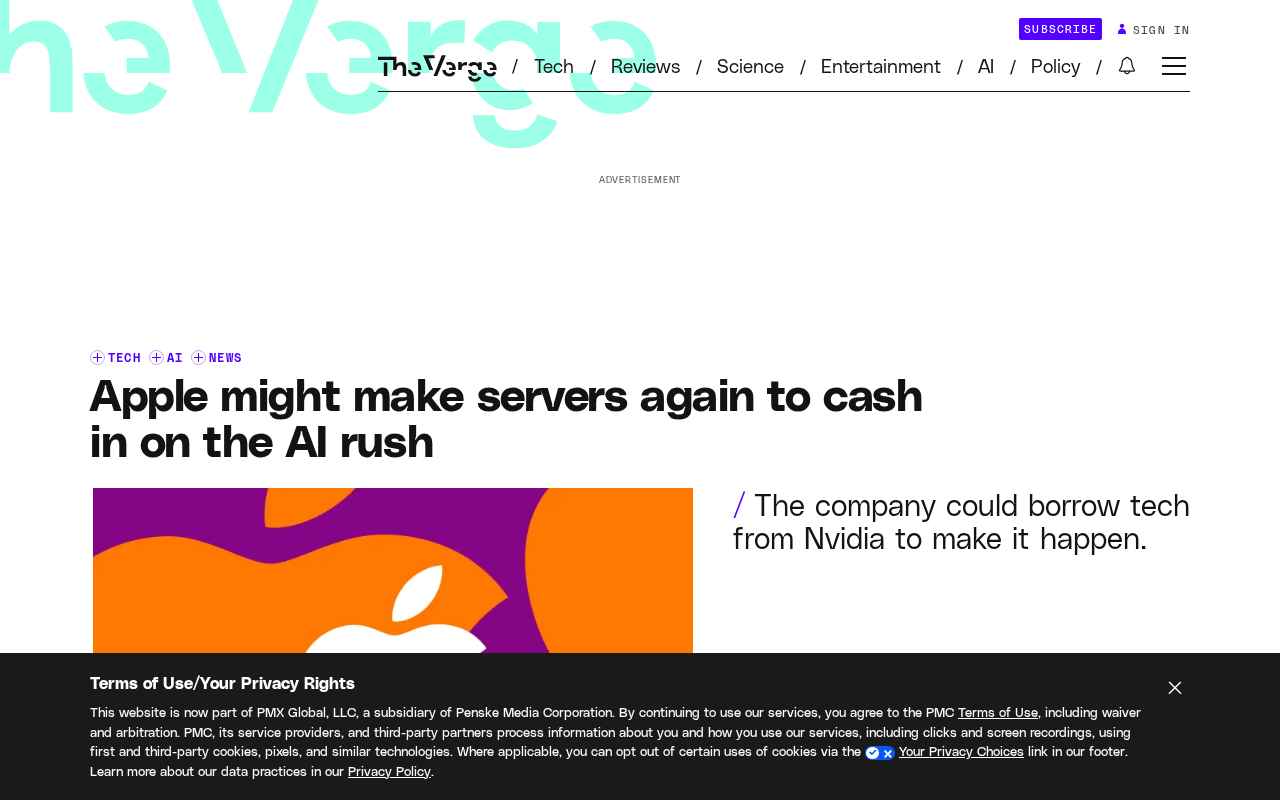
Apple may return to the server market after 14 years, potentially teaming up with NVIDIA to ride the AI computing wave.
According to The Information, Apple is planning to re-enter the server market and may partner with NVIDIA. Apple exited enterprise hardware when it discontinued the Xserve in 2011, and the driving force behind this potential return is the explosive demand for AI computing power. Apple Intelligence and other AI features require significant cloud-side computing, making in-house servers both a strategic asset and a possible new business. Notably, Apple and NVIDIA share a contentious GPU history — making any server-level partnership a sign that AI-era commercial interests can bridge long-standing divides. The news remains unconfirmed by Apple.
Apple Reboots Its Server Business After Years Away
According to tech outlet The Information, Apple is planning to re-enter the server space and may partner with NVIDIA to make it happen. If true, this would mark a significant return for Apple to the enterprise hardware market.
Apple discontinued its Xserve server product line back in 2011, leaving the enterprise machine market to specialists like Dell, HP, and Supermicro ever since. The company — best known for consumer electronics and personal computing devices — has stayed off the data center hardware track for years. Now, that appears to be changing.
The Xserve was a 1U rack-mounted server line Apple launched in 2002, powered by PowerPC or Intel processors and aimed primarily at creative professionals (such as film and TV production, research institutions) and the education market. At its peak, the Xserve was quite competitive in certain niches thanks to macOS Server and deep integration with Apple software like Final Cut Server. However, limited overall market share, a weak enterprise sales infrastructure, and a lack of scale compared to dedicated server vendors like Dell and HP led Apple to officially discontinue the Xserve in January 2011 — suggesting users switch to Mac Pro or Mac mini paired with third-party server solutions. It remains one of the rare cases where Apple voluntarily exited an entire hardware category.
The AI Computing Boom as a Catalyst for Return
The core force driving Apple to reconsider the server business is the explosive demand for computing power fueled by the AI industry's continued expansion. As the computational needs of large model training and inference keep climbing, server and data center hardware has become one of the hottest segments across the entire tech sector.
For Apple, this represents both an external market opportunity and a strategic priority. Apple has been aggressively pushing AI features like Apple Intelligence in recent years, and that requires substantial server-side computing power. Previous reports have noted that Apple has been exploring the possibility of building servers based on its custom chips to handle AI workloads. Developing in-house server capabilities could serve internal needs while potentially becoming a new line of business externally.
Apple Intelligence is an AI feature suite Apple unveiled at WWDC 2024, integrated into iOS 18, iPadOS 18, and macOS Sequoia. It covers writing assistance, image generation, enhanced Siri capabilities, and more. Unlike other major tech companies' AI services, Apple Intelligence emphasizes a "Private Cloud Compute" architecture — user data is processed on-device first, and only sent to Apple's own cloud servers when necessary, with Apple claiming that no user data is retained on the server side. This architecture places significant demands on Apple's own server infrastructure: it needs powerful AI inference capabilities while also meeting strict privacy compliance standards at both the hardware and software levels. This is one of the key internal motivations behind Apple building out its own server capabilities.
The Strategic Significance of a Potential NVIDIA Partnership
Another key detail in the report is that Apple may partner with NVIDIA — a noteworthy point, given that Apple has long followed a path of vertical integration and custom silicon, while NVIDIA is the undisputed leader in AI computing, with its GPUs serving as the de facto standard for large model training.
The two companies have a fraught history in the GPU space. Apple long since moved to its own graphics solutions across its product lineup. If the two sides can genuinely join forces in the server space, it signals that commercial interests in the enormous AI computing market are now outweighing past grievances. This kind of partnership also reflects the reality that even a company as committed to in-house development as Apple may find it difficult to entirely sidestep NVIDIA's ecosystem when it comes to the complex demands of AI infrastructure.
The history between Apple and NVIDIA traces back to around 2008. At the time, MacBooks and Mac Pros relied heavily on NVIDIA GPUs, but a widespread hardware defect in NVIDIA's chipsets caused GPU failures across a large number of Apple laptops, saddling Apple with enormous repair costs and souring the relationship dramatically. Apple subsequently shifted its laptop lineup toward AMD and Intel integrated graphics, before ultimately leaving third-party discrete GPUs behind entirely with the in-house Apple Silicon (M-series chips with integrated GPUs). NVIDIA CEO Jensen Huang has publicly referred to Apple as a customer NVIDIA "lost." Against that backdrop, any server-level collaboration between the two companies would represent their most substantive business overlap in over a decade.
A Future Still Waiting to Be Written
It's worth noting that all of this information remains at the reporting and planning stage — Apple has not officially confirmed any of these moves. The server business differs significantly from the consumer products Apple excels at, in terms of channels, customers, and operational models, so re-entering this market is far from straightforward for the company.
That said, the AI wave is genuinely reshaping the business boundaries of many tech giants. From Google and Amazon to Microsoft, cloud and computing infrastructure has become a core battleground. Whether Apple chooses to reposition itself in the server space in some form — whether to serve its internal AI strategy or to break into the external market — is something the industry will continue to watch closely. Whether this potential move ultimately materializes, and what product form it might take, remains to be seen.
Related articles

The Siberian Ice Maiden and the Archaeological Mysteries of the Scythian World
The Siberian Ice Maiden is a Scythian female mummy from the Ukok Plateau. Her tattoos, silk garments, and grave goods reveal ancient nomadic art, social hierarchy, and cross-regional trade — alongside ongoing repatriation controversies.
SQL Row Pattern Matching: Implementing "Row-Level Regex" with MATCH_RECOGNIZE
MATCH_RECOGNIZE gives SQL regex-like power over row sequences. Detect brute-force attacks, fraud patterns, and user behavior flows with clean, declarative syntax — no more messy self-joins.
Hackers Break Into Flock Surveillance Cameras, Exposing the Inner Workings of License Plate Recognition Systems
Hackers breached Flock Safety's ALPR cameras, exposing how license plate recognition systems collect data and the privacy and security risks they pose.