Apple Releases 14-Inch MacBook Pro: M6 Chip, 24-Hour Battery Life
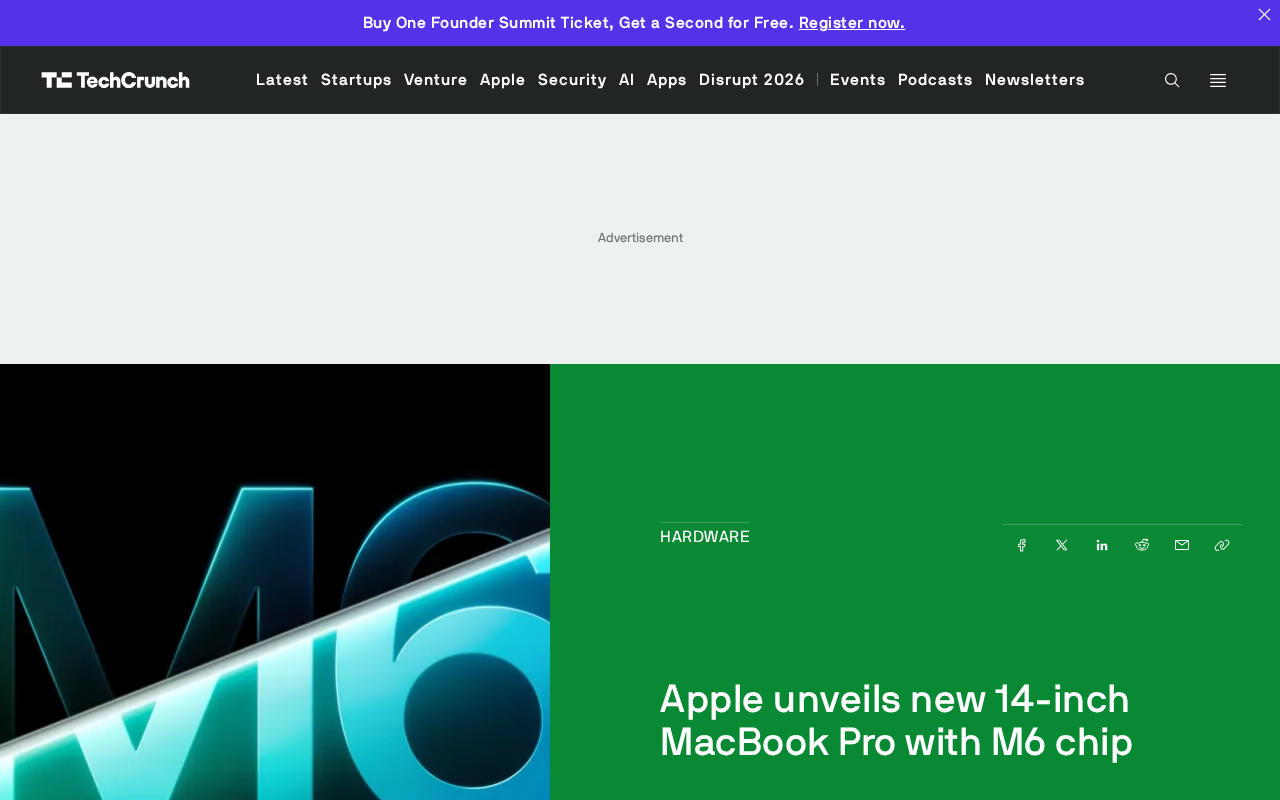
Apple's 14-inch MacBook Pro gets the M6 chip, 24-hour battery life, and support for Wi-Fi 7 and Bluetooth 6.
Apple has quietly updated the 14-inch MacBook Pro. The core change is the next-generation M6 chip, which extends battery life to 24 hours and adds Wi-Fi 7 and Bluetooth 6 support. The article notes that the M6 continues Apple's custom silicon iteration logic of "stronger performance at the same power draw and longer battery life," and is more of a steady upgrade than an architectural revolution; specific core counts and process node have not been disclosed. Wi-Fi 7 and Bluetooth 6 fill gaps in wireless specs, delivering real improvements for high-density office environments and wireless peripheral experiences. Overall, this update centers on efficiency and connectivity, making it suitable for heavy mobile workers on older machines to upgrade, while recent buyers need not rush; actual performance still awaits third-party review verification.
Apple has quietly updated its 14-inch MacBook Pro lineup. The core change is the introduction of the next-generation M6 chip, along with battery life extended to 24 hours and added support for Wi-Fi 7 and Bluetooth 6 connectivity. For professional users and mobile workers, this is a pragmatic upgrade centered on power efficiency and connectivity.
M6 Chip: An Iteration Logic That Prioritizes Efficiency
From M1 to M6, the evolution path of Apple's custom silicon has become quite clear: each generation delivers stronger CPU and GPU performance at the same power draw while pushing battery life to new heights. The M6 continues this strategy—official figures show the new machine reaches 24 hours of battery life, a notable improvement over the previous generation. This means that for long stretches of working on the go, video editing, or programming, the charger will feel even less necessary.
A quick note: Apple has not disclosed the M6's specific core counts, process node, or performance gains this time. Judging by product positioning, the M6 is more likely a steady iteration than an architectural revolution. For users who already own M3 or M4 machines, there is limited reason to upgrade purely for the chip; but for those still on Intel models or M1 devices, the appeal of 24-hour battery life and connectivity upgrades is quite direct.
Apple's custom chips use a Unified Memory Architecture, in which the CPU, GPU, and neural engine share a single high-bandwidth memory pool. Data does not need to be copied between multiple memory regions, which both reduces power consumption and makes memory access more efficient for tasks such as video editing and compiling large projects. M-series chips also use an SoC package design that integrates memory and the processor on the same substrate, shortening signal transmission distances—one of the physical foundations for maintaining high performance at lower power. Understanding this helps clarify that the M6's "efficiency-first" approach is not simply about stacking specs, but about continuous optimization at the architectural level.
Wi-Fi 7 and Bluetooth 6: Filling the Connectivity Gaps
The new MacBook Pro supports Wi-Fi 7 and Bluetooth 6, which is an easily underestimated part of this update. Wi-Fi 7 can provide more stable throughput in high-density, multi-device environments, which is especially practical for users who often work in offices, cafés, or at conference venues. Bluetooth 6 brings lower latency and more precise positioning capabilities, delivering tangible improvements for wireless peripherals and audio devices.
Keeping pace with connectivity standards shows that Apple is addressing the MacBook Pro's shortcomings one by one. In previous generations, the pace of updates to ports and wireless specs was often criticized as conservative; introducing two new standards at once this time counts as a direct response to the demands of professional users.
The core improvements of Wi-Fi 7 (IEEE 802.11be) include support for 320MHz channel bandwidth, 4096-QAM modulation, and Multi-Link Operation (MLO), the latter allowing devices to establish connections across the 2.4GHz, 5GHz, and 6GHz bands simultaneously, thereby reducing latency and improving throughput stability in high-density network environments. Bluetooth 6 introduces ranging based on Channel Sounding, enabling precise distance measurement from centimeter to meter level and further reducing connection latency. It is worth noting that fully realizing Wi-Fi 7 performance requires a router that supports the standard; with an older router, the device will automatically fall back to Wi-Fi 6 or earlier standards.
Who Should Consider Upgrading?
Based on the available information, the core selling points of this update are battery life and connectivity, not a leap in performance. Heavy mobile workers such as video creators, developers, and consultants will benefit most directly from the 24-hour battery life. Conversely, if your daily use is mainly at a fixed desk with easy access to power, the motivation to upgrade depends mainly on whether you need the Wi-Fi 7 router ecosystem.
Apple has not yet disclosed detailed specs or pricing for the M6. What is worth watching next is real-world performance testing and thermal behavior. Beyond official figures, third-party reviews will determine whether the M6 can deliver on its "efficiency-first" promise.
For users still on Intel-based Macs, the benefits of switching are not limited to battery life; they also include the native Apple Silicon application ecosystem, lower operating temperatures and fan noise, and increased Thunderbolt port bandwidth. For users who started with the M1, although day-to-day office experience differs little, the generational efficiency gap will gradually become apparent in heavy workloads such as long video exports and multi-track editing. To judge whether an upgrade is worthwhile, focus on whether the software you commonly use already has optimized versions for the new chip, and whether the battery health of your current device has noticeably declined.
Summary
The M6 update to the 14-inch MacBook Pro is a routine iteration centered on battery life and connectivity. It does not pursue showy spec sheet numbers, but instead nails the two experiences professional users feel most in daily use. For long-time users waiting to upgrade, this is a device worth considering; for those who recently bought a machine, there is no need to rush to follow suit.
Related articles

Cursor AI in Practice: Weighing Efficiency Gains Against Costs in an AI IDE
An in-depth look at Cursor AI IDE's interface layout, four modes (Agent/Plan/Debug/Ask), model selection, and Git context integration, with hands-on demos weighing subscription costs against going direct to Claude.

Free Landing Page Design Rules Library: A Practical Guide for Claude Code and Cursor
A free landing page design skill for Claude Code and Cursor: MIT licensed, nearly 9,000 stars, asks about offer/audience/action before planning 12 sections with hard font and spacing constraints.

Cursor Keeps Writing Wrong Code? The Problem May Be Context, Not Prompts
Cursor keeps writing wrong code? The problem may be context, not prompts. Learn how to supply relevant files, full error messages, and expected results, plus a plan-first, small-step, test-driven workflow to reduce AI coding errors—while remembering code review remains the developer's job.