Apple Releases M6 14-inch MacBook Pro: In-House Silicon Advances Again

Apple releases the M6 14-inch MacBook Pro as HN debates local compute and generational upgrade value.
Apple's Newsroom announced a 14-inch MacBook Pro with the M6 chip, quickly gaining 283 points and 354 comments on Hacker News—showing strong developer interest in Apple's silicon cadence. The M6 continues the M-series evolution, likely focusing on CPU/GPU architecture, efficiency, and unified memory bandwidth. For local-compute workflows like video editing, 3D rendering, and local LLM inference, the generational change matters; HN focuses on low-level details such as memory bandwidth, Neural Engine specs, and toolchain support. The author advises older-device users to consider upgrading, while those on recent generations should wait for third-party benchmarks.
Apple Quietly Lists M6 MacBook Pro
Apple's Newsroom announced the launch of a 14-inch MacBook Pro powered by the M6 chip. The link quickly sparked discussion on Hacker News, accumulating 283 points and 354 comments in a short time—clear evidence of how closely the developer community follows Apple's in-house silicon iterations.
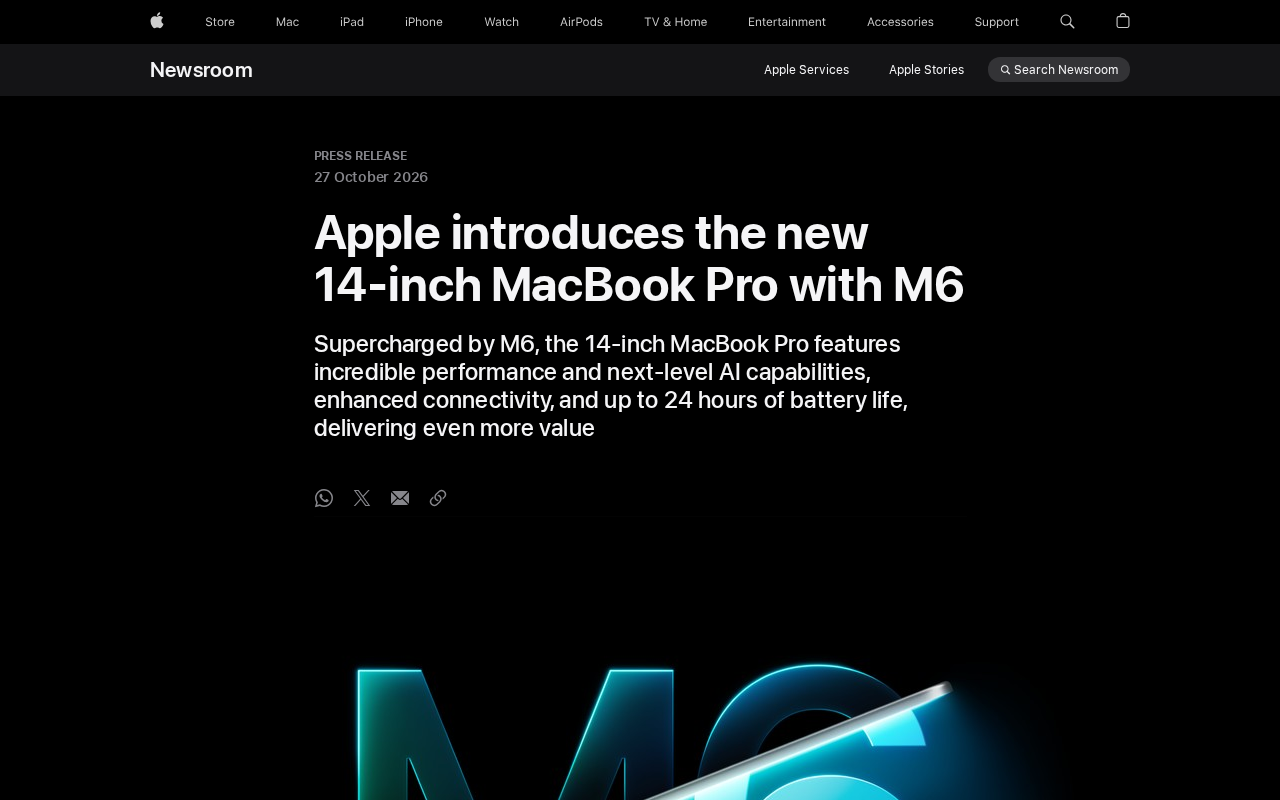
From a product cadence perspective, the M6 succeeds the previous M-series chips and represents a routine move in Apple's ongoing effort to compress chip refresh cycles. The 14-inch MacBook Pro has long been Apple's mainstream professional laptop, and jumping directly to the M6 name suggests Apple is not slowing its in-house chip roadmap.
What the Generational Leap Means
The arrival of the M6 shows that Apple's in-house silicon has now passed through multiple full generations. Each M-series upgrade typically focuses on CPU/GPU core architecture, power efficiency, and unified memory bandwidth, and the M6 most likely continues that direction.
For ordinary users, the generational number change may not bring dramatic differences in day-to-day experience, but for professional workflows that depend on local compute—video editing, 3D rendering, local LLM inference—a chip generation change still matters. The high engagement in the HN comments also reflects developers' expectations for improved local AI compute.
Unified Memory Architecture is one of the core designs of Apple's M-series chips: the CPU, GPU, and Neural Engine share a single high-bandwidth memory pool, so data does not need to be copied back and forth between dedicated VRAM and system memory, reducing latency and improving energy efficiency. For local LLM inference, the capacity of unified memory directly determines how large a parameter model can be loaded, while bandwidth affects inference speed; for video editing and 3D rendering, high bandwidth can likewise significantly shorten asset read/write and frame buffer exchange times. Therefore, when the M6 generation arrives, one of the most noteworthy specs is precisely the bandwidth and maximum capacity ceiling of unified memory.
Community Reaction and Discussion Focus
With 354 HN comments, the discussion is clearly lively. Typical topics under posts like this include the actual performance gap between the new chip and the previous generation, whether the thermal design can keep up, and whether the price is reasonable. Since the original material only provides a link and engagement data, specific performance specs and pricing should be verified on Apple's official page.
Interestingly, HN community discussions about Apple hardware tend to focus more on low-level details than ordinary consumers do—for example, memory bandwidth, Neural Engine specifications, and support in the compilation toolchain. These discussions are valuable for judging whether the M6 is worth upgrading to.
The Neural Engine is a dedicated acceleration unit in Apple's SoC for machine learning workloads, handling inference tasks under the Core ML framework across scenarios such as image recognition, speech processing, and real-time video analysis. Unlike the GPU's general-purpose parallel computing, it uses a more specialized dataflow architecture that can deliver higher inference throughput at the same power consumption. When discussing the M6, paying attention to Neural Engine specs is essentially about judging the efficiency limits of running local AI models—the Neural Engine's compute, accessible memory, and the maturity of software stack support (Core ML, Metal Performance Shaders) together determine whether developers can effectively offload inference workloads to this dedicated unit.
Buying Advice
If your current device still uses an earlier M-series chip and your daily work involves heavy local compute tasks, the M6 14-inch MacBook Pro is worth considering. If your device is from the last one or two generations, the marginal benefit of upgrading may be limited, and it is advisable to wait for third-party benchmark data before deciding.
For developers, paying attention to how the new chip performs in compile speed, containerized workloads, and local inference is more meaningful than focusing on paper specs.
Marginal benefit, in the context of hardware upgrades, refers to the incremental performance gain a new-generation device brings relative to your existing device. When a device is already within the last one or two generations, a chip generation change often manifests only as minor architectural tweaks and frequency increases, with absolute gains possibly in the range of ten-plus to a few dozen percent, while the thermal enclosure, display, ports, and other peripheral configurations remain basically unchanged—so the perceived difference in real use is limited. Conversely, upgrading from a model several generations old yields multiple stacked benefits across architecture, process node, and energy efficiency. To judge whether an upgrade is worthwhile, weigh marginal benefit together with the cost of switching, resale value, and third-party sustained-load performance measurements—rather than looking only at peak benchmark scores.
Related articles
AWS AgentCore Gateway: Connecting AI A…
AWS AgentCore Gateway: Connecting AI Agents to Enterprise Backends with MCP
How AWS AgentCore Gateway acts as a primary MCP server to aggregate REST APIs, Lambda, and existing MCP services? Analyzing its AST real-time mapping, zero cold start, semantic search for tool overload, session isolation, and key injection security design, plus the architectural approach to decoupling enterprise AI agents from backends.

One Link Gives Figma AI a New Skill: Hands-On with MCP Connectors
Paste one MCP server link and the AI Agent in Figma gains new tool capabilities. We break down the setup flow, 20+ one-click apps, read/write permissions and execution policies, and the public HTTPS requirement.

Cognition SWE-2 in Practice: One Prompt to Handle the Whole Product Launch Process
Analyzing a YouTube creator's prompt for using Cognition SWE-2 to launch a product: a landing page, seven-email sequence, and non-buyer follow-up tool, plus how the 'test and report' constraint changes AI delivery quality.