Apple Sues OpenAI for Trade Secret Theft: AI Hardware Competition Reaches a Boiling Point

Apple sues OpenAI and two ex-employees for allegedly stealing core trade secrets including hardware designs and supply chain data.
Apple has officially filed suit against OpenAI and two former Apple employees — including OpenAI's Chief Hardware Officer Tang Tan — alleging coordinated theft of trade secrets covering product design, manufacturing, and supply chain strategy. Key allegations include emailing supplier data to personal accounts, using job interviews to obtain prototypes, and accessing Apple's internal network after resignation. The case unfolds against a backdrop of intensifying AI hardware rivalry, even as Apple and OpenAI remain partners through the Apple Intelligence and ChatGPT integration.
Apple Files Suit Against OpenAI
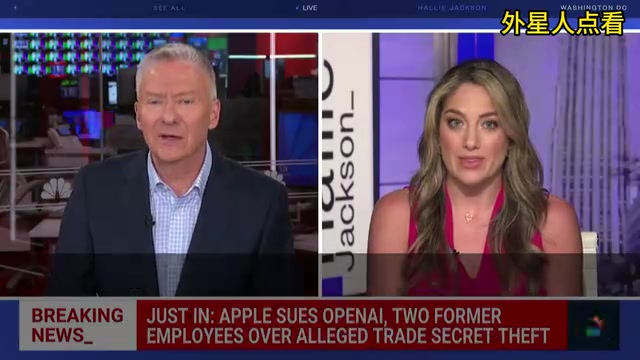
According to NBC News, Apple has officially sued OpenAI and two former Apple employees, alleging that all three parties conspired to steal Apple's trade secrets. The complaint states that the stolen secrets include core information related to product design, manufacturing processes, and supply chain strategy.
In a statement, Apple said it will always defend its team's innovations and take every necessary measure to protect them. As of the time of reporting, OpenAI had not responded.
The lawsuit is widely seen as a reflection of the accelerating competition in the AI industry. As the AI wave continues to surge, the rapid movement of talent and technology between major players is making the boundaries of trade secrets increasingly blurry.
Legal Background: Trade secret protection in the United States is primarily governed by the Defend Trade Secrets Act (DTSA), enacted in 2016 — the first federal-level trade secret protection law in the U.S. The DTSA allows trade secret owners to file civil suits in federal court and apply for emergency injunctions to prevent further disclosure. For information to qualify as a trade secret, two core conditions must be met: first, the information must have independent economic value and not be publicly known; second, the owner must have taken reasonable measures to keep it confidential. The supplier information, prototype designs, and unreleased product data cited in Apple's complaint all fall squarely within the categories of protected trade secrets.
Key Details Revealed in the Complaint
The lawsuit targets two former Apple employees now working at OpenAI, including OpenAI's Chief Hardware Officer Tang Tan. The allegations are specific and striking.
Emailing Supplier Information to Himself
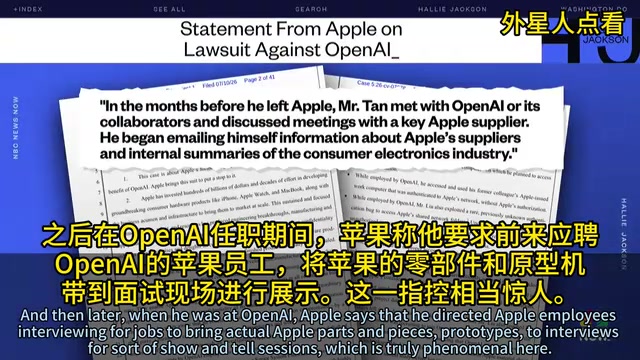
Apple alleges that before leaving the company, Tang Tan emailed himself information about Apple's suppliers. In trade secret disputes, this type of action is often the most direct starting point for establishing a chain of evidence — email server logs record the send time, recipient address, and attachment contents in full, creating digital evidence that is hard to refute.
Job Interviews Turned Into "Prototype Show-and-Tell"
Even more dramatic: Apple claims that after Tang Tan joined OpenAI, he instructed Apple employees who came in to interview to bring actual components and prototypes for a so-called "show and tell" session. If the allegations are true, it means the hiring process was used as a channel to obtain physical samples from a competitor. This technique is known in the industry as "competitive intelligence gathering" — once physical prototypes are involved, it can trigger dual charges of evidence theft and trade secret misappropriation.
"LOL, I Can Still Access the Network Storage"
The complaint includes a particularly striking direct quote: after leaving Apple, a former employee discovered they could still access Apple's network storage and wrote, "LOL, I found out I can access the network storage. So funny." Apple alleges that this individual then downloaded dozens of confidential hardware files, including information about unreleased products. This episode also exposes a vulnerability in the company's employee offboarding process — specifically, the failure to revoke access permissions — a problem that is not uncommon in organizations where Zero Trust Architecture has yet to be fully implemented.
Coaching Someone on How to Evade Security Review
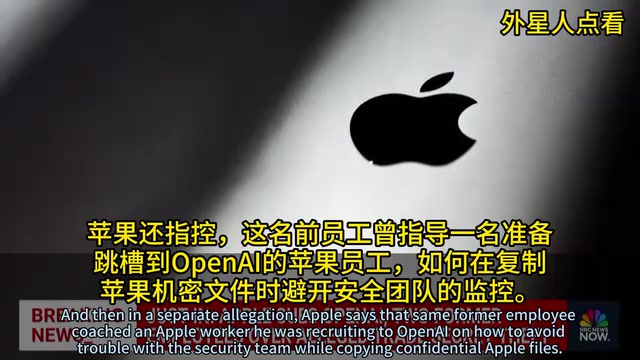
Apple further alleges that the same former employee, while recruiting another Apple employee to join OpenAI, coached that person on how to copy confidential files without triggering a review by the security team. Taken together, these allegations paint the picture of what Apple describes as an "organized theft" scheme.
The Backdrop: A Head-On Clash Over AI Hardware
The deeper context of this lawsuit is the increasingly fierce competition between Apple and OpenAI in the AI consumer products space.
In recent years, OpenAI has been steadily expanding into hardware, seeking more direct access to consumers. Its most high-profile move was the acquisition of io, a hardware company co-founded by former Apple Chief Design Officer Jony Ive. Ive spent over 27 years at Apple, leading the design of landmark products such as the iMac G3, iPod, iPhone, and MacBook Air — widely regarded as one of the founding figures of modern consumer electronics design aesthetics. In 2019, he left Apple as Chief Design Officer to establish the independent design firm LoveFrom, later co-founding io, a company focused on AI hardware. OpenAI's acquisition of io for approximately $6.5 billion is its largest acquisition to date, widely interpreted by the industry as a strategic signal of its transition from a pure software/model company toward an on-device hardware ecosystem — a path that directly mirrors Apple's successful model of deep software-hardware integration, and a key catalyst for the escalating tensions behind this trade secret lawsuit.
Also worth noting: OpenAI has confidentially filed for an IPO, meaning any legal dispute or reputational risk could impact its valuation and listing process, making the stakes of this case exceptionally high.
For Apple, it has at times been perceived as slow to respond to the AI wave and playing catch-up. As competitors like OpenAI push forward rapidly, protecting its competitive edge in hardware R&D and supply chain has become an urgent priority.

A Delicate Balance: Cooperation and Competition at Once
What makes this particularly intriguing is that Apple and OpenAI are still partners — ChatGPT has been integrated into Apple's systems through Apple Intelligence, and Apple has made clear that this lawsuit does not involve that partnership agreement.
Apple Intelligence is the system-level AI feature suite Apple unveiled at WWDC 2024, deeply integrated into iOS 18, iPadOS 18, and macOS Sequoia. As part of this, Apple reached an agreement with OpenAI allowing users to seamlessly hand off complex requests to ChatGPT when Siri cannot handle them — with a strong emphasis on privacy protection, as users receive a clear prompt before any data is transferred. This partnership has been seen as a key component of Apple's "AI catch-up strategy": leveraging external large model capabilities to compensate for gaps in its own in-house models, while using the scale of its hardware ecosystem to maintain platform control.
This situation — suing on one hand while partnering on the other — is a vivid reflection of the deeply intertwined dynamics between today's AI giants: they are tightly bound and mutually dependent at some levels, while going head-to-head in fierce competition on other fronts. The tech industry has a specific term for this: "coopetition" — a portmanteau of cooperation and competition — a pattern long seen in semiconductors and cloud computing, but now playing out in even more extreme form in the AI era.
Will Apple Suffer the Same Fate as Musk?
This case inevitably draws comparisons to Elon Musk's previous lawsuit against OpenAI and Sam Altman. Musk alleged that Altman had "stolen" the company — with the core claim being that OpenAI had betrayed its founding mission of benefiting humanity as a nonprofit — but the lawsuit ran into trouble over statute of limitations issues.
The statute of limitations is a critical procedural hurdle in trade secret cases: the plaintiff must file suit within a specified period after discovering (or reasonably should have discovered) the infringing conduct — typically three years under California law — or forfeit the right to sue. A judge determined that some of Musk's claims had already exceeded this window.
Apple's case has an advantage in that some of the alleged conduct — such as accessing the internal network and downloading files after leaving the company — occurred relatively recently, making it easier to satisfy the timeliness requirement. Moreover, the evidence takes the form of digital logs, email records, and communication screenshots, which are far more amenable to proof. This stands in fundamental contrast to Musk's case, which centered on corporate governance and promises — relying heavily on subjective interpretation of the founders' original intent — while Apple's allegations point to specific, traceable data transfer activities.
The ultimate outcome will depend on the court's assessment of the chain of evidence, the statute of limitations, and each party's liability. But it is foreseeable that as AI talent accelerates its movement between leading companies, trade secret disputes may become the norm in the industry. This lawsuit may be just the beginning.
Key Takeaways
Related articles

Liang Wenfeng's Three Big Bets: Why Did DeepSeek Open-Source Its 82% Gross Margin?
Why did DeepSeek open-source DeepInfer, its 82% gross margin inference framework, and then launch a hundred-billion funding round? An analysis of Liang Wenfeng's three big bets and the open-source strategy.

Restoring 169 Episodes of a Classic TV Show with AI Super-Resolution: A 95-Hour Home PC Diary
A Bilibili creator used an RTX 3070 Ti home desktop and open-source AI super-resolution tools to restore 169 episodes of Growing Pains from DVD quality over 95 hours, costing only 20 yuan in electricity. The diary reveals real pitfalls in deinterlacing, model selection, and fully automated pipelines, plus lessons in AI collaboration.

Open-Source Desktop Pet of Murasame with 503 Voice Lines: Customizable and Cries 'Goshujin-sama' on Click
Bilibili developer turns Murasame from *Senren * Banka* into an open-source desktop pet with 503 TTS voice lines, click to hear "Goshujin-sama," supporting sequential/random/repeat modes, voice library management, and custom characters.