Apple TV 4K In-Depth Review: Four Years of Waiting, and the Gap Between Hopes and Reality for Home Theater Enthusiasts

After four years of waiting, the new Apple TV 4K is still excellent but fails to address enthusiasts' core demands.
This article reviews the new Apple TV 4K after a four-year gap from a home theater enthusiast's perspective. The author praises its tvOS smoothness, App ecosystem, HDR10+/Dolby Vision support, and ad-free experience, considering it still the benchmark for streaming boxes. However, the focus is on "unfulfilled expectations": audio passthrough is still missing so home theater users can't pass the original bitstream to their receiver; the lack of 4K/120Hz makes gaming positioning awkward; and improvements to remote locator and smart home integration are limited. The conclusion is that this device suits users seeking stability, no ads, and deep Apple ecosystem integration, but struggles to satisfy home theater players and high-refresh-rate gamers' expectations for a qualitative leap—more a mild upgrade than a breakthrough.
As a home theater enthusiast, I had been waiting a full four years for the new Apple TV 4K. But after getting my hands on it, my feelings were mixed—it's a good enough streaming box, but not the "dream device" I had in mind.
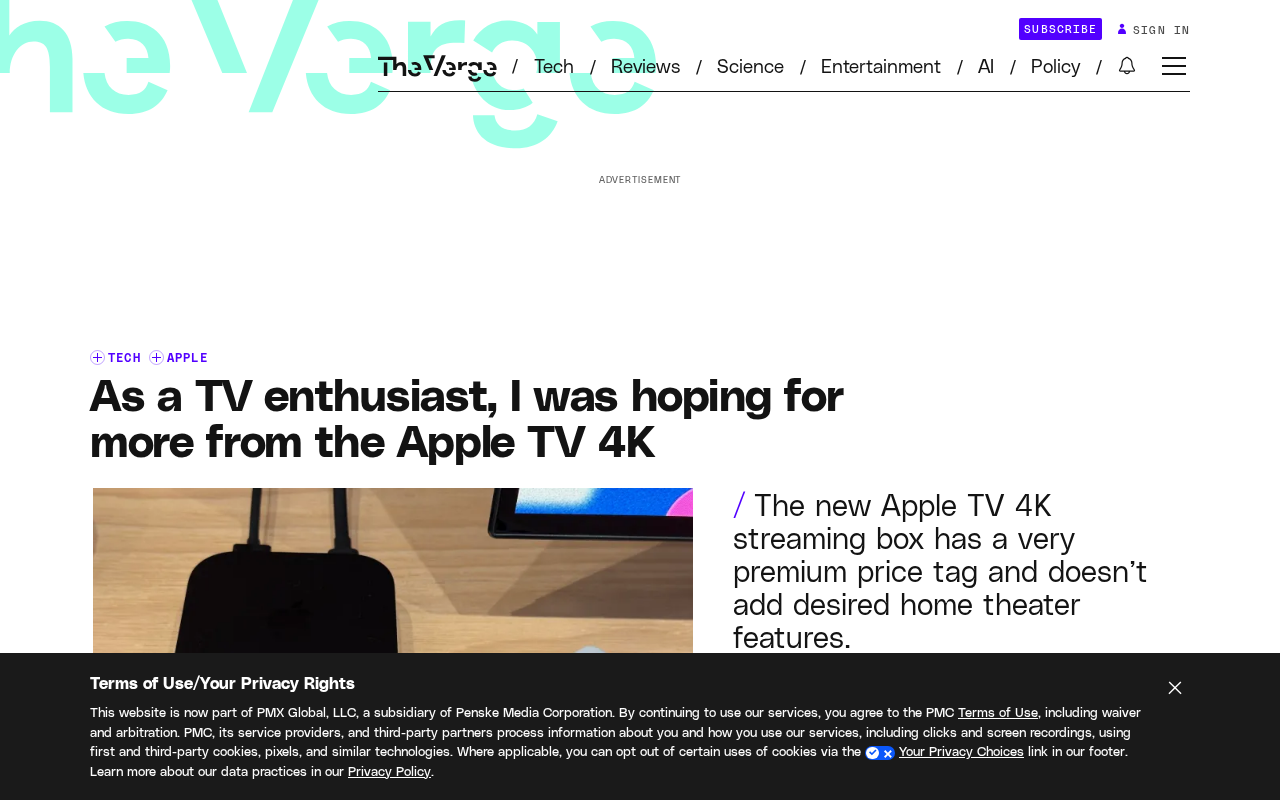
Four Years of Waiting—What Was Expected
It's been four years since the last Apple TV 4K was released. During that time, the streaming ecosystem has changed dramatically: 4K HDR content has become standard, demand for high-refresh-rate gaming has risen, and smart home protocols have gradually unified. As a long-time user, I've been waiting for Apple to deliver a more aggressive answer.
My expectations were specific:
- A more powerful chip: to support smoother gaming and more complex on-device processing
- 4K/120Hz support: so high-frame-rate content is no longer limited
- Audio passthrough: letting the AV receiver handle decoding, rather than the box doing a second round of processing
- Remote locator feature: an end to the daily routine of "digging for the remote in the couch cushions"
- Better home control integration: making Apple TV a true smart home hub
These expectations weren't unfounded—they were the most frequently discussed and most requested features in the community over the past few years.
What It Got Right
It must be admitted that the Apple TV 4K itself is an excellent device. tvOS's smoothness, the completeness of the App ecosystem, and seamless integration with iPhone and AirPods remain the benchmark among similar products.
In terms of image quality, its support for HDR10+ and Dolby Vision is stable and reliable; at the system level, there's no ad harassment, no bloated recommendation feeds—this kind of "cleanliness" is almost extinct in today's TV boxes. For users who just want to quietly watch streaming content, it remains the top choice.
The problem is that these advantages were already largely present four years ago.
The Expectations That Weren't Fulfilled
Audio passthrough is still missing
For home theater users, this is the most painful point. Apple TV 4K still decodes and re-outputs audio, rather than passing the original bitstream through to the AV receiver. For users pursuing lossless audio tracks and wanting the receiver to handle decoding, this means an unnecessary processing step in the audio chain.
Audio passthrough refers to a playback device not decoding or re-encoding the audio bitstream, but instead passing the original bitstream of Dolby Atmos, DTS:X, TrueHD, etc. directly to an AV receiver or soundbar, letting the latter handle decoding and rendering. Its value lies in three points: first, avoiding audio quality loss from secondary processing on the box side; second, allowing the receiver to recognize and light up native formats like Atmos and DTS:X; third, reducing the risk of audio-video desync. Apple TV has long adopted a "decode first, then output as PCM" approach, which, while ensuring compatibility, prevents home theater users pursuing lossless audio from fully handing decoding authority to the receiver—this is exactly what enthusiasts have been most hung up on for years.
High refresh rate and ambiguous gaming positioning
The lack of 4K/120Hz makes it awkward in gaming scenarios. Although Apple has been pushing Apple Arcade, the hardware specs haven't kept up with the "living room console" narrative. For users connecting to high-refresh-rate TVs, this shortcoming is quite obvious.
4K/120Hz refers to refreshing at 120 frames per second at 3840×2160 resolution, typically requiring an HDMI 2.1 interface and sufficient bandwidth (about 48Gbps) to carry. It matters significantly for two types of scenarios: first, when connected to a 120Hz high-refresh-rate TV or monitor, system animations, cursor movement, and sports events are smoother; second, combined with Variable Refresh Rate (VRR) and Auto Low Latency Mode (ALLM), console or cloud gaming images no longer tear and have lower latency. If Apple TV lacks 4K/120Hz output, even if Apple Arcade content itself has limited frame rates, it will be at a spec disadvantage in the "living room console" narrative, creating a generational gap with PS5, Xbox Series X, and other consoles.
Remote and home integration
The remote locator feature did not appear, and improvements to home control integration were relatively modest. With the Matter protocol gradually becoming widespread, users had originally expected Apple TV to play a deeper role as a smart home hub.
Matter is a unified smart home protocol led by the Connectivity Standards Alliance (CSA), aiming to enable lights, locks, sensors, and plugs from different brands to interconnect across platforms like Apple Home, Google Home, and Amazon Alexa. It's built on IP networking and uses Thread as a low-power mesh network transport layer. For Apple TV, the significance of Matter is that it naturally has the conditions for always-on power, always-on networking, and Thread Border Router capability, theoretically allowing it to become a hub node for home automation. Users therefore expected Apple TV to be not just a "streaming box," but core hardware capable of coordinating Matter devices and hosting Thread networks.
Who Is It Really For
If you just want a stable, ad-free streaming box that seamlessly works with the Apple ecosystem, Apple TV 4K remains a hard-to-replace choice. Its experience floor is very high, and daily use almost never runs into problems.
But if you're a home theater player, a high-refresh-rate gamer, or someone hoping it will serve as the core of a smart home, then these four years of waiting may have yielded only a mild upgrade rather than a qualitative leap.
Enthusiast here doesn't refer to ordinary heavy users, but to a group of people with clear requirements for audio-video specs, interface bandwidth, and decoding chains: they typically have TVs supporting Dolby Vision/Atmos, standalone AV receivers, multi-channel speakers, and even calibration instruments; they pay attention to parameters like HDMI 2.1, eARC, and 4:4:4 chroma sampling. For them, "works" and "meets standards" are two different things, and a device's shortcomings get magnified under scrutiny. This is also why the author of this article, while acknowledging Apple TV's daily experience, still feels regret over its unfulfilled spec promises—the two types of users have inherently different definitions of a "good device."
An Enthusiast's Regret
Four years is enough time for competitors to continuously iterate on audio passthrough, high refresh rates, and peripheral expansion. Apple TV 4K has held onto the basics of the experience, but hasn't responded to core users' most urgent demands.
As a TV enthusiast, I understand Apple's product logic of pursuing a "mass experience," but I also have to admit: this time, it's more like making a good box even better, rather than creating an exciting new device.
One-line Summary
After four years of waiting, the new Apple TV 4K is still excellent, but hasn't addressed enthusiasts' core demands.
Paragraph Summary
This article examines the new Apple TV 4K released after a four-year gap from the perspective of a home theater enthusiast. The author affirms its advantages in tvOS smoothness, App ecosystem, HDR10+/Dolby Vision support, and ad-free experience, considering it still the benchmark for streaming boxes. But the article focuses on "unfulfilled expectations": audio passthrough is still missing, so home theater users can't hand the original bitstream to their receiver; the lack of 4K/120Hz makes its gaming positioning awkward; and improvements to the remote locator and smart home integration are limited. The final conclusion is that this device suits users seeking stability, no ads, and deep integration with the Apple ecosystem, but struggles to satisfy home theater players and high-refresh-rate gamers' expectations for a qualitative leap—it's more a mild upgrade than a breakthrough.
Related articles

AI Writes Code, Will Programmers Lose Their Jobs? The Truth About Devin's Autonomous Programming
Devin and other autonomous AI coding agents are changing software development: from Copilot-assisted coding to fully automated engineering agents, the programmer's role shifts from writing code to system design and oversight. This article analyzes the impact of AI programming on employment, code security, and junior developer training, as well as the real direction of programmer demand under the efficiency paradox.

Citigroup's 14,000 Engineers Use Devin, Slashing Tech Outsourcing Bill by 30%
Citigroup's 14,000 engineers used AI coding agent Devin to cut its tech vendor bill by 30% and speed releases 30-40%, while JPMorgan says AI gains aren't in earnings yet.

AGENTS.md in Practice: Making Coding Agents Actually Work
AGENTS.md and CLAUDE.md can boost coding agent performance, but research shows misuse raises costs 20%. Here's what to write, what to delete, the 200-line and 32KB limits, monorepo nesting rules, and a security warning.