Apple Watch's Offline Reading Gem: Watch Reader Lets Books and Articles Speak

Watch Reader brings AI speech synthesis to Apple Watch for offline listening to books and news.
Watch Reader is an Apple Watch app debuting on Product Hunt, centered on on-device offline speech synthesis: after adding books, articles, or web pages on iPhone, the watch can read content locally without the phone or network. It offers 25 voices, morning news, free classics, and 30 minutes of permanently free listening per day. It targets runners, commuters, and users reducing screen time, though offline TTS may compromise audio quality and the paid plan is undisclosed.
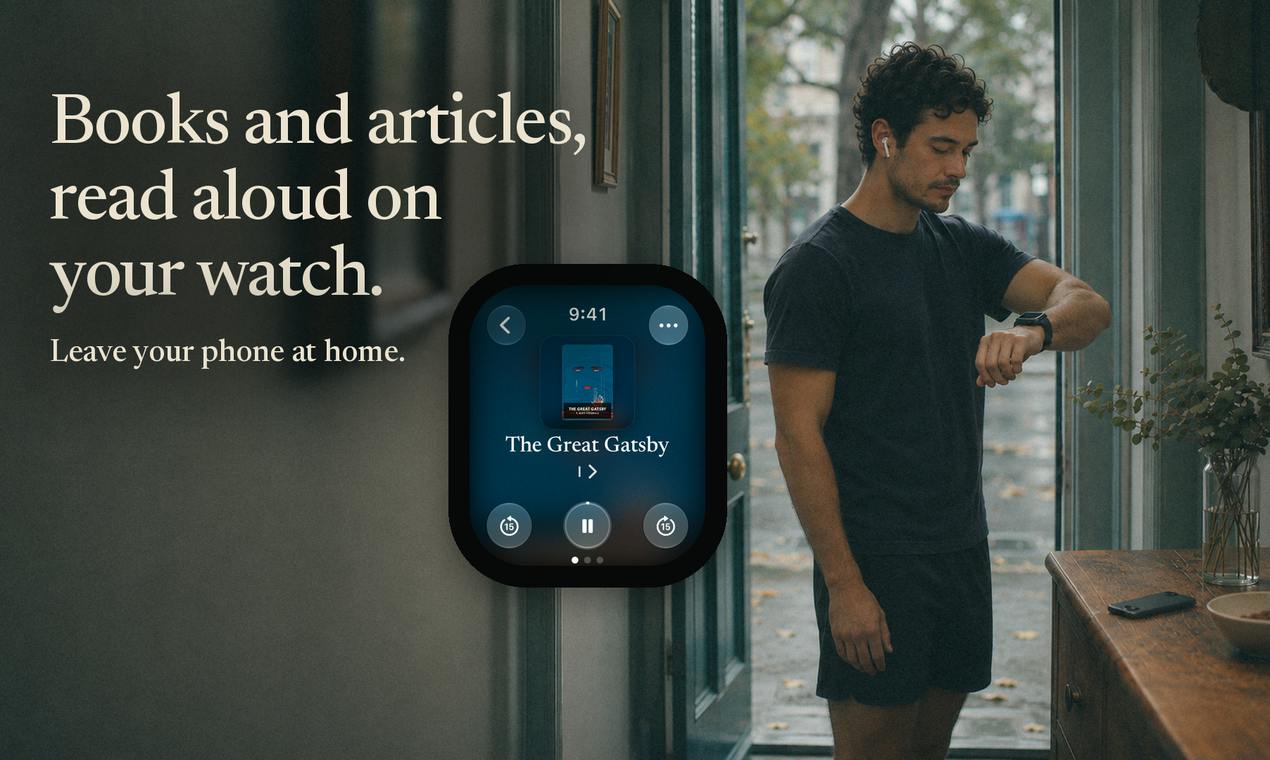
Reading on a smartwatch isn't new, but having the watch itself read an entire book aloud offline is something else entirely. A new app called Watch Reader recently appeared on Product Hunt, bringing AI speech synthesis directly to the Apple Watch—so when you head out for a run or to buy groceries, you can simply raise your wrist to listen to books, articles, or even morning news.
Core Feature: Offline Reading on the Watch
Watch Reader is straightforward to use: add books, articles, or web pages on your iPhone, then leave the phone at home. The app's built-in AI speech engine runs locally on the Apple Watch, so it can read content without a network connection. This means reading won't be interrupted in subway tunnels, on planes, or in signal dead zones.
According to the Product Hunt page, the app offers 25 voices and supports morning news and free classic literature. After a free download, you get 30 minutes of free listening per day, permanently. For users who want to make use of fragmented time during their commute to "read," this design is quite user-friendly.
On-device TTS (Text-to-Speech) refers to deploying a text-to-speech model entirely on the local device, rather than uploading text to a cloud server for synthesis and then sending the audio back. The technical challenge lies in model compression: high-quality neural TTS models (such as Transformer-based acoustic models and vocoders) often have a large number of parameters and need to undergo quantization, pruning, or distillation to enable real-time inference on devices with limited memory and compute, like watches. The chips Apple Watch has used in recent years (such as the S9/S10 SiP) include a neural engine, providing the hardware foundation for on-device inference. Compared with cloud TTS, the advantages of on-device solutions are zero network latency, offline availability, and privacy that stays on the device; the trade-off is that audio quality and voice naturalness are usually slightly inferior to large cloud models, and the richness of the voice library is limited by storage space.
Why Offline Reading on a Watch Is Worth Noticing
Apple Watch compute power has improved significantly over the past few generations, but few apps actually run speech synthesis models locally on the watch. Watch Reader chooses the offline route, and the benefits are obvious: no network latency, no dependence on the phone, and private data stays on the device.
Another notable detail is the "morning news" feature. Users can subscribe to news sources and have the watch automatically read out the day's summary in the morning—easier on the eyes than scrolling on a phone screen, and better suited to busy morning routines.
The Product Hunt ranking mechanism provides context for the "71 votes, ranked 15th" figure mentioned in the article. Product Hunt is a community platform for launching and discovering new products. Products are launched daily, and community users can upvote and comment. The daily leaderboard is sorted by vote count, and top-ranked products gain homepage exposure, bringing more traffic. 71 votes is a moderately low level of traction, usually meaning the product has received some attention but did not enter the top tier for the day; ranking 15th also suggests there were many competing products that day. Therefore, this figure is better used as a reference for "initial buzz" rather than an absolute indicator of product quality—many products continue to accumulate users and reputation in the weeks after launch.
Use Cases and Limitations
This app is best suited to three groups: running/cycling enthusiasts, commuters, and users who want to reduce screen time. Leave the iPhone at home, go out with just the watch, and you can still "listen" through an article or a chapter of a book.
However, offline speech synthesis usually compromises on audio quality and naturalness. How the 25 voices actually perform cannot be judged from the product page at present. In addition, the free 30 minutes per day is enough for short articles, but listening to long books may require paying to unlock more time.
Competition and Outlook
There are already audiobook platforms on the market such as Audible and Spotify, but they rely on a phone or network. Watch Reader's differentiation lies in "local operation on the watch" and "freely adding web content." If it can subsequently optimize voice naturalness and expand content sources, it has a chance to become a lightweight reading tool on the Apple Watch.
Currently, the product has received 71 votes and 11 comments on Product Hunt, ranking 15th, with moderate traction. Developer Jonathon Lau has not yet disclosed details of the paid plan, which is also one of the issues potential users care about most.
One-line Summary
Watch Reader brings AI speech synthesis to Apple Watch, enabling offline listening to books and news.
Paragraph Summary
Watch Reader is an Apple Watch app that appeared on Product Hunt, with its core selling point being on-device offline speech synthesis: after users add books, articles, or web pages on their iPhone, the watch can read the content locally even without the phone and without a network. The app offers 25 voices, supports morning news and free classic literature, and provides 30 minutes of permanently free listening per day. It targets runners and cyclists, commuters, and users who want to reduce screen time. However, offline TTS usually compromises on audio quality and naturalness, and the actual performance of the 25 voices is not yet clear; the 30 minutes per day may also be insufficient for long books, and the paid plan has not been announced. The product currently has 71 votes, 11 comments, and ranks 15th, with moderate traction; its differentiation lies in local operation and freely adding web content.
Related articles

Nothing CMF Buds 2A Drops to $17.89 on Black Friday: A New Low for ANC Earbuds
Nothing CMF Buds 2A wireless earbuds Black Friday deal: just $17.89 on Amazon, about $11 off retail and a record low. ANC earbuds at an entry-level price.

When AI Creation Gets Accused of "Spitting": Hacker News Heats Up Over the Glaude Controversy
A Hacker News post, "Spitting in the Face of Glaude," sparks debate on AI creation transparency and attribution ethics. This analysis examines the blurred creator identity behind the controversy and offers practical advice for AI content production.

Akai Embraces Custom Firmware: MPC Sample 1.4 Lets Users AI-Program Their Sampler
Akai embraces the modding community with MPC Sample 1.4 firmware, supporting vibe-coded custom firmware and effects. We analyze the impact of this open strategy on music hardware and AI-assisted programming.