Archon Deep Dive: A Practical Guide to the Open-Source AI Coding Harness Builder

AI programming evolves from Prompt Engineering to Harness Engineering, boosting code quality through multi-Agent orchestration.
AI programming has undergone three paradigm shifts: from Prompt Engineering to Context Engineering to Harness Engineering. Harness Engineering orchestrates multiple coding Agent sessions, decomposing complex tasks into multi-step processes with enforced validation, solving single-Agent context limitations and error accumulation. Data shows Harnesses can boost PR acceptance rates from 6.7% to 70%. Archon, as the first open-source Harness builder, enables deterministic, reproducible AI programming workflows through node-based design.
From Prompt Engineering to Harness Engineering: The Evolution of AI Programming
AI programming is undergoing a clear evolutionary trajectory: 2022-2024 was the era of Prompt Engineering, focused on how to get the best output from a single LLM; this evolved into Context Engineering, concerned with providing models with just the right context; and now, the industry has officially entered the era of Harness Engineering—orchestrating multiple coding Agent sessions to handle complex tasks far beyond what a single Agent can manage.
These three stages represent three paradigm shifts in AI programming. Prompt engineering originated in the GPT-3 era, with the core insight that model output quality is highly dependent on input phrasing, giving rise to techniques like Chain-of-Thought and Few-shot Prompting. Context engineering is an upgrade from prompt engineering—as RAG (Retrieval-Augmented Generation) and long context windows became prevalent, engineers realized that "what information you give the model" matters more than "how you ask the model." Harness engineering emerged from the ceiling of single-Agent capabilities: even the most powerful models suffer from context limitations and error accumulation effects during single sessions when handling complex engineering tasks that span multiple files, multiple services, and require multi-round verification, leading to sharp quality degradation. A Harness (originally meaning "a tool for controlling") fundamentally solves this problem by decomposing complex tasks into multiple deterministic steps and enforcing validation at critical checkpoints.
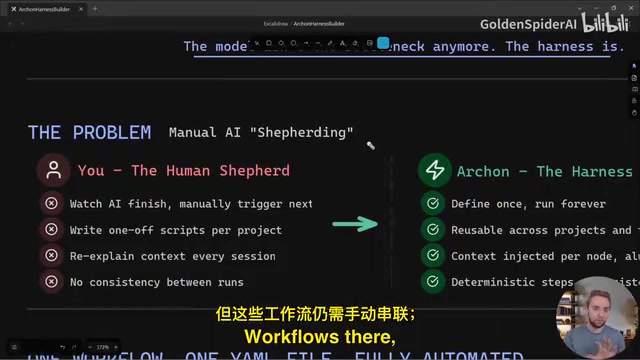
Archon is a product of this trend. As the first open-source Harness builder, it positions itself as an orchestration layer above AI coding Agents, making AI programming deterministic and reproducibly executable. Regardless of how you currently use AI coding Agents, you can package your entire workflow into an Archon workflow, run it across codebases, and even process different tasks in parallel.
Why AI Coding Harnesses Matter So Much
Data Validation: PR Acceptance Rate from 6.7% to 70%
Research data shows that directly having LLMs generate code and submit PRs yields an acceptance rate of only 6.7%. But after building a Harness with validation, context management, and multi-step review, the PR acceptance rate can soar to nearly 70%. This isn't theoretical speculation—Stripe has proven it in practice.
The 6.7% baseline reflects the limitations of unconstrained LLMs in real engineering environments: lack of understanding of codebase history, disregard for team coding standards, and inability to self-verify logical correctness. The 70% acceptance rate doesn't mean AI code requires no human review, but rather indicates that Harness-processed code has reached a quality threshold of "worth seriously reviewing"—this is precisely where the engineering value lies. Similar systems have been deployed at Google (internally called Cider AI) and Meta (the SapFix auto-repair system), confirming the universality of the Harness pattern.
Through their internal "Stripe Minions" system, Stripe ships 1,300 fully AI-generated PRs per week. Stripe Minions decomposes code modification tasks into an understand → plan → implement → test → review pipeline, with clear input/output specifications and quality gates at each stage. The scale of 1,300 PRs per week means Stripe has elevated AI programming from an "assistive tool" to "productivity infrastructure." Their approach was to build a complete AI coding workflow with enforced context management and validation at critical steps. Essentially, they built a system similar to Archon—just not open-source.
Anthropic's Harness Strategy
Claude Code is Anthropic's command-line AI programming tool, and its design philosophy fundamentally differs from traditional IDE plugins: it runs in Agent mode, capable of autonomously reading/writing files, executing commands, and calling external tools, rather than merely providing code completion suggestions. From its open-source code, we can see that Anthropic is heavily investing in the Harness direction, building features around Agent teams and sub-Agents, with 40% of the codebase related to Harness functionality. This 40% covers inter-Agent communication protocols, context-passing mechanisms, and result aggregation logic—a strong industry signal.
Anthropic's strategy aligns with their "Responsible Scaling Policy": improving reliability through structured orchestration rather than a single powerful model, reducing single-point-of-failure risks. More notably, when Claude is about to release top-tier models like Mythos, average users may not be able to afford using them directly. But building a Harness around Opus can make it outperform using Mythos alone—this is the leverage effect of Harnesses. The three-tier pricing structure of Haiku/Sonnet/Opus inherently provides the economic foundation for "select model per task" strategies within a Harness.
Archon's Core Architecture Explained
Node-Based Workflow Design
Every Archon workflow is a composition of nodes, which fall into two categories:
- Prompt Nodes: Send prompts to coding Agent sessions
- Deterministic Command Nodes: Force execution of specific operations (such as context management, test validation)
This node-based design borrows the core philosophy of workflow engines (like Apache Airflow and Prefect): decomposing complex processes into atomic operational units, where each node has clear preconditions, execution logic, and post-validation.
Related articles
 Tutorials
ChatGPT Plus Subscription Guide: Are GPT-5.5, image-2, and Codex Worth the Upgrade?
A detailed look at ChatGPT Plus features — GPT-5.5, image-2, and Codex — with a Plus vs Pro comparison and a complete step-by-step subscription guide for users outside the US.
 Tutorials
Harness AI Engineering in Practice: Using Claude Code to Master Enterprise-Level E-Commerce Development
Deep dive into Harness AI Engineering: master enterprise e-commerce development with Claude Code using the Rules, Skills, Wiki, and Changes framework.
 Tutorials
Cursor + Codex Dual-IDE Collaboration: A Practical Methodology for Open-Source Project Customization
A complete methodology for open-source project customization based on real-world experience, detailing the Cursor+Codex dual-IDE workflow, seven-stage process, MVP validation, and AI source code reading techniques.