Are Book Summary Apps a Waste of Money? An In-Depth Comparison of Blinkist and Shortform

A cognitive science-informed comparison of book summary apps and when they help vs. hinder real learning.
This article compares Blinkist, Shortform, and Faroa—three distinct approaches to book summary apps—examining whether they deliver real learning or just the illusion of it. Drawing on cognitive science research including the generation effect and retrieval practice, it argues these tools work best as screening aids rather than learning replacements, and offers actionable methods for genuine knowledge retention.
A Real Question: Are Book Summary Apps Actually Worth It?
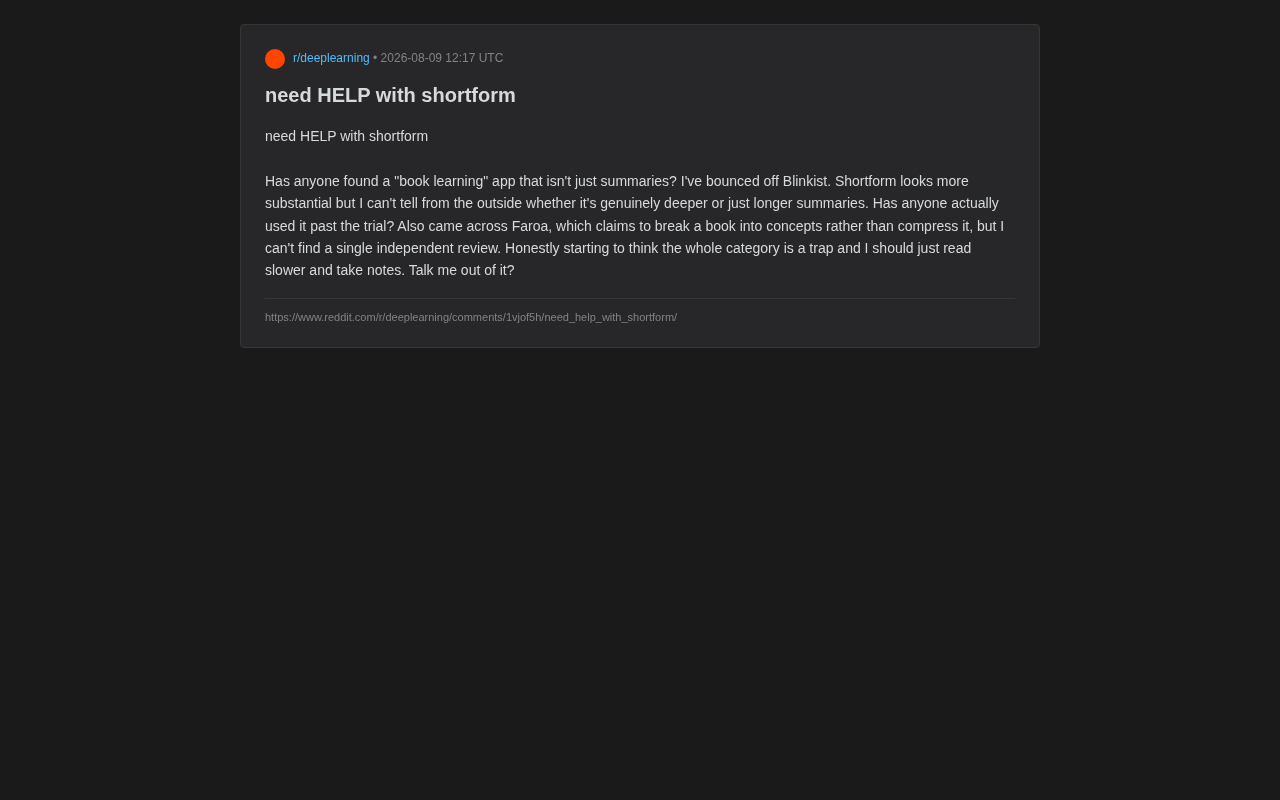
Recently, I came across a question on Reddit that resonated widely. A user admitted they'd tried Blinkist but could never stick with it, then turned their attention to Shortform, which appeared to offer "more substance." But from the outside, they couldn't tell whether it was genuinely deep analysis or just longer summaries. They'd also discovered a new tool called Faroa, which claims to "deconstruct books into concepts" rather than "compress them into summaries," but couldn't find any independent reviews.
The user ultimately began to wonder: "Is the entire book summary app category just a trap? Should I just slow down, read properly, and take my own notes?"
This question may seem ordinary, but it hits precisely at the core contradiction in today's "knowledge economy" and "efficiency learning" space: Do we actually want to understand a book, or do we just want the psychological comfort of feeling like we've "read" it?
The knowledge-as-a-service industry has experienced explosive growth since around 2016, and in the English-speaking world, Blinkist (founded in Germany in 2012) was an early pioneer. The entire industry rests on a core assumption: modern people's time is heavily fragmented, and they need efficient pathways to acquire knowledge. According to Blinkist's official data, it has over 28 million users globally, but user retention rates and actual learning outcomes remain topics the industry avoids discussing. The business model of these apps (annual subscriptions, typically in the $60–$120 range) means they need users to continuously feel they're "getting value" rather than actually achieving their learning goals and leaving—this misaligned incentive is precisely the root of much criticism.
Summary-Type vs. Deconstruction-Type Book Apps: What's the Real Difference?
The Blinkist Model: The Ultimate Speed-Reading Compression Tool
Blinkist represents the typical approach of first-generation book apps—compressing a 300-page book into something you can read in 15 minutes. Specifically, it breaks each book into roughly 12 "Blinks" (key points), with each Blink containing one core argument and a brief explanation, totaling about 1,500–2,000 words in English. Its advantage is extreme efficiency, making it ideal for quickly screening whether a book is worth reading. But the core problem is equally obvious: summaries are essentially second-hand processed conclusions, stripped of the author's reasoning process, case studies, and thought patterns.
The cognitive cost behind this extreme compression is far more severe than most imagine. According to Cognitive Load Theory (proposed by John Sweller in 1988), when information is stripped of its supporting arguments and concrete examples, readers lack sufficient "schemas" to anchor new knowledge into their existing cognitive structures. In other words, summaries provide the "what" but omit the "why" and "how it was derived"—and these latter two are precisely the key cues for long-term memory encoding.
Readers end up with a pile of "opinion fragments" but lose the context for understanding why these opinions hold true. This is the fundamental reason many people "forget immediately after reading" or "can't apply what they learned." The original poster's experience of "bouncing off" Blinkist illustrates exactly the ceiling of this model.
The Shortform Model: Longer, Deeper Structured Analysis
Shortform was founded by Blas Moros in 2016, positioning itself between summaries and close reading. It not only provides chapter-level detailed breakdowns but also adds editorial supplementary analysis, cross-book connections, and critical commentary on the author's arguments.
Its core differentiation manifests in three dimensions: First, each book breakdown is approximately 5–8 times the length of Blinkist's, preserving key chains of reasoning. Second, it introduces "editorial notes" that cite other books or research to verify or challenge the author's claims, creating cross-validation. Third, it offers a "one-page summary + full breakdown" dual-layer structure to meet different depth requirements. In terms of user profile, Shortform's typical users are people who already have reading habits and want to improve comprehension efficiency, rather than people who don't read at all. Its annual subscription price is around $200, more than double Blinkist's, reflecting its "premium positioning."
Based on actual user feedback, it is indeed "deeper," but the tradeoff is longer content and more reading time—in a sense, it's no longer a "speed-reading tool" but closer to a "guided close-reading assistant." In other words, if what you're looking for is "deeper understanding," Shortform will likely deliver; but if what you want is "to finish faster," it might actually increase your burden.
The Faroa Model: Reorganizing Knowledge by Concept
Faroa promotes the idea of "deconstructing concepts rather than compressing content," which theoretically aligns more closely with how the human brain organizes knowledge—because what we tend to remember are concepts and the relationships between them, not linear text.
The theoretical foundation of this approach traces back to the Semantic Network Model in cognitive psychology. In the 1960s, Allan Collins and Ross Quillian proposed that knowledge in the human brain is not stored as linear text but organized as a network of nodes (concepts) and edges (relationships). The subsequent ACT-R theory (John Anderson, 1993) further confirmed that learning is essentially about establishing new connections between existing concept nodes. From this perspective, Faroa's direction does align with cognitive principles—but the key lies in execution quality: whether algorithms can accurately extract "concepts," and whether the relationships between concepts are correctly modeled. These all require rigorous verification.
As the original poster pointed out, it currently lacks independent third-party reviews, and there may be a gap between marketing claims and actual experience. For any emerging tool, the absence of objective validation is itself a signal that warrants caution.
Are Book Summary Apps Really a "Waste of Money"?
The original poster's suggestion of a "trap" actually reveals a deeper truth: Book apps often solve an "anxiety problem" rather than a "learning problem."
Many people subscribe to these services essentially to pay for the self-image of being "ambitious and self-improving," rather than genuinely wanting to master knowledge. When a tool gives you the illusion that "I read 3 books today," it's very likely hindering rather than facilitating real deep learning.
Cognitive science research has long demonstrated that active processing is far more effective than passive reception. A single page of notes you write yourself, or a concept map you draw yourself, often surpasses ten perfectly written summaries by others in terms of memory retention and comprehension. This is the so-called "generation effect"—the brain remembers information it produces itself more firmly.
The generation effect was rigorously demonstrated by Slamecka and Graf in 1978: when subjects generated information themselves (such as completing words or paraphrasing in their own language), memory retention was significantly higher than passively reading the same information. A 2011 study by Jeffrey Karpicke at Purdue University, published in Science, further showed that active retrieval practice produces learning outcomes superior even to repeated reading and concept mapping. This means the "perfect summaries" provided by book apps may actually deprive the brain of its most effective learning mechanism—the process of struggling, recalling, making mistakes, and then correcting. UCLA cognitive psychologist Robert Bjork's theory of "desirable difficulties" corroborates this point: moderate difficulty during learning actually catalyzes deeper encoding.
More Practical Advice: Treat Tools as Crutches, Not Replacements
Scenario 1: Use Summary Tools During the Screening Phase
If you're facing a massive reading list and don't know which book to pick, summary tools like Blinkist serve as efficient "filters." Spending 15 minutes to determine whether a book is worth investing several hours in—that's a legitimate use case.
Scenario 2: Use Deconstruction Tools to Aid Comprehension
When you're tackling a difficult book (such as works on philosophy or economics), deconstruction tools like Shortform or Faroa can serve as "reading guides" and "verification aids"—look at their frameworks first, then return to the original book to read, and finally cross-check whether your understanding is on track.
Scenario 3: Truly Internalizing Knowledge Requires Active Output
The original poster's instinct to "read slower and take my own notes" is absolutely correct. There are no shortcuts to true deep learning; any tool can only serve as an aid. Here are several proven effective learning methods:
- The Feynman Technique: After reading a concept, try to explain it to someone else in the simplest possible language. Named after Nobel Prize-winning physicist Richard Feynman, the core logic is: if you can't explain something in simple language, you don't truly understand it. The "stuck points" revealed during explanation are precisely the weak links in your understanding.
- Active Recall: Close the book, write down the core ideas from memory, then check against the source. This method directly corresponds to Karpicke's retrieval practice research mentioned above, and is several times more effective than repeatedly flipping through notes.
- Zettelkasten (Slip-Box Method): Turn each concept into an independent card and establish connections between them. This is precisely the approach Faroa is trying to simulate, but doing it yourself produces better results.
Zettelkasten (German for "slip box") originated with German sociologist Niklas Luhmann (1927–1998). Using this knowledge management system of approximately 90,000 handwritten cards, Luhmann published over 70 books and 400 academic papers across an astonishing breadth of fields including law, economics, politics, and art. Its core principles include: each card records only one atomic concept (atomicity); each card must be restated in your own words rather than copied (directly triggering the generation effect); cards are connected through a numbering system that establishes explicit links (simulating the brain's semantic network). Sönke Ahrens' 2020 book How to Take Smart Notes brought this method into mainstream awareness, and modern digital tools like Obsidian, Logseq, and Roam Research are all deeply influenced by it. The key insight is: the system's value lies not in storing information, but in the deep thinking forced upon you when establishing connections—and this is precisely the part that no automated tool can replace.
Conclusion: Don't Let Tools Think for You
Returning to the original question—should book summary apps be dismissed entirely?
The answer is: They're not entirely a waste of money, but they're certainly not the savior of learning. Summary-type and deconstruction-type apps each have legitimate use cases. Shortform is genuinely deeper than Blinkist, and Faroa's philosophy has merit. But if your goal is to truly master a book's ideas, no tool—however good—can replace the process of reading, thinking, and producing output yourself.
Tools can help you move faster, but they can't help you go deeper. The original poster's impulse to "slow down and take notes seriously" may well be the most valuable answer in this entire discussion.
Related articles

Go Microservices in Practice: Detailed Architecture for E-Commerce, AI Agent, and IM System Integration
Deep dive into integrating e-commerce, AI Agent, and IM systems under Go microservices architecture, covering unified auth, gRPC, componentized Agent engines, and group chat bots.

X Platform's Recommendation Algorithm Caught Filtering Brazilian Election Content, Reigniting Algorithm Transparency Debate
X (formerly Twitter) was found filtering Brazilian election content in its For You feed, sparking debate over algorithm transparency and free speech.

Poison-Resistant Concept Anchoring: A New Approach to Defending Against AI Data Poisoning
Deep dive into Poison-Resistant Concept Anchoring, defending against data poisoning via signed anchors and bounded updates. Experiments show 62% poison isolation with 0% false rejection rate.