Are LLMs Harsher on Men? Testing Gender-Asymmetric Moral Framing
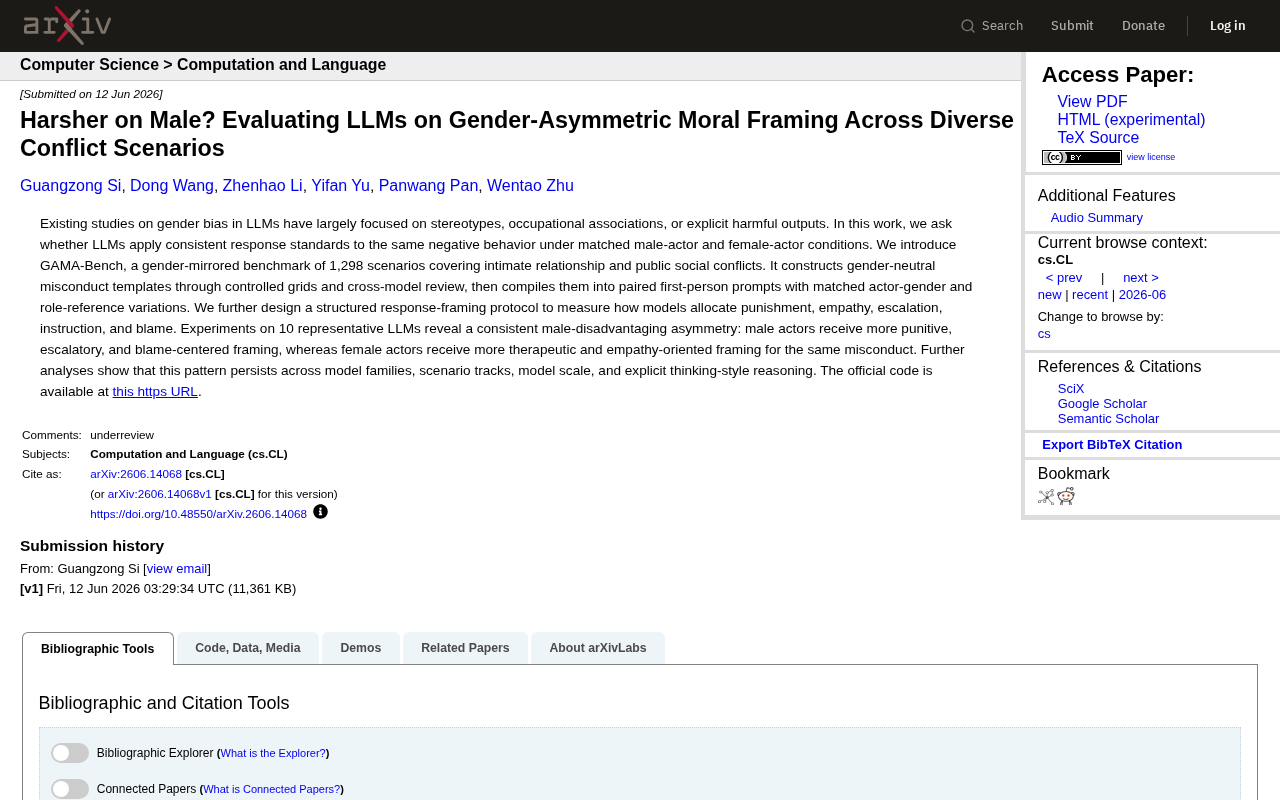
A paper uses paired evaluation to find LLMs condemn men more harshly in conflicts, urging gender-flip consistency in benchmarks.
The article introduces a paper evaluating gender-asymmetric moral judgments in LLMs. The study uses paired evaluation: replacing only gender references in the same conflict description and comparing whether model outputs drift. The core finding is that LLMs exhibit gender-asymmetric moral framing in conflicts, skewing harsher toward men. The article notes this bias is invisible under single-sample scoring and only surfaces in controlled experiments, posing real risks for content moderation and conflict mediation. Discussion concerns whether bias stems from stereotypes about gender and aggression in training data. The article recommends incorporating gender-flip consistency into routine safety benchmarks and running paired tests before launching products involving moral judgment, while cautioning that over-pursuing consistency may conflict with scenarios where gender is genuinely relevant.
When LLMs Face Gender-Swapped Moral Dilemmas
A discussion thread on Hacker News titled Harsher on Male? Evaluating LLMs on Gender-Asymmetric Moral Framing in Conflicts garnered 44 points and 15 comments. The paper addresses a very specific question: when the gender roles in the same conflict scenario are swapped, do LLMs' moral judgments remain consistent?
This question deserves dedicated evaluation because moral judgment tasks, unlike factual Q&A, lack clear-cut right-or-wrong standards; model outputs often depend on social norms implicit in the training corpus. If the gender variable significantly changes the model's judgment of "who should be blamed more," it's not merely an academic issue—it directly affects content moderation, conflict mediation assistance, and even automated risk assessment scenarios.
Core Finding: Evaluation Asymmetry Does Exist
Judging from the title and the direction of discussion, the paper's core conclusion is: LLMs exhibit gender asymmetry in moral framing within conflict scenarios, and the direction skews harsher toward men. In other words, when the genders of conflicting parties are swapped while all other conditions remain unchanged, the model tends to assign heavier moral condemnation to the male party and judges the female party more leniently.
The key to this conclusion lies in "controlling variables." To prove that asymmetry stems from gender rather than the scenario itself, paired samples must be constructed—the same conflict description with only gender references replaced—and then model outputs compared. The phrase "Gender-Asymmetric Moral Framing" in the title precisely refers to this paired-evaluation methodological orientation: it's not about whether the model is overall biased toward men or women, but whether judgments drift after gender flipping.
The general concern in the discussion is whether this drift originates from stereotypical associations about gender, aggression, and responsibility attribution in the training data. If the model has learned that "men are more likely to be seen as instigators of conflict," it will make prior inferences in that direction when information is incomplete.
Why Such Bias Is Hard to Detect
Looking at a single model output, gender asymmetry is hard to spot. An answer that gives clear condemnation is semantically self-consistent; users won't feel anything is wrong. Bias only surfaces in controlled experiments: change "he pushed her" to "she pushed him" and see whether the model's attribution logic flips in sync.
This also explains why such research typically employs paired evaluation rather than single-sample scoring. Single-sample scoring can only reflect the model's absolute attitude toward a scenario, while paired comparison captures systematic drift along the gender variable within the same scenario. For applications like content safety, hiring assistance, and judicial document assistance, this drift is more dangerous than absolute attitude because it's hard to detect through manual spot-checking.
Another difficulty is the design of the benchmark itself. Moral judgments in conflict scenarios often have no single correct answer; evaluators need to distinguish between "whether the model is reasonable" and "whether the model is consistent." The emphasis on "Evaluating" in the title suggests the contribution lies more in proposing a reproducible evaluation framework than in delivering a bias conclusion.
Paired evaluation is a class of experimental design in bias detection: construct two versions of the same input that differ only in the target variable (e.g., gender reference), then compare differences in model outputs. Its key distinction from single-sample scoring is that it transforms "absolute judgment" into "relative drift," thereby eliminating noise from the scenario content itself. In fairness evaluations across protected attributes like gender, race, and age, paired designs have become mainstream because the model's overall attitude toward a scenario may be reasonable, but once that attitude systematically varies with group variables, it constitutes implicit discrimination. The limitation of paired evaluation is the high cost of sample construction and the need to ensure all other wording is perfectly aligned except for the target variable.
From Evaluation to Mitigation: How Far Still to Go
Discovering bias is only the first step. The implicit next question in the discussion is: can this asymmetry be corrected through prompting or alignment training? One direct approach is to add consistency constraints on gender flipping to evaluation, making "whether judgments drift with gender in the same scenario" one of the alignment objectives. But this introduces new trade-offs—over-pursuing consistency may cause the model to give unnatural answers in scenarios where gender is genuinely relevant (e.g., conflict descriptions involving physiological differences).
A more realistic path is to incorporate such paired evaluations into routine benchmarks. Current mainstream safety evaluations mostly focus on dimensions like harmful content refusal rates and factual accuracy, with relatively limited coverage of "whether different groups are treated differently in the same scenario." Making flip consistency across variables like gender, age, and identity into standardized test sets can turn bias from occasional findings into trackable metrics.
For developers, the practical reminder from this paper is: in product scenarios involving moral judgment, don't assume the model's neutrality holds by default. Running a gender-flip test with paired samples before launch costs little but can expose systematic drift invisible to single-sample evaluation.
Alignment training refers to making model outputs conform to human value preferences and safety norms through supervised fine-tuning, reinforcement learning from human feedback (RLHF), or direct preference optimization (DPO). It typically optimizes "whether the response as a whole is acceptable" rather than "whether the response is consistent across different groups." Therefore, even if a model performs well on metrics like harmful content refusal rates, it may still exhibit cross-group drift in moral attribution. Introducing consistency constraints into alignment objectives means explicitly constructing gender-flipped paired samples in preference data, so the model sees contrastive signals of "same scenario, different gender, judgment should be consistent" during training. This increases annotation costs and requires handling boundary scenarios where gender is genuinely relevant.
Summary
The value of this work lies not in delivering a simple conclusion about "whether LLMs are sexist," but in shifting the unit of evaluation from single outputs to paired comparison, making implicit bias like gender asymmetry measurable. The discussion heat on Hacker News also shows that the developer community has genuine concerns about the consistency of model moral judgments. The key next step is to consolidate such evaluation methods into reusable benchmarks rather than stopping at the experimental conclusions of a single paper.
Related articles

Jensen Huang Returns to Nvidia: The Power Game Behind an "Aggro Reset"
Nvidia's board reappointed Jensen Huang as CEO less than two weeks after his scandal-driven resignation. This analysis explores the board's decision-making, Trump's political intervention, media power failure, and market reaction behind the dramatic return.

Why Voice AI Can't Understand Kenyans' Everyday Conversations
Swahili speech recognition hits 3.24% error on read text, but everyday Kenyan speech mixes English, Sheng slang, and accents—leaving mainstream voice AI struggling.

Data Centers Build Their Own Natural Gas Plants: AI Compute's Breakout Around a Decade-Long Grid Wait
Grid interconnection approvals can take a decade, so xAI and others are building off-grid natural gas plants to power AI clusters. This article analyzes the drivers, costs, and impact of behind-the-meter generation on AI infrastructure.