Are We Living in the Golden Age of AI? The Subscription Model May Be Coming to an End

A viral Reddit post asks whether the $20/month AI golden age is built on unsustainable vendor subsidies.
A Reddit post struck a chord with heavy AI users: today's $20/month unlimited access to top-tier AI models is commercially unsustainable. The author observed OpenAI apparently nerfing its models and using discounts to migrate users from subscriptions to pay-per-use API billing — a model far friendlier to vendors. This raises fears that Anthropic and others may follow, raising barriers for everyday users and shifting AI's benefits back toward well-funded institutions. The article advises users to make the most of today's high-value window while bracing for pricing model changes ahead.
A Growing Concern in the Community
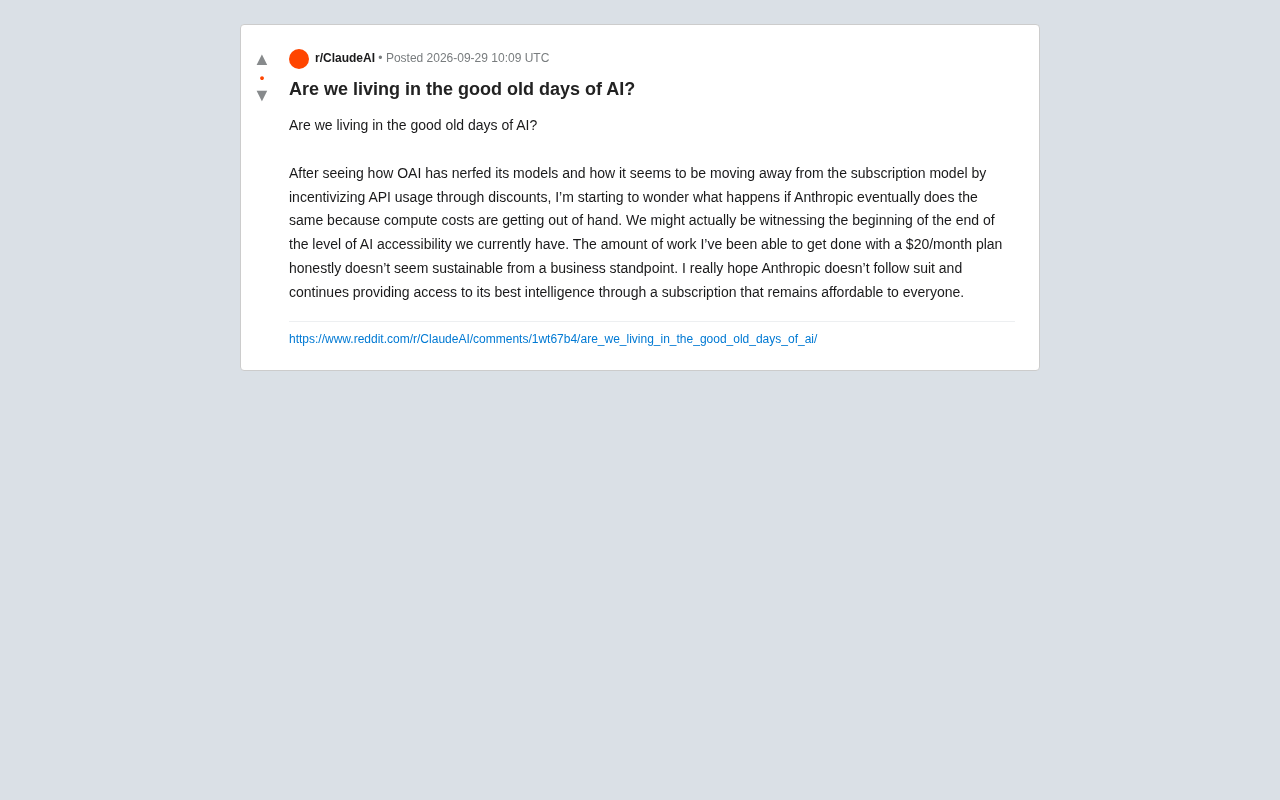
A Reddit user recently posed a thought-provoking question: are we living in the "good old days" of AI? Behind this question lies a shared anxiety among heavy AI users — how much longer can this era last, where top-tier models are accessible for just $20 a month?
The user observed that OpenAI appears to be "nerfing" its models while simultaneously offering API usage discounts to nudge developers toward pay-per-use billing, gradually de-emphasizing subscription plans. This trend has raised concerns: if compute costs continue to spiral out of control, will Anthropic and other providers follow suit?
The "Unsustainable" Paradox of the $20 Plan
One line from the post resonated deeply: "The amount of work I get done with my $20/month subscription doesn't seem commercially sustainable from a business perspective."
This captures a core contradiction in today's AI consumer market. For users, a monthly fee of a few dozen dollars grants access to near-unlimited top-tier intelligence — arguably one of the best-value productivity tools in history. But for the companies providing these services, every inference request translates into real GPU compute and electricity costs. When heavy users' daily query volumes surge, subscription revenue can fall far short of covering the underlying compute expenses.
In other words, the "windfall" users are enjoying is, to some extent, built on vendors burning cash to capture market share. Once this subsidized pricing gives way to commercial rationality, the experience gap could be quite jarring.
OpenAI's Signal: From Subscriptions to API
The author's reading of OpenAI's moves is worth paying attention to. They argue OpenAI is shifting direction through two actions: a perceived decline in model performance, and discount incentives pushing users toward API-based billing.
From a business logic standpoint, pay-per-use API pricing is far more favorable to vendors — the more you use, the more you pay, aligning costs and revenue precisely and eliminating the risk of heavy users over-consuming under a flat subscription fee. For ordinary users, this means that stable access to top-tier AI in the future may require paying for every single call, raising both the barrier and the cost.
It's worth noting that "model nerfing" is largely a subjective user perception — vendors typically frame such changes as efficiency optimizations or safety alignment adjustments. Whether a causal relationship exists remains unproven.
The core difference between API billing and subscription models lies in billing granularity. Under a subscription, users pay a fixed monthly fee for unlimited (or capped) model access, and the vendor absorbs the risk of heavy users exceeding their expected consumption. API pay-per-use, by contrast, is typically metered in tokens — the smallest unit of text a model processes, roughly equivalent to 0.5 to 1 English word or half a Chinese character. Every prompt sent and every response generated consumes tokens, and charges accrue accordingly. For heavy users with extremely high daily query volumes, actual spending under the API model could far exceed a $20 monthly fee — though for light, occasional users it might actually be cheaper. This structural difference is precisely the commercial motivation behind vendors offering discounts to "nudge" users into migrating on their own.
Hopes and Concerns About Anthropic
The author closes with a simple wish: that Anthropic won't follow this trend, and will continue offering its most powerful intelligence to everyone at an affordable subscription price.
Behind that wish lies a much larger question: can AI remain universally accessible over the long term? Today, products like Claude and ChatGPT allow individual developers, students, and small teams to access frontier AI at minimal cost — a democratizing effect that is profoundly reshaping knowledge work. But if compute cost pressures ultimately flow through to pricing and raise the accessibility bar, will AI's benefits once again concentrate in the hands of institutions and enterprises that can afford to pay?
Accessibility in the AI context generally refers to how easy or difficult it is for users of varying economic means and technical backgrounds to access and use AI capabilities. One important social function of the current subscription pricing model is that it anchors cost at a relatively fixed, predictable level — bringing individual developers, students, and users in developing countries into the fold of beneficiaries. Historically, technologies like cloud computing and smartphones did transition from "expensive elite tools" to "mass consumer products," but this trajectory is not inevitable. If compute costs remain stubbornly high, AI services could take a different path: basic features free, advanced capabilities priced at a premium for enterprises and institutions, with a significant quality gap between what individual users can access and what paying organizations receive — creating a new kind of "intelligence divide."
Appreciate the Present, but Set Realistic Expectations
This post resonated so widely because it captured a near-universal user sentiment — enjoying the convenience while sensing, just beneath the surface, how fragile that convenience really is.
Industry history tells us that any market dependent on subsidies must eventually face the test of a viable profit model. AI services are no exception. For individual users, the rational approach may be: take full advantage of the current high-value window to sharpen your productivity, while maintaining realistic expectations about potential price changes and model shifts down the road.
Whether Anthropic ultimately adjusts its strategy or not, the question of whether "the golden age of AI can last" is one every serious user deserves to think carefully about. And the battle between compute costs and universal accessibility may well define the direction of the entire industry over the next few years.
Related articles

The Disinformation War in the Russia-Ukraine Conflict: Bot Farms Still Operating After Drone Strike on Yandex
After Ukrainian drone strikes on Russian data centers, Zelensky claimed social platforms improved, but Russian bot farms are still operating. This article analyzes the decentralized architecture and resilience of disinformation networks.

Nothing Headphone A Hits Half Price for the First Time: Headphone + Album Bundle Promo
Nothing Headphone A is on sale at half price for the first time via an Amazon bundle deal: add the headphone and Charli XCX's album CD to get 33% off the full order. Black and white both included. Here's how the bundle works and whether it's worth it.

Flox Intelligence Uses AI Acoustic Deterrence to Protect Transportation Infrastructure
Flox Intelligence uses edge AI devices to identify wildlife species and play species-specific sounds to deter them from railways, airports, and highways, addressing the habituation problem of traditional deterrence methods.