ARS Academic Framework Explained: A Complete System Where 35 AI Agents Collaborate on Research

The ARS framework uses 35 AI Agents to collaboratively assist academic research while maintaining integrity.
ARS (Academic Research System) is a multi-agent academic research framework built on Claude Code, featuring 35 AI Agents collaborating across literature retrieval, writing assistance, and intelligent peer review. The system employs a three-layer architecture and ten-step standardized workflow, uses RAG technology to reduce AI hallucination risks, sets up 12 human checkpoints to safeguard academic integrity, and includes built-in data de-identification and full traceability mechanisms. Writing a paper costs only $4-6, with the core philosophy being that AI serves as an assistant rather than a replacement for researchers.
Introduction: AI Isn't Here to Write Your Paper — It's Your Research Partner
When you have a powerful AI tool like Claude Code at your disposal, the biggest temptation might be to let it write your paper directly. But that's clearly not the right approach to academic research. The ARS (Academic Research System) framework was designed with a clear purpose: to make AI an "exceptionally capable but never overstepping" research assistant — you're always in the driver's seat, deciding where the research goes.
The core philosophy of this multi-agent system is straightforward: hand off the tedious, repetitive, time-consuming tasks (sifting through massive literature, organizing data, formatting) to AI Agents, freeing researchers to focus on deep thinking and genuine innovation.

ARS System Architecture: How 35 AI Agents Divide and Conquer
Core Design Philosophy
ARS isn't an ordinary chatbot — it's a multi-agent system purpose-built for academic research. Multi-Agent Systems (MAS) represent one of the core paradigms in distributed artificial intelligence. The fundamental idea is to decompose a complex task into multiple subtasks, each handled by different agents. Each Agent possesses independent perception, reasoning, and action capabilities while collaborating through predefined communication protocols. This architecture isn't new in software engineering — microservices architecture follows a similar approach — but applying it to academic research workflows means addressing additional challenges like knowledge consistency across agents, task dependency ordering, and conflict arbitration.
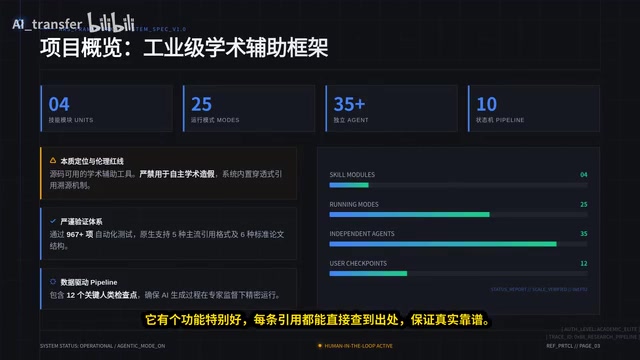
The system runs 35 AI Agents simultaneously with extremely granular division of labor: some handle literature retrieval, others focus on logical reasoning, and some specialize in quality control. This scale approaches the practical engineering limits of current open-source multi-agent frameworks (such as AutoGen and CrewAI), making system stability and output quality at this scale the core technical challenge. To ensure stability, the team established 25 operational modes, validated through over a thousand tests, covering various paper formats and citation standards.
Three-Layer Architecture
Breaking the system down, it resembles a well-organized research team:
- Top Layer (Steward Layer): Monitors a ten-step research checklist, ensuring each phase progresses on schedule
- Middle Layer (Execution Layer): Three core roles — the Data Miner, the Draft Writer, and the Logic Reviewer
- Bottom Layer (Standards Layer): Ensures all operations comply with academic conventions
There's also an independent "security checkpoint" — external raw data must pass through verification, confirmed as safe and accurate before entering the system.
Academic Integrity Red Lines
On academic integrity, the ARS framework draws hard lines:
- Every citation can be traced directly to its source, guaranteeing authenticity
- The workflow includes 12 checkpoints where researchers must personally review critical stages
- AI Agents don't "go rogue" — when they encounter logical inconsistencies, they proactively flag them
Four Core Capabilities: How AI Agents Handle Real Academic Challenges
Literature Review & Writing Assistance
During the research phase, the system can directly access academic databases, help you verify citation sources, and let you see what experts are actually debating on a given topic. The core technology behind this is Retrieval-Augmented Generation (RAG). RAG's basic principle: before a large language model generates a response, it first retrieves relevant document fragments from external knowledge bases and injects them as context into the prompt, grounding the model's output in evidence. In academic scenarios, this means the system can connect to Semantic Scholar, PubMed, arXiv, and other open academic APIs to retrieve paper abstracts, citation relationships, and metadata in real time. Compared to a model merely "recalling" information from training data, RAG dramatically reduces the risk of fabricated citations while enabling access to the latest research published after the model's training cutoff date. Before you even start writing, you can thoroughly map out the relevant field.

On the writing side, it handles complex formulas and formatting with ease. Particularly noteworthy is the Mentor Mode — when you're stuck, it won't just hand you a paragraph. Instead, it keeps asking you questions, guiding you toward inspiration. This design draws on the classic Socratic Method from pedagogy — rather than providing answers directly, it uses continuous questioning to guide learners toward independent discovery and argument construction. If AI directly generates large blocks of text, researchers easily fall into a "copy-paste" laziness loop, undermining both academic originality and their ability to think independently. Mentor Mode forces researchers to clarify their own argumentative logic through questioning, while the AI provides further materials and direction based on their answers — essentially finding the balance point between efficiency and academic training. It also learns from your previous papers, mimicking your word choices and writing habits to maintain stylistic consistency.
Intelligent Review System
Finishing the paper is actually just the beginning — the most headache-inducing part is passing peer review. The system has 7 virtual review experts from different domains built in, with extremely fine-grained specialization:
- Some focus exclusively on logic
- Some scrutinize experimental methodology
- Some specifically look for highlights
The system produces a comprehensive score. For example, 82 points means basically passing, while scores in the 50s or 60s will directly tell you what needs revision. This way, you have a clear picture before formal submission.
Collaborative Observer Mechanism
The system includes a "Collaborative Observer" role that monitors the entire process as you work with AI. If your logic gets stuck somewhere, or your argumentation lacks depth, it proactively jumps in with suggestions. It's more like a well-synced partner that helps you polish every detail while ensuring you remain in control of the research.
Ten-Step Research Workflow: A Standardized Path from Blank Page to Finished Draft
Standardized Workflow
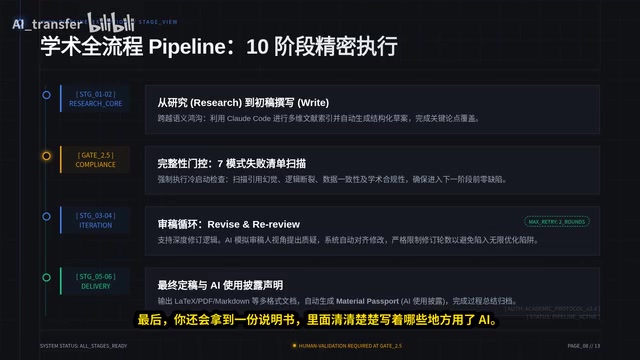
The entire research process is broken into ten concrete steps:
- AI Agents extract key points from massive literature
- Build the article framework
- Pass through the quality checkpoint (orange marker)
- Gradually fill in content
- Repeatedly question and challenge to refine arguments
- Generate the final AI usage disclosure document
The quality checkpoints act like strict teachers, scrutinizing whether every citation is real and whether the logic holds up. If this gate isn't passed, the workflow stops entirely.
Transparency Guarantee
In the end, you receive a complete disclosure document that clearly states where AI assistance was used. This transparency design ensures the baseline of academic integrity.
Quality Control: Preventing AI Agents from "Confidently Making Things Up"
Multi-Layer Defense Mechanisms
AI writes fast and saves effort, but the biggest risk is "hallucination" — fabricating references. AI Hallucination refers to when large language models output factually non-existent or incorrect information with extremely high confidence. In academic contexts, this problem is particularly fatal: models may fabricate paper titles, authors, and DOI numbers that don't exist, while the generated text reads entirely convincingly. In 2023, a New York lawyer was sanctioned for citing ChatGPT-fabricated case law in court filings, bringing academic and legal awareness of AI hallucination to a peak.
The ARS framework's solutions include:
- Human Confirmation Nodes: At critical stages like outlines, logic, and literature, AI must pause and wait for your review
- Automated Scanning: The system automatically checks data accuracy and citation authenticity
- Unified Standards: Regardless of how AI performs, formatting and professionalism must remain consistent
- Full Traceability: Every edit, every piece of data can be traced back to its source
Data Security Workflow
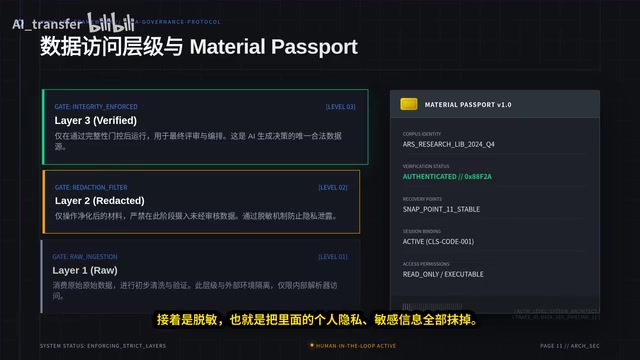
Before AI processes data, it performs a complete "health check":
- Cleaning: Removing noise data
- De-identification: Stripping personal privacy and sensitive information
- Validation: Ensuring what remains is reliable material
The de-identification step responds to increasingly strict data privacy regulations in academic research. In fields like medicine and social sciences involving human subjects, raw data often contains personally identifiable information (PII) such as names, ID numbers, and medical records. The EU's GDPR, the US's HIPAA, and China's Personal Information Protection Law all impose strict regulations on processing such data. When this data is fed into AI systems for analysis without de-identification, it may not only violate laws and regulations but could also leak sensitive information to model providers through API calls. By making de-identification a mandatory step before data enters the system, the ARS framework surpasses most general-purpose AI writing tools in compliance.
Every piece of data has a "digital passport" — source, reviewer, whether it's been modified — all visible at a glance.
AI Agents with "Opinions" by Design
Today's AI is no longer a "yes-man" that agrees with everything you say:
- If evidence is insufficient, it will push back
- When encountering unreviewed new papers, it proactively flags risks
- It can assess your current state and automatically switch between "mentor" and "assistant" roles
Cost & Usage: Write a Paper for the Price of a Coffee
The Economics
Writing a high-quality paper of approximately 15,000 words costs about $4-6 total. The cost breakdown is roughly:
- 40% for initial draft writing
- The rest allocated to research, workflow management, and review
The system employs a tiered model strategy: the strongest models handle core logic and final quality control, while cheaper lightweight models handle simple grunt work, effectively controlling costs. This strategy reflects an important engineering practice in current AI application development — not all tasks require the most powerful (and most expensive) model. Taking Anthropic's Claude series as an example, top-tier models excel at complex reasoning and long-text understanding, but their API cost per million tokens can be several times or even ten times higher than lightweight models. Mature AI applications route tasks by tier: top models for core reasoning, logic review, and final quality gates, while format conversion, simple summaries, and data cleaning go to more economical smaller models. This strategy not only controls costs but also significantly improves overall system response speed, since lightweight models typically have far lower inference latency than large models.
Installation & Deployment
The installation process is extremely simple — a single line of code, like installing a plugin. As long as your computer environment and API keys are configured, you can start using it immediately.
Conclusion: The Right Approach to AI-Assisted Research
The ARS framework represents a new paradigm for AI-assisted research: rather than having AI replace researchers, it deploys 35 AI Agents each fulfilling their roles as smart, rule-abiding, and opinionated assistant teams. It addresses the biggest pain points of current AI tools in academic settings — credibility and traceability.
Of course, this system isn't perfect yet and requires some adjustment period. But the direction is clear: make every piece of data and every conclusion traceable to its source, letting AI truly serve academic rigor rather than undermining it.
No matter how good the tools get, the standards of academic rigor cannot be lowered. That's the right approach to AI-assisted research.
Related articles
Deep Dive into AI Agent Skill Design: …
Deep Dive into AI Agent Skill Design: Engineering Practices from Anthropic and Perplexity
A deep dive into Skill design philosophy from Anthropic's Claude Code team and Perplexity's Agent team, covering the Tax Test, Gotchas Flywheel, progressive disclosure, and Eval-First practices for building high-quality AI Agent skill systems.
Deep Dive into OpenAI's Official GPT-5…
Deep Dive into OpenAI's Official GPT-5.6 Prompting Guide: The Shift from Manual to Automatic
A deep dive into OpenAI's official GPT-5.6 Sol prompting guide: conciseness-first, outcome-oriented design, autonomy boundaries, tool routing, and reasoning intensity tuning.
 Deep Dives
Deep Dive into How OpenClaw (Open-Source Crayfish) AI Agent Works
Deep analysis of OpenClaw AI Agent internals: System Prompt, tool calling, SubAgents, Skill system, memory, and Context Engineering explained.