Arturia MiniFreak 49 Review: 49-Key Upgrade Makes the Freak Series More Professional
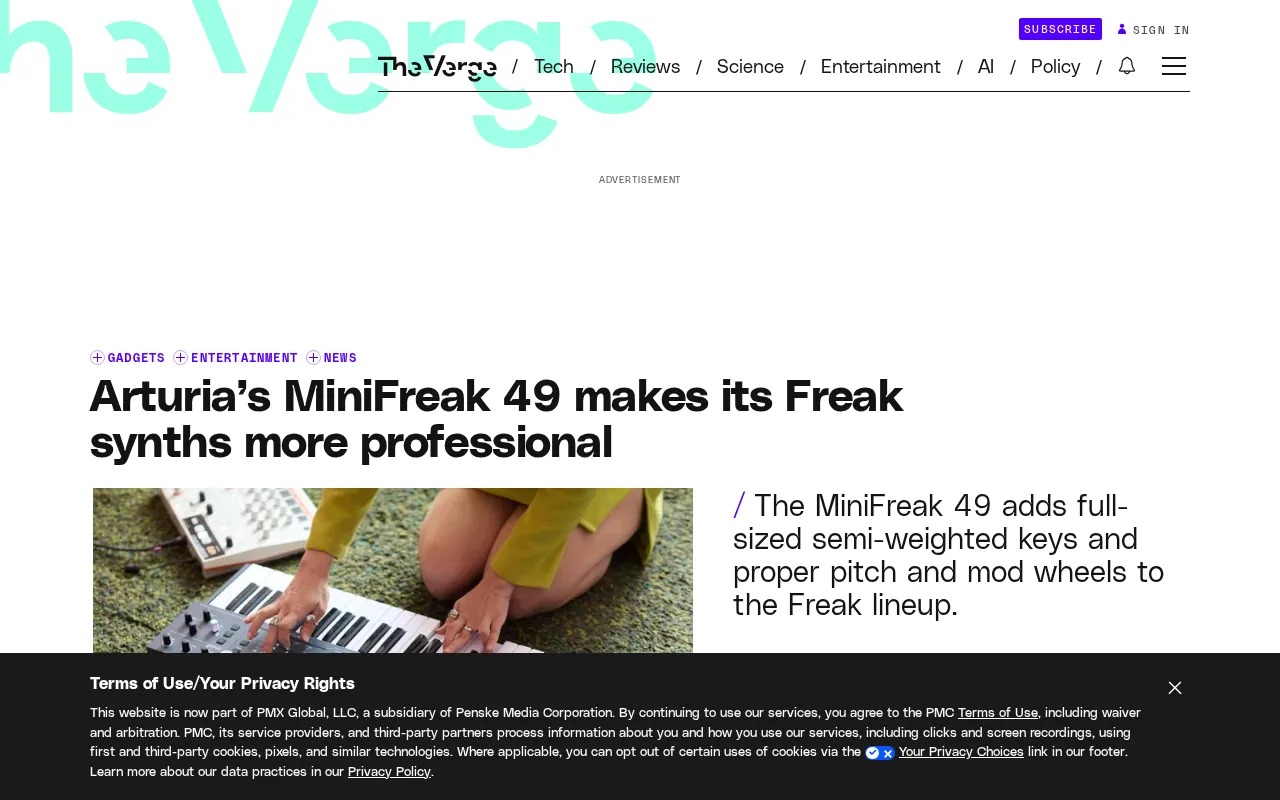
Arturia launches the MiniFreak 49, upgrading the Freak series to a 49-key full-size keyboard and completing professional features.
Arturia releases the MiniFreak 49 synthesizer, with the core change being the upgrade from the original MiniFreak's 37 mini keys to a 49-key full-size velocity-sensitive keyboard, significantly improving playing feel and shifting its positioning from a desktop module to a capable live main keyboard. The sound engine is almost identical to the current MiniFreak, with upgrades focusing on the keyboard and interfaces, plus multiple professional features and interface improvements, possibly involving CV/Gate connectivity, DAW integration, or modulation matrix optimization. The product positioning fills the gap between the MiniFreak and larger keyboard synthesizers, targeting professional musicians and bedroom producers who have been holding off due to keyboard feel. Currently, price, release date, and weight/size information have not been announced.
Arturia's Freak series synthesizers have always been known for their quirky, fun digital sounds, but the keyboard size and playing feel have always made professional musicians hesitate. The newly launched MiniFreak 49, while retaining the core sound engine, upgrades the keyboard from 37 mini keys to 49 full-size keys and adds several professional features, attempting to break the "toy" impression.
From Mini Keys to Full-Size: A Qualitative Change in Playing Experience
According to RSS sources, the most significant change in the MiniFreak 49 is the keyboard. The original MiniFreak had 37 mini keys, and the MicroFreak only had 25, while the MiniFreak 49 jumps directly to 49 full-size keys with velocity sensitivity. This means it is no longer just a replacement for a desktop module, but can serve as a main keyboard for live performance. For musicians who need to play chords and melodies with both hands, 49 keys provide a layout closer to traditional synthesizers while maintaining portability.
This change also addresses long-standing user feedback: the Freak series' sound engine is professional enough, but the mini keys limit expression. Arturia clearly hopes to attract users who have been holding off due to keyboard feel with the MiniFreak 49.
Professional Features Completed: More Than Just the Keyboard
Besides the keyboard, the MiniFreak 49 has also been enhanced in terms of interfaces and features. Although the original article does not list all new additions in detail, it mentions "multiple more professional features and interface improvements." It is reasonable to speculate that these improvements may include richer CV/Gate connectivity, better DAW integration, or a more intuitive modulation matrix. For live performance and studio production, these details often determine whether a synthesizer can integrate into a professional workflow.
Interestingly, the "under the hood" of the MiniFreak 49 is almost identical to the current MiniFreak, meaning the sound engine, oscillator types, and filters remain unchanged. For users who already own a MiniFreak, the upgrade motivation mainly comes from the keyboard and interfaces, not the sound itself.
CV/Gate stands for Control Voltage and Gate signal, an analog protocol for communication between modular synthesizers and early analog synthesizers. CV is used to transmit continuously varying signals such as pitch and modulation, while Gate is used to transmit note on/off trigger signals. Synthesizers with CV/Gate interfaces can directly interconnect with other modular devices or semi-modular synthesizers without going through MIDI conversion, making them very practical in live performance and modular systems. For digital synthesizers like the MiniFreak 49, retaining CV/Gate connectivity means it can integrate into traditional analog workflows.
Modulation Matrix is a routing system in synthesizers used to assign modulation sources (such as LFOs, envelopes, velocity, mod wheels, etc.) to modulation destinations (such as pitch, filter cutoff frequency, pulse width, etc.). An intuitive modulation matrix allows users to create complex dynamic timbral changes with minimal operations. In digital synthesizers, the modulation matrix is usually presented as a software interface, and its flexibility and depth directly affect the sound's malleability. The MiniFreak series itself has certain modulation capabilities, and interface improvements may make the routing process more efficient.
Market Positioning: The Freak Series' Professionalization Attempt
Arturia's Freak series, starting with the MicroFreak, has sold itself on "controlled chaos," with mini keys and touch keyboards as its signature design, but this has also deterred many traditional keyboard players. The launch of the MiniFreak 49 is a key step for Arturia to move closer to the professional market while maintaining the series' personality.
From a product line perspective, the MiniFreak 49 fills the gap between the MiniFreak and larger keyboard synthesizers. It retains the experimental nature of the Freak series while providing a hardware foundation for professional performance. If priced reasonably, it could become a new choice for live electronic musicians and bedroom producers.
However, information is currently limited, and the specific price and release date of the MiniFreak 49 are not yet known. In addition, whether the 49 full-size keys will significantly increase weight and size, affecting portability, is also a point potential buyers need to weigh.
MicroFreak is a 25-key touch keyboard synthesizer launched by Arturia in 2019, known for its unique touch keyboard (no mechanical moving parts) and variable digital oscillator algorithms. It does not have a traditional filter, but uses a digital state-variable filter, with a sound leaning towards experimental and edgy. Although the MicroFreak's mini size and touch keyboard are highly recognizable, they also limit the playing experience for traditional keyboard players. The MiniFreak is its successor, switching to a 37-key mini mechanical keyboard and adding more features, while the MiniFreak 49 further moves toward professional performance needs. Understanding this product lineage helps judge the positioning of the MiniFreak 49 within the Freak family.
"Controlled chaos" is the core philosophy of the Freak series' sound design: through digital oscillator algorithms, wavetable synthesis, and clever modulation routing, it creates unexpected and experimental sounds within a predictable range. This philosophy appeals to electronic music producers seeking unique timbres rather than traditional pianists. While retaining this sonic personality, the MiniFreak 49 lowers the playing barrier with full-size keys, essentially seeking a broader user spectrum between "chaos" and "control."
Conclusion: A Pragmatic Upgrade
The MiniFreak 49 is not a revolutionary product, but it precisely solves the biggest shortcoming of the Freak series—the keyboard. For musicians who pursue tonal personality and need professional feel, this may be the most balanced Freak synthesizer currently available. We look forward to more details, especially the price and actual playing feel.
One-line Summary
Arturia launches the MiniFreak 49, upgrading the Freak series to a 49-key full-size keyboard and completing professional features.
Paragraph Summary
Arturia releases the MiniFreak 49 synthesizer, with the core change being the upgrade from the original MiniFreak's 37 mini keys to a 49-key full-size velocity-sensitive keyboard, significantly improving playing feel and shifting its positioning from a desktop module to a capable live main keyboard. The sound engine is almost identical to the current MiniFreak, with upgrades focusing on the keyboard and interfaces, plus multiple professional features and interface improvements, possibly involving CV/Gate connectivity, DAW integration, or modulation matrix optimization. The product positioning fills the gap between the MiniFreak and larger keyboard synthesizers, targeting professional musicians and bedroom producers who have been holding off due to keyboard feel. Currently, price, release date, and weight/size information have not been announced.
Related articles

Claude Code v2.1.316 Update Analysis: Enterprise Gateway and Multiple Stability Fixes
Claude Code v2.1.316 released: new enterprise gateway pooled group budgets, layered policy mode, subagent effort control, dozens of Shell, network, and session recovery fixes, and Opus 4.8 fast mode deprecated.

17th-Century British Floods and Doomsday Panic: A New Perspective on Weather History
Based on a Hacker News discussion of '17th-Century British Floods and Foreboding,' this piece explores how extreme weather was given divine and political significance, and what weather history teaches us about contemporary climate communication.

Salesforce Acquires Rune for $375M: AI Logistics Tech Bolsters Defense Business
Salesforce reportedly acquires defense tech startup Rune for $375M. Rune's AI logistics tech will strengthen Salesforce's Missionforce defense platform, continuing its M&A spree.