arXiv Implements Two-Submission Monthly Limit for Academic Preprints

arXiv caps submissions at two papers per person per month to manage AI-driven content inflation.
arXiv has introduced a new policy limiting each submitter to a maximum of two papers per calendar month. The move comes as generative AI tools have dramatically accelerated paper output, overwhelming the platform's volunteer-driven moderation system. While the cap has little practical impact on most individual researchers, it presents real constraints for large collaborative teams or authors who habitually split work into multiple submissions. The academic community is divided: supporters see it as a check on low-quality mass output, while critics worry it undermines academic freedom and rapid knowledge sharing. The policy is widely viewed as an early institutional response to AI-driven disruption, and may foreshadow similar measures at other platforms.
arXiv's New Submission Policy: Two Papers Per Person Per Month
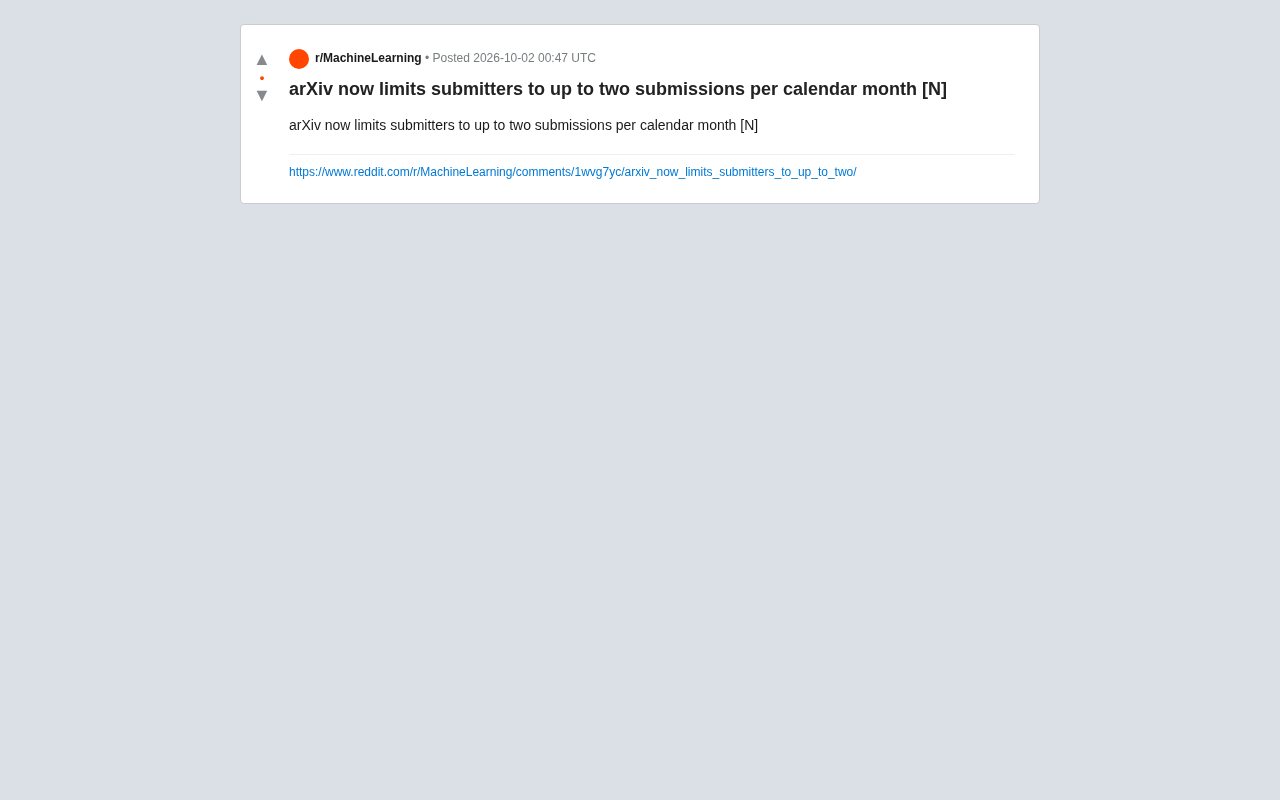
arXiv recently updated its submission policy, capping each submitter at a maximum of two uploads per calendar month. The change has sparked widespread discussion in the academic community — particularly on technical forums like Reddit. As one of the world's largest and most widely used academic preprint platforms, any policy shift at arXiv tends to reverberate across the research community.
arXiv has long served as a core channel for rapidly disseminating research in physics, mathematics, computer science, and related fields. Researchers can upload papers before formal peer review, establishing priority for their findings while gathering community feedback. Thanks to its relatively low barrier to entry and fast distribution, submission volumes on arXiv have climbed steadily in recent years — placing growing pressure on the platform's content quality and operational capacity.
Why Cap Submissions?
Although the official announcement offers limited detail, several likely motivations can be inferred from the direction of this policy. As AI tools have proliferated, the pace of paper production has accelerated dramatically. Some authors may be submitting content in bulk over short periods, straining the platform's moderation and classification systems.
The two-per-month cap is, at its core, a form of rate limiting. It effectively curbs the disproportionate resource consumption by a small number of high-frequency submitters, while giving the moderation team more breathing room to maintain basic content standards. For the vast majority of researchers, a regular academic publishing pace of two papers per month is more than sufficient — so the practical impact on typical users is minimal.
Uneven Impact Across Different Groups
This policy does not affect all submitters equally. For individual researchers publishing at a normal academic cadence, the two-paper quota is unlikely to feel restrictive. But for large labs, prolific collaborative teams, or authors who habitually split a single large paper into multiple sub-submissions, the new rule may require a rethinking of release strategy.
One nuance worth watching is the question of attribution between corresponding authors and collaborators. In complex multi-author collaborations, determining whose monthly quota gets "used up" may become a practical detail that teams need to sort out.
arXiv has never been entirely without moderation. The platform maintains a moderation system where volunteer subject-matter experts review submissions to verify proper categorization and filter out content that clearly falls below academic standards. However, this system was never designed to anticipate the productivity explosion brought on by generative AI. Since 2023, arXiv has been receiving more than 20,000 new papers per month — nearly double the volume from five years ago. Moderators, most of whom work without compensation, face severely limited resources in the face of this deluge. The two-per-month cap is essentially a demand-side reduction in workload, rather than a supply-side expansion of moderation capacity.
Community Reaction and Debate
Discussions on Reddit reveal a divided community response. Supporters argue that limiting submission volume will help improve overall content quality on the platform, curb the low-quality mass output associated with "paper mills," and make genuinely valuable research easier to surface.
Criticism and concerns, meanwhile, center on academic freedom and the efficiency of knowledge dissemination. Some argue that a blanket numerical cap could inadvertently penalize researchers who are both highly productive and high-quality — especially in fast-moving fields like AI, where tracking progress often depends on frequent preprint updates.
The Preprint Dilemma in the Age of AI
This policy reflects a deeper industry-wide trend: generative AI is reshaping the ecosystem of academic publishing. As the cost of writing and generating papers drops sharply, preprint platforms are bearing the brunt of a content flood. arXiv's submission limit can be read as an early response from traditional academic infrastructure to this wave of disruption.
Going forward, more academic platforms may introduce similar quality and volume control mechanisms — such as tiered quotas based on author reputation, automated content quality screening, or disclosure requirements for AI-generated content. arXiv's move may be just the opening act in a broader recalibration of the academic communication system.
The core value of a preprint server lies in "priority claims" and "rapid dissemination": researchers can make their work public before formal peer review is complete, locking in a timestamp for their findings while quickly receiving feedback from peers. arXiv was founded in 1991 by physicist Paul Ginsparg, initially serving the high-energy physics community before expanding into mathematics, computer science, quantitative biology, and other fields. It now hosts more than 2.3 million papers. Unlike journal publication, preprints go live without rigorous peer review — giving the platform its speed advantage, while also making it a potential entry point for low-quality content. The arrival of generative AI has amplified this tension considerably. Producing papers that look formally structured but are substantively hollow has become extremely cheap, creating systemic pressure for platforms that rely on volunteer moderation.
How Researchers Should Adapt
For researchers who depend on arXiv, it's worth revisiting your publication cadence. Reserve your limited monthly quota for your most mature and impactful work, and avoid fragmenting a single contribution into too many small papers submitted in sequence. For collaborative teams, coordinating in advance on who will serve as the submitter and how to allocate quota across submissions can help avoid unnecessary friction.
It's also worth keeping an eye on other preprint channels as supplementary options, and staying current with official arXiv announcements — since policies of this kind are often refined based on community feedback in the early stages of implementation.
On balance, arXiv's two-per-month submission limit is a pragmatic adjustment aimed at the platform's long-term sustainability. It seeks a balance between controlling content inflation and preserving academic freedom. While it will inevitably generate debate in the short term, it also reflects the structural transformation that academic publishing is undergoing in the age of AI.
Related articles

Gemini 4 Argon Hands-On: AI Builds Board Games, Constructs Temples, and Trains Robots Autonomously
Gemini 4 Argon hands-on roundup: AI autonomously builds a desk racetrack and temple in Blender, writes a ray tracing engine, trains a humanoid robot to sink 7 shots, plus API pricing and developer access.

The Magic Octagonal Coin: Why Only 9% of People Can Predict Its Flip?
Only 9% of people can correctly predict the Magic Octagon coin flip. This article explains its spatial rotation mechanism, common cognitive pitfalls, and a new hypothesis based on Relevance Theory, exploring the limits of human spatial reasoning.

Sam Altman: AI Is Entering the Era of Scientific Discovery — Math Breakthroughs Will Replicate in Biology and Energy
Sam Altman says AI is entering the era of scientific discovery — math breakthroughs will replicate in biology, materials science, and energy to help develop new drugs and energy sources.