Asahi Linux Officially Supports M3 Chip Macs: Current Status and Limitations Explained
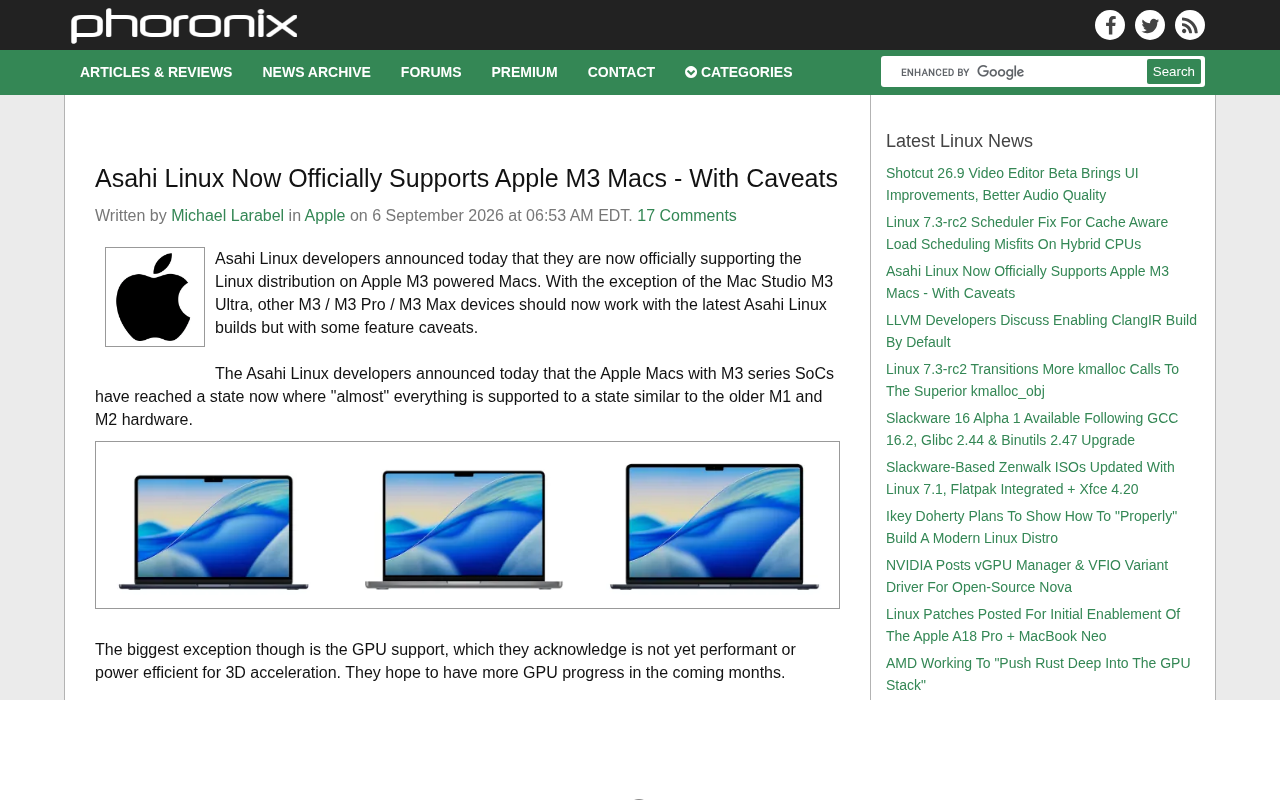
Asahi Linux now officially supports M3 Macs, though GPU, peripherals, and power management remain limited.
The Asahi Linux project has officially extended support to Apple M3 chip Macs, marking another milestone in bringing Linux to Apple Silicon. Despite lacking official documentation, the team successfully reverse-engineered M3's new 3nm architecture and Dynamic Caching GPU features. Current limitations include incomplete GPU acceleration, limited peripheral support (especially Touch ID), and power management refinement needs. The community-driven project continues pushing code upstream to benefit the broader Linux ecosystem.
Asahi Linux Lands on M3: Another Step Forward for Linux on Apple Silicon
Since Apple's full transition to its custom Apple Silicon chips, running Linux on these closed hardware platforms has been a major challenge for the open-source community. Apple Silicon is the custom ARM-based chip series Apple began using in its Mac lineup starting in 2020. Previously, Macs had long relied on Intel's x86 architecture processors, and developers had accumulated extensive Linux drivers and toolchains for the x86 platform. After Apple shifted to ARM architecture, not only did the instruction set change, but the company also adopted a unique Unified Memory Architecture (UMA), integrating CPU, GPU, and Neural Engine on a single chip sharing a common memory pool. While this highly integrated design delivers exceptional power efficiency, it also means that traditional Linux kernel drivers written for discrete GPUs and separate memory architectures are almost entirely incompatible, requiring driver models to be redesigned from the ground up.
Recently, the Asahi Linux project—dedicated to porting Linux to the Apple Silicon platform—announced that it has officially expanded support to Mac devices powered by the M3 chip. This milestone means more users of Apple's newer devices can experience a native Linux environment, though some limitations currently remain.
The announcement sparked significant attention in the tech community, garnering 221 upvotes and over 130 comments on Hacker News alone, reflecting the developer community's sustained enthusiasm for openness on the Apple Silicon platform.
From Reverse Engineering to Official Support
The core challenge of the Asahi Linux project lies in Apple's refusal to publicly document its custom chip hardware. In traditional Linux hardware support workflows, chip manufacturers typically provide hardware specification documents (datasheets) or directly contribute open-source driver code—for example, both AMD and Intel have dedicated teams submitting GPU drivers to the Linux kernel. However, Apple has never released critical technical documentation such as hardware register mappings, firmware interfaces, and GPU instruction sets for Apple Silicon. Therefore, the development team must conduct extensive reverse engineering work to systematically uncover how key components like the GPU, display controllers, and power management operate, then write functional drivers.
Asahi's reverse engineering methods primarily include: inferring hardware behavior by analyzing system calls and memory access patterns in macOS drivers, using custom hardware tracing tools to record GPU command streams, and conducting bare-metal register probing experiments. This work demands not only deep expertise in low-level systems programming but also comprehensive understanding of graphics, power management, and SoC design.
From initial M1 series support to subsequent M2 series, and now M3, the Asahi team must adapt to architectural changes with each new chip generation. The M3 is manufactured using TSMC's first-generation 3nm process (N3B), making it one of the first consumer-grade chips to use this process. Compared to the 5nm (N5P) process used in M2, the 3nm process can accommodate more transistors in the same area—M3 contains approximately 25 billion transistors. Process changes affect not only the chip's physical characteristics but are often accompanied by microarchitectural redesigns—Apple fundamentally restructured the GPU cores in M3, shifting from the previous generation's grouped execution unit model to a more flexible scheduling architecture, directly impacting GPU driver command submission and resource management logic. This official announcement of M3 support marks the team's success in overcoming some of the core challenges introduced by the new chip.
Why M3 Adaptation Deserves Attention
The M3 series introduces new features like Dynamic Caching, with significant GPU architecture adjustments. Dynamic Caching is a key innovation Apple introduced in the M3 GPU: in traditional GPU architectures, each shader task pre-allocates a fixed amount of register and local memory space at launch, and regardless of actual usage, these resources remain locked until the task completes. M3's Dynamic Caching implements hardware-level on-demand allocation—the GPU evaluates each shader's actual resource requirements in real-time during execution and dynamically adjusts allocations. This mechanism dramatically improves GPU resource utilization and parallel execution efficiency, but from a driver development perspective, it changes the fundamental model of GPU memory management and task scheduling. Drivers must understand and correctly configure this new resource allocation protocol, or risk rendering errors or severe performance degradation.
These underlying changes mean drivers written for M1 and M2 cannot be directly reused; the team must re-understand and adapt each component. Accomplishing this work without official documentation fully demonstrates the Asahi community's powerful reverse engineering capabilities and long-term technical expertise.
"Qualified" Support: Current Functional Limitations
As emphasized in the official announcement—"With Caveats"—current M3 support is not flawless. This reflects Asahi Linux's consistently honest approach: clearly informing users which features work and which remain under development.
Notably, installing Asahi Linux does not require jailbreaking or bypassing Apple's security mechanisms. Apple has retained a boot mode called "Reduced Security" in Apple Silicon Macs, allowing users to install third-party operating systems on separate APFS volumes. macOS and Linux can safely coexist on the same device, with users selecting the system through a boot manager at startup. Apple's Secure Enclave and other security hardware continue protecting macOS partition integrity in this mode, but this is also why some features struggle to work under Linux—these security components' communication protocols are highly closed and tightly coupled with macOS's security framework.
Common limitations in the current early support phase include:
- Incomplete GPU acceleration: Graphics performance and certain rendering functions may not be fully optimized
- Limited peripheral support: Some interfaces, cameras, fingerprint recognition (Touch ID), and other hardware features may be temporarily unavailable, with Touch ID particularly difficult to adapt due to its reliance on Secure Enclave's closed communication protocols
- Power management needs refinement: Battery life and sleep/wake functions may not be as stable as macOS
- External display compatibility: External displays and similar features may have compatibility issues
For users wanting to experiment, Asahi Linux on M3 is currently better suited for tech enthusiasts and developers to explore and test, and is not yet recommended as a daily production environment.
A Community-Driven Open Source Exemplar
Asahi Linux is a purely community and volunteer-driven project without any official Apple support. This "bottom-up" development model embodies the core values of open source: facing a closed hardware ecosystem, the community can still secure more choice and freedom for users through collaboration and technical capability.
Worth mentioning is that Asahi Linux doesn't simply maintain an independent Linux fork; its core strategy is to push all driver code upstream to the mainline Linux kernel whenever possible. The project's key technical achievements include: the open-source GPU driver led by core developer Alyssa Rosenzweig, implementing OpenGL and Vulkan support for Apple GPUs based on the Mesa 3D graphics library; and platform initialization code, interrupt controller drivers, and device tree description files advanced by project founder Hector Martin (marcan). Asahi has also developed its own bootloader (m1n1) to load the Linux kernel within Apple's boot chain. Most of these components have been merged into the mainline Linux kernel and Mesa project, meaning other Linux distributions like Fedora and Ubuntu will directly benefit from these achievements in the future, not just Asahi Linux's own distribution.
Every project advancement depends on support from donors and contributors. The landing of M3 support is not only a technical breakthrough but also a powerful validation of the open-source community's collaborative capabilities. It proves that even facing highly closed hardware platforms like Apple's, open-source forces can still find breakthroughs.
Significance and Outlook
For users, Asahi Linux's M3 support means Apple's high-performance hardware is no longer limited to the macOS operating system alone. Apple Silicon is widely praised for its exceptional power efficiency and performance; being able to run Linux on these devices undoubtedly opens new possibilities for developers, researchers, and even ordinary Linux users. For example, machine learning researchers can leverage Apple Silicon's Neural Engine and unified memory architecture for model training in a Linux environment, while embedded developers can perform cross-compilation and testing on high-efficiency ARM-native platforms.
Looking ahead, as the team continues refining drivers and filling functional gaps, the Linux experience on M3 is expected to gradually approach the maturity of M1 and M2 platforms. This also accumulates valuable experience for adapting subsequent chips like M4. Reverse engineering achievements from each chip generation will consolidate into the team's systematic understanding of Apple's hardware design philosophy, potentially shortening future adaptation cycles.
Asahi Linux will continue playing a key role in Linux porting for Apple Silicon, persistently exploring pathways for open-source freedom on closed hardware. If you're interested in installing Linux on your Mac, carefully read Asahi Linux's official documentation before actual deployment to fully understand current functional limitations and installation requirements.
Key Takeaways
- Asahi Linux has officially expanded support to M3 chip Macs, but with current functional limitations
- M3's new architecture (3nm process, Dynamic Caching) required extensive reverse engineering adaptation work
- Early support phase may have GPU, peripheral, power management, and external display limitations
- Installation does not require jailbreaking; uses Apple's "Reduced Security" boot mode for safe coexistence with macOS
- The project is purely community-driven and aims to contribute all code to the Linux mainline kernel
- Currently recommended for tech enthusiasts and developers to explore, not yet suitable as a daily production environment
Related articles

OmniVibe: Deep Dive into the AI Agent Creator Economy Marketplace
OmniVibe is a two-sided marketplace connecting AI agent creators with users, supporting multi-agent collaboration and pay-per-use monetization. Deep analysis of its product logic, differentiation, and challenges.

Berlin Under Ransomware Attack: Why Government Agencies Have Become Prime Targets
Berlin faces a severe ransomware attack targeting municipal systems. This analysis explores why government agencies are high-value targets, decodes double extortion tactics, and examines cybersecurity defense strategies in urban digital transformation.
AI Penetration Testing Learning Roadmap: Four Stages from Beginner to Advanced
A systematic breakdown of the four-stage AI penetration testing roadmap covering AI-assisted vulnerability discovery, automated asset collection, enterprise security integration, and intelligent Agent development.