Assembly Studio: A Deep Dive into the AI App Builder for Professional Service Firms

Assembly Studio is an AI app builder that helps professional service firms replace expensive per-seat SaaS tools.
Assembly Studio is an AI app builder targeting law firms, consultancies, and other professional service organizations. It lets users generate production-ready apps from natural language descriptions, clone expensive per-seat SaaS tools, and integrate with third-party platforms. With 20+ remixable templates and a free forever plan, it reframes software development as a cost-cutting business decision rather than a technical challenge.
In an increasingly crowded landscape of low-code and AI app builders, a product called Assembly Studio has climbed to #4 on the Product Hunt daily leaderboard with 256 upvotes. Its positioning is remarkably clear: an AI app builder purpose-built for professional service firms, backed by an aggressively worded tagline — "Stop paying for someone else's software."
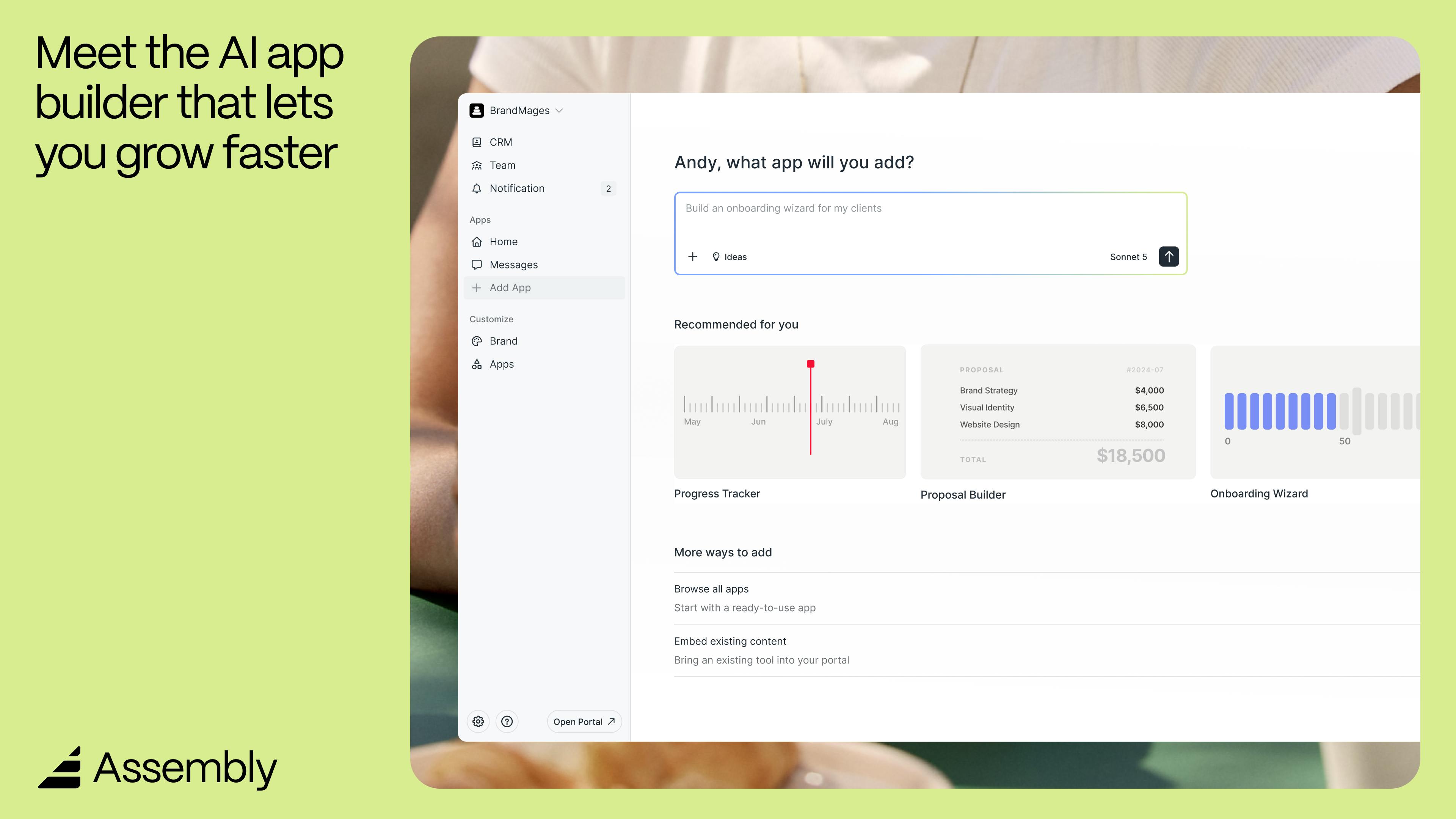
What Is Assembly Studio: An AI App Builder Targeting a Vertical Market
Unlike universal platforms that aim for "anyone can build software," Assembly Studio has laser-focused its target audience on law firms, consulting companies, accounting firms, agencies, and other professional service organizations. These organizations share a common pain point: their business processes are highly customized, yet they're forced to purchase numerous generic SaaS tools charged on a per-seat basis — resulting in high long-term costs and tools that never quite fit their workflows.
Assembly Studio's core proposition is simple: let these firms describe their needs in natural language and generate production-ready apps within minutes. Typical use cases highlighted by the company include onboarding agents, data analytics dashboards, and community hubs — precisely the functional modules that professional service firms encounter repeatedly in their daily operations.
From "Describe" to "Deploy": Assembly Studio's Product Logic
The user journey is compressed to extreme simplicity: describe what you want in a single sentence, and the system generates the corresponding app. This is powered by AI's ability to understand requirements and generate code, supplemented by 20+ remixable templates that let users make adjustments on top of existing structures rather than starting from scratch.
This "templates + AI generation" combination effectively lowers the barrier for non-technical users. For law firm partners or management consultants, what matters is whether the business workflow runs smoothly — not the underlying implementation. Assembly Studio aims to hide technical complexity behind a natural language interface.
The Core Selling Point: The Business Ambition of "Cloning Any Expensive SaaS App"
Assembly Studio's most provocative selling point is its open encouragement for users to "Clone any overpriced app charging you per seat." This statement takes direct aim at the per-user subscription model prevalent across the SaaS industry.
For professional service firms with dozens or even hundreds of employees, per-seat pricing means software costs scale linearly with team size. Assembly Studio's alternative: instead of continuously paying subscription fees for generic tools, build "the firm only you can build."
The brilliance of this narrative lies in reframing "building software" from a technical challenge into a cost-cutting business decision. Combined with the promise of a free forever plan, the product sets virtually no barriers at the acquisition stage — aligning with the common AI tool playbook of using free tiers to rapidly accumulate users.
Third-Party Integration: The Critical Variable for Real-World Adoption
The product also emphasizes its ability to "connect any third-party tool." For professional service firms, this may matter more than the generation capability itself — their existing workflows typically span CRM systems, document management platforms, financial software, and more. An app that can't integrate into the existing toolchain will struggle to achieve real adoption, no matter how quickly it's generated.
Whether Assembly Studio can deliver on the "connect any tool" promise — and the depth and stability of those integrations — will directly determine whether it remains a "quick prototyping tool" or can genuinely replace existing paid software.
Opportunities and Challenges: A Sober Assessment
From an industry trend perspective, Assembly Studio aligns with two clear directions: AI-driven app generation is maturing rapidly, and vertical industries have genuine demand for customized, de-subscriptionized solutions. Compared to generic no-code platforms, its focus on the professional services niche makes the value proposition considerably sharper.
However, behind the aggressive positioning lie several questions that need validation:
- The reality of production-grade quality: "Generate production-ready apps in minutes" is standard marketing language for virtually all AI builders. Actual delivery quality, maintainability, and security still require long-term scrutiny.
- The boundaries of cloning: Encouraging users to "clone" existing paid apps may face challenges around feature completeness and potential compliance concerns.
- Sustainability of the free model: While a "free forever" plan helps with user acquisition, how the company achieves commercial viability through premium features or enterprise plans will determine its long-term survival.
Conclusion: A Landmark Product in AI App Builders' Shift from General to Vertical
Assembly Studio represents a textbook example of AI app builders moving from "general-purpose" to "vertical-specific." Rather than trying to please everyone, it precisely targets the cost pain point of professional service firms, using the provocative tagline "Stop paying for someone else's software" to translate technical capabilities into language that business operators understand.
For small and mid-sized professional firms burdened by SaaS subscription costs, this type of tool is worth watching and experimenting with. But before migrating core business systems over, firms should carefully evaluate its stability, integration capabilities, and long-term reliability. AI has made "building your own apps" easier than ever before — but building apps that are truly "battle-tested" remains the real dividing line.
Related articles

Gemini 4 Argon Hands-On: AI Builds Board Games, Constructs Temples, and Trains Robots Autonomously
Gemini 4 Argon hands-on roundup: AI autonomously builds a desk racetrack and temple in Blender, writes a ray tracing engine, trains a humanoid robot to sink 7 shots, plus API pricing and developer access.

The Magic Octagonal Coin: Why Only 9% of People Can Predict Its Flip?
Only 9% of people can correctly predict the Magic Octagon coin flip. This article explains its spatial rotation mechanism, common cognitive pitfalls, and a new hypothesis based on Relevance Theory, exploring the limits of human spatial reasoning.

Sam Altman: AI Is Entering the Era of Scientific Discovery — Math Breakthroughs Will Replicate in Biology and Energy
Sam Altman says AI is entering the era of scientific discovery — math breakthroughs will replicate in biology, materials science, and energy to help develop new drugs and energy sources.