Asset4D-Bench: How Do Coding Agents Reconstruct Editable 3D/4D Scenes?

Asset4D-Bench shows coding agents are decent at 3D/4D reconstruction dynamics, but object relationship recovery is a clear weak spot.
Asset4D-Bench is a new benchmark for evaluating AI coding agents' ability to reconstruct 3D/4D scenes from visual references. It contains 114 conditions covering image editing, video reconstruction, and from-scratch tasks, with 228 archived scores collected. Evaluation requires agents to output editable Blender project files, and reviewers reopen projects and compare them item by item against native reference states. The key finding is: among 24 from-scratch tasks, each model earned full dynamics credit on 14 tasks, but the relationship dimension had zero scores, and the average recovery fidelity gap between GPT-6.1-Sol and GPT-6-Astra was 6.50 points, with the relationship dimension contributing 5.15 points. The study shows agents perform well in object and motion recovery, but understanding spatial and physical relationships between objects remains the main bottleneck.
Introduction: When Coding Agents Meet 3D/4D Reconstruction
Imagine a scenario: a small cart travels along a reference trajectory, but its cargo hovers above the deck. This physically implausible phenomenon is exactly the typical failure of current AI coding agents when reconstructing 3D/4D scenes. The Asset4D-Bench benchmark was created to evaluate whether coding agents can recover objects, motion, and interactions from visual references and output editable Blender scenes.
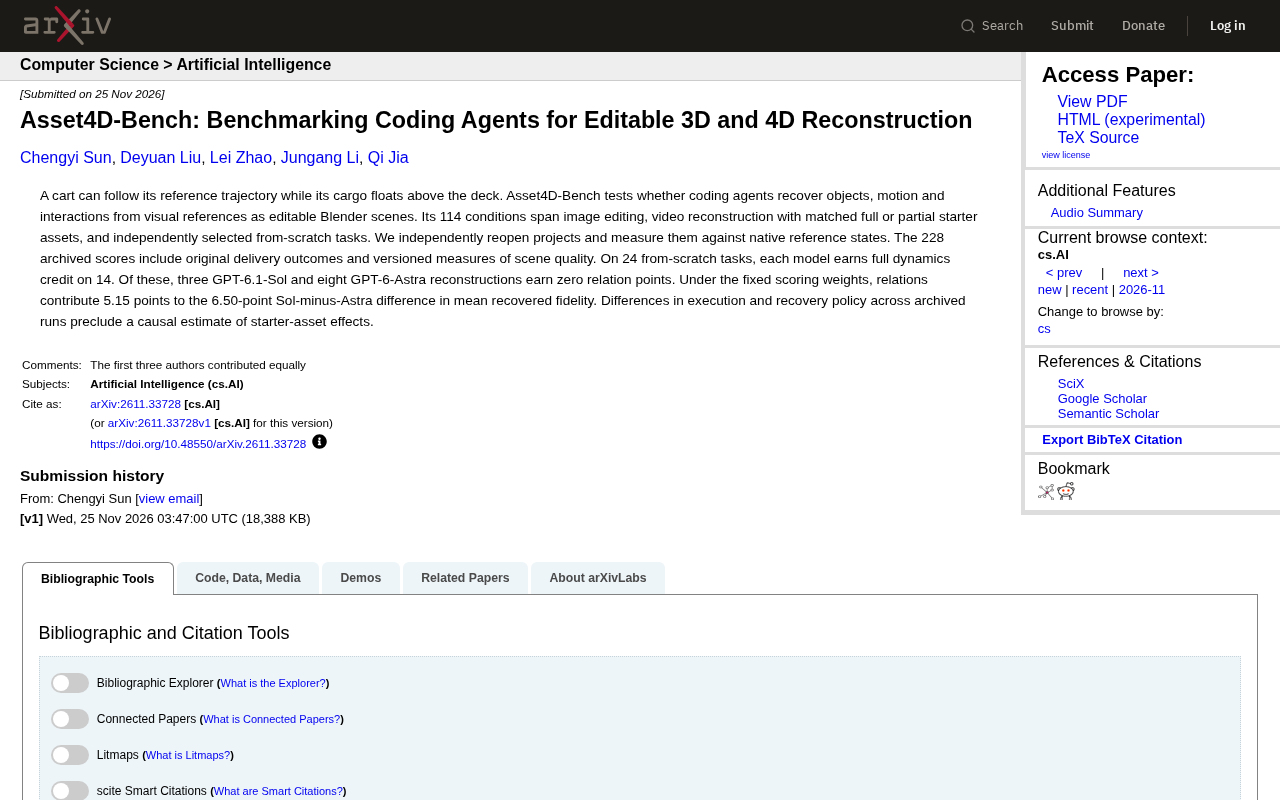
The benchmark contains 114 conditions, covering image editing, video reconstruction (matching complete or partial starting assets), and independently selected from-scratch tasks. The research team collected 228 archived scores by independently reopening projects and measuring them against native reference states, including original delivered results and versioned measures of scene quality.
Blender project files are the native project format (.blend) of the Blender software, which fully preserves editable data such as scene hierarchy, mesh geometry, material nodes, lights and cameras, keyframe animations, and modifier stacks. Unlike outputting only rendered images or videos, delivering a .blend file means reviewers can reopen the project and check item by item whether objects are separated, materials are adjustable, and motion curves are correct, thereby evaluating the editability and structural fidelity of the reconstruction result. This is precisely why Asset4D-Bench requires agents to output Blender scenes rather than merely generating images or videos.
Key Findings: High Dynamics Scores, Relationship Recovery Is the Weak Spot
Among the 24 from-scratch tasks, each model earned full dynamics credit on 14 tasks. However, relationship recovery performance was less satisfactory. Specifically, three reconstructions by GPT-6.1-Sol and eight reconstructions by GPT-6-Astra scored zero on the relationship dimension.
Under fixed scoring weights, relationships contributed 5.15 points, while the difference between Sol and Astra in average recovery fidelity was 6.50 points. This data highlights the critical role of relationship modeling in scene reconstruction and exposes current models' shortcomings in understanding interactions between objects.
Dynamics credit here refers to whether the agent correctly reconstructed the motion trajectories and temporal evolution of objects in the scene, for example whether the cart travels along the reference trajectory and whether animation keyframes match the motion in the video. It focuses on "how objects move," while the relationship dimension focuses on "how objects interact with and constrain each other," for example whether cargo sits firmly on the deck and whether objects maintain reasonable spatial and physical contact. The two are complementary: a scene may have completely correct motion trajectories yet lose points on the relationship dimension because objects hover, interpenetrate, or lose contact. This is precisely the significance of the benchmark distinguishing dynamics and relationship metrics.
Methodology: Multi-Dimensional Evaluation and Independent Verification
The evaluation system of Asset4D-Bench is rigorously designed. It examines not only the final rendered result but also the editability of the generated scene. Each task requires the agent to output a Blender project file, and the review team reopens these projects and compares them item by item against native reference states.
The evaluation dimensions include object geometry, materials, motion trajectories, and interactions between objects. Among them, the relationship dimension specifically examines whether the spatial and physical relationships between objects are reasonable, such as whether cargo is correctly placed on the deck. This fine-grained evaluation approach can more comprehensively reflect the true capabilities of agents.
Native reference state refers to the original Blender scene project constructed by humans or the author team as the scoring baseline. Reviewers open the .blend file submitted by the agent side by side with this reference project and compare object poses, material parameters, and animation curves at the same viewpoint and the same time point, rather than making subjective judgments based solely on rendered screenshots. This "reopen the project and compare item by item" approach can capture errors that are difficult to notice in rendered images (such as internal hierarchy disorder in objects or unapplied modifiers), and also makes scores across different models comparable.
Model Comparison: Analyzing the Difference Between Sol and Astra
Among the 24 from-scratch tasks, both models earned full dynamics credit on 14 tasks. But on the relationship dimension, both GPT-6.1-Sol and GPT-6-Astra had zero-score cases, and Astra had more zero scores.
In average recovery fidelity, Sol led Astra by 6.50 points, of which the relationship dimension contributed 5.15 points. This means the main source of the gap between the two is relationship modeling capability. However, the study also notes that due to differences in execution and recovery strategies across archived runs, no causal estimate can be made about the effect of starting assets.
Implications and Outlook
The launch of Asset4D-Bench provides a standardized evaluation tool for the 3D/4D reconstruction capabilities of coding agents. Current results show that agents already perform reasonably well in recovering objects and motion, but still have obvious shortcomings in understanding relationships between objects.
Future improvement directions may include: enhancing understanding of physical laws, introducing relationship reasoning modules, and optimizing recovery strategies that start from partial assets. As the benchmark continues to improve, we can expect to see more intelligent and reliable 3D/4D scene reconstruction agents.
One-line Summary
Asset4D-Bench shows coding agents are decent at 3D/4D reconstruction dynamics, but object relationship recovery is a clear weak spot.
Paragraph Summary
Asset4D-Bench is a new benchmark for evaluating AI coding agents' ability to reconstruct 3D/4D scenes from visual references. It contains 114 conditions covering image editing, video reconstruction, and from-scratch tasks, with 228 archived scores collected. Evaluation requires agents to output editable Blender project files, and reviewers reopen projects and compare them item by item against native reference states. The key finding is: among 24 from-scratch tasks, each model earned full dynamics credit on 14 tasks, but the relationship dimension had zero scores, and the average recovery fidelity gap between GPT-6.1-Sol and GPT-6-Astra was 6.50 points, with the relationship dimension contributing 5.15 points. The study shows agents perform well in object and motion recovery, but understanding spatial and physical relationships between objects remains the main bottleneck.
Related articles

Samsung Tests Recompose Feature: Change the Viewing Angle After Taking a Photo
Samsung One UI 9.5 beta code reveals a Recompose feature based on the existing Move tool that may let users adjust a photo's viewpoint after capture. We analyze its technical logic, user value, and launch prospects.

Nimble's Detachable Power Bank Drops $20 — Is It Worth Buying?
Nimble SharePower 10,000mAh detachable power bank drops to $59.96, a $20 discount and all-time low. We analyze its detachable design, pricing, and buying advice across all four colors.

An Author Under a Gag Order: Sarah Wynn-Williams on 'Careless People'
Sarah Wynn-Williams, author of Careless People, discusses living under a gag order in a Guardian interview, exploring its impact on writers and platform power.