AstroForge Hands Spacecraft Control to AI: The Autonomous Ambitions of Autonomy-1

AstroForge's Autonomy-1 will be the first spacecraft commanded by an onboard Transformer AI model.
Space startup AstroForge has announced that its next-generation probe Autonomy-1 will carry a small Transformer-based AI model to autonomously control the spacecraft, replacing the traditional ground-commanded operations model. The decision is rooted in a core pain point of deep-space exploration: round-trip communication delays can stretch to hours, making any ground-dependent response to contingencies a serious mission liability. The Transformer architecture's strengths in sequential decision-making make it well-suited for the role, while miniaturization is a necessary compromise given the tight compute and power constraints of space hardware. The attempt also raises serious challenges: there is a fundamental tension between aerospace's extreme reliability requirements and the inherent uncertainty of neural networks, making interpretability, fail-safe design, and predictability critical questions AstroForge must answer head-on.
AI Takes the Command Seat on a Deep-Space Probe for the First Time
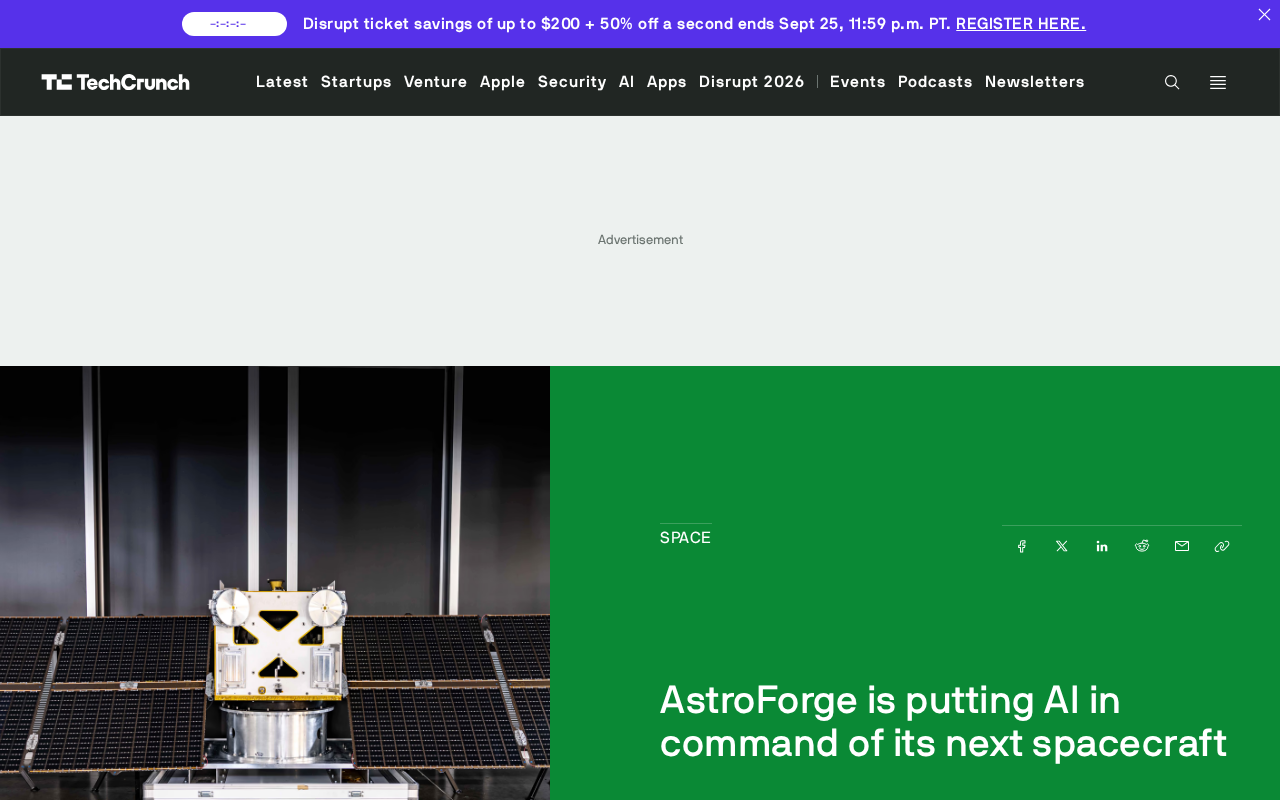
Space startup AstroForge has announced that its next-generation spacecraft, Autonomy-1, will hand direct control to a small, Transformer-based AI model. This marks a shift away from the traditional model of spacecraft operations — dominated by ground control centers and pre-programmed command sequences — toward onboard autonomous decision-making.
This is no marketing stunt. It's a deliberate technical response to the inherent challenges of deep-space exploration. As a probe ventures farther from Earth, communication delays, bandwidth constraints, and the need for frequent ground intervention all become bottlenecks to mission efficiency. Letting an AI make real-time judgments onboard is the most direct way to work around these limitations.
Why Transformer Architecture?
One key technical detail worth noting: AstroForge chose a small Transformer-based model rather than a traditional rule engine or a large deep neural network. The Transformer architecture has dominated natural language and multimodal AI in recent years thanks to its strengths in sequence modeling and contextual understanding. Porting it to spacecraft control reflects a broader trend: taking mature AI paradigms developed on the ground and compressing, trimming, and deploying them onto space hardware where compute and power budgets are extremely tight.
"Small" is the operative word here. Deep-space probes face severe constraints in computational resources, power budgets, and radiation hardening requirements — there's simply no room for models with tens of billions of parameters. A stripped-down Transformer model must retain sufficient decision-making capability while running reliably in a constrained environment. That balance is itself a significant engineering challenge.
The Transformer architecture was originally introduced by Google in 2017 in the paper Attention Is All You Need. Its core mechanism — self-attention — allows the model to reference the full context of a sequence when processing any given position, rather than passing state incrementally the way earlier RNN/LSTM models did. This gives Transformers a natural advantage in capturing long-range dependencies. Spacecraft control is fundamentally a continuous sequential decision problem: sensor data streams in over time, and the model must integrate historical state with current readings to make judgments — a task profile that maps closely onto what Transformers do well. The engineering path to deploying a "compressed" version on space hardware typically involves knowledge distillation (training a small model using a larger one), weight quantization (reducing parameter precision to cut computation), and task-specific pruning — all aimed at preserving sufficient inference capability within a memory footprint of tens to hundreds of megabytes.
From Ground-Controlled to Onboard Autonomous
Traditional space missions rely heavily on ground operations: engineers write command sequences, uplink them to the spacecraft, and the probe executes them step by step. When something unexpected happens outside the planned scenarios, the team must wait for ground analysis and re-upload new instructions — and in deep space, a single round-trip communication can take minutes to hours.
Autonomy-1 aims to break that cycle. By having an AI model "command" the probe onboard, the spacecraft can respond faster to contingencies, target identification, attitude adjustments, and other dynamic situations, reducing dependence on the ground link. This aligns with the industry's growing interest in autonomous space systems and reflects the practical demands of missions like asteroid mining and deep-space resource prospecting — tasks that require long periods of independent operation.
A High-Stakes Technical Bet
Handing control to an AI means greater autonomy — but it also means a far more complex reliability verification problem. The aerospace industry has an extremely low tolerance for failure, and any onboard software must undergo rigorous testing. Placing a Transformer model in the commanding role raises fundamental questions that AstroForge will need to answer: How do you ensure the model's decisions are interpretable, predictable, and fail-safe?
From a broader perspective, this effort is yet another signal of AI pushing from consumer applications into high-reliability, mission-critical systems. If Autonomy-1 can validate the feasibility of onboard AI autonomous control, it could serve as a technical blueprint for future deep-space missions that go farther and tackle greater complexity.
The aerospace software domain has long favored formal verification and deterministic algorithms — for good reason. Neural network models are products of statistical learning, and their outputs can behave unpredictably when faced with out-of-distribution inputs. Interpretability is therefore critical: when the AI makes a particular attitude adjustment or mission abort decision, ground engineers need to be able to trace the decision pathway after the fact. While Transformer attention weights offer some visualization window, they don't constitute rigorous causal explanation. Mitigation approaches currently being explored in the industry include: constraining the AI within strict "operating envelopes" that force a fallback to conservative, deterministic safe modes when boundaries are exceeded; and deploying runtime monitors that independently validate model outputs. How AstroForge designs fail-safe mechanisms within these constraints will directly determine whether the system can achieve aerospace-grade certification.
Closing Thoughts
Publicly available information remains limited — the specific model size, training methodology, and mission details for Autonomy-1 have yet to be disclosed. But AstroForge's choice signals that spacecraft control is undergoing a paradigm shift from "remote execution" to "autonomous decision-making." Whether AI can prove itself in the most unforgiving environment imaginable — where failure is not an option — is a question well worth watching.
Related articles

A Single Prompt Triggers a Global PHP Security Storm: Is AI a Savior or a Hidden Risk?
A single AI prompt triggered a global PHP security crisis affecting Wikipedia and the Internet Archive. This article reviews the incident, analyzes the OpenAI-Amazon controversy, and explores the security paradox of lowered vulnerability discovery barriers in the AI era and developer response strategies.

When AI Is Taken Away: How Reliance on Shortcuts Undermines Your Problem-Solving Resilience
A study of 1,222 people found that after using AI to answer questions, once AI was removed, people gave up on more problems than a control group that never used AI. The article analyzes the impact of AI reliance on learning resilience and metacognition, and explores design implications for AI learning tools.

Carta and NewView Partner to Let Startup Employees Cash Out Equity Early
Carta and NewView Capital partner to simplify startup tender offers, helping employees sell equity early. Analysis of the mechanism, liquidity pain points, and impact.