Athena: A Three-Tier Memory System That Teaches AI Agents to Forget

Athena uses the Ebbinghaus forgetting curve and topic-based chaining to teach AI agents active forgetting over indiscriminate storage.
Common agent memory solutions — expanding context windows or storing everything in a vector database — sidestep the question of what information actually matters. The open-source service Athena introduces a three-tier memory structure (short-term window, middle summary layer, long-term graph), uses cosine similarity to split chains by topic, and scores each memory with an Ebbinghaus forgetting curve formula. Frequently retrieved memories decay slowly and get promoted to the long-term graph; unused ones fade away. The core insight: forgetting should be the default, and remembering must be earned through repeated use.
An Agent's History Is Not the Same as Memory
Every AI agent starts each new session almost completely blank — it has no knowledge of what happened before. Developers typically reach for one of two fixes: expand the context window, or build a vector database that stores every single message ever exchanged. Both approaches share the same instinct — "keep more" — but they sidestep a more fundamental question: what actually matters.
A Reddit developer shared their open-source memory service called Athena, built specifically to address this pain point. The core idea is straightforward: memory shouldn't be an indiscriminate pile-up. Like the human brain, it should actively decide what's worth remembering and what can safely be forgotten.
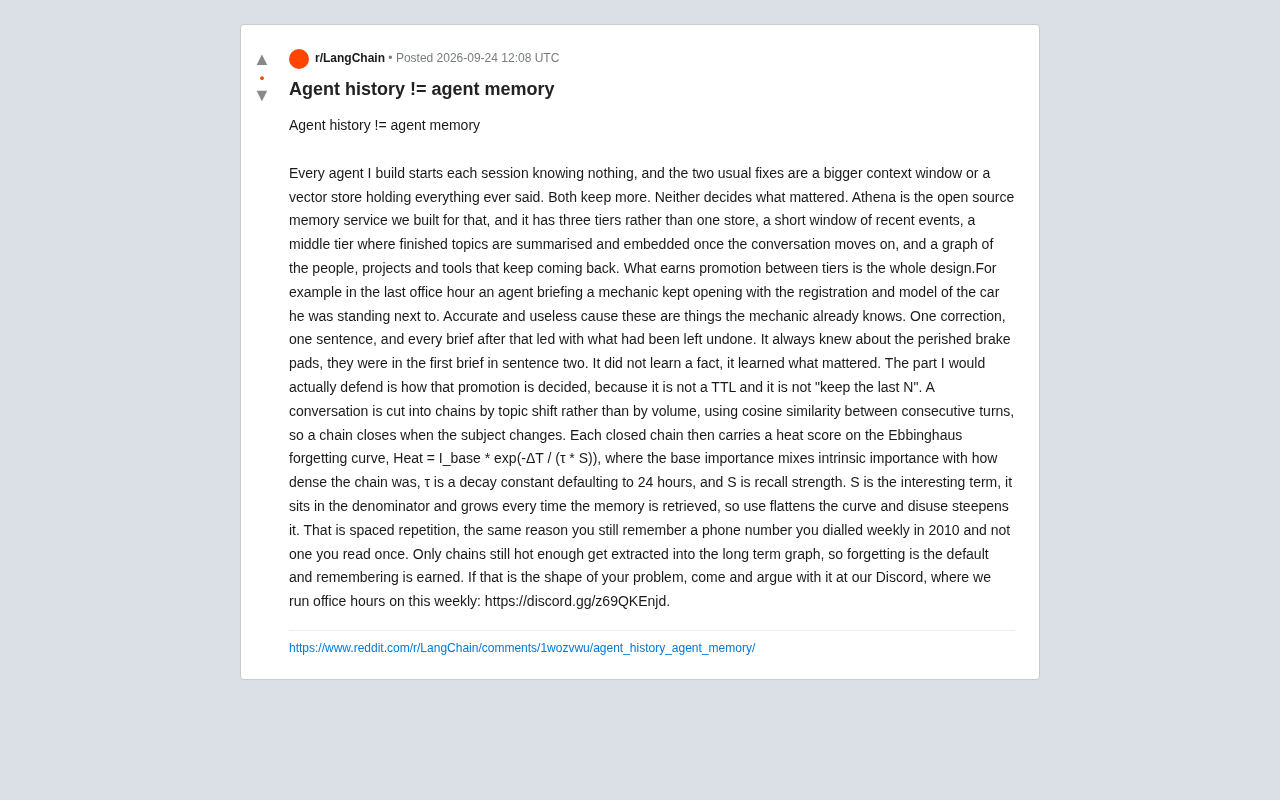
Three-Tier Memory Architecture: From Short-Term Window to Long-Term Graph
Rather than using a single storage layer, Athena is designed around three tiers:
- Short-term window: Stores recent events — essentially working memory;
- Middle layer: When a conversation shifts to a new topic, the now-closed previous topic gets summarized and embedded in one pass;
- Long-term graph: Tracks recurring people, projects, and tools, forming a continuously evolving relationship network.
What matters isn't how many tiers there are, but how information "gets promoted" between them. That promotion mechanism is the soul of the entire design.
A Real-World Example: The Auto Mechanic's Briefing
The author shared an example from a recent office hour that illustrates the point well. An agent was generating briefings for an auto mechanic and would open every one with the vehicle's license plate and model. The information was accurate — and completely useless. The mechanic was standing right next to the car; he already knew all of that.
After a single corrective instruction, every subsequent briefing opened with "items still unresolved." What's interesting is that the agent hadn't learned a new fact — "worn brake pads" had been sitting in the second sentence of the very first briefing all along. What it learned was what mattered, not an additional data point. That distinction is the essential difference between memory and a history log.
The Promotion Mechanism: Not TTL, Not a Rolling Window
The part the author most wants to defend is the promotion logic itself. It deliberately rejects two mainstream approaches: TTL (time-to-live) for periodic cleanup, and the blunt "keep the last N messages" window.
Split by Topic, Not by Volume
A conversation is divided into "chains" based on topic shifts, not arbitrary size. The system computes cosine similarity between consecutive conversation turns — when the topic changes, similarity drops and a chain closes. This aligns memory boundaries with natural semantic divisions.
Cosine similarity measures the directional difference between two pieces of text in vector space, ranging from −1 to 1, where values closer to 1 indicate greater semantic similarity. In practice, each conversation turn is encoded as a high-dimensional vector (typically via an embedding model), and the cosine of the angle between adjacent turn vectors is calculated. When consecutive turns stay on the same topic, the vectors point in similar directions and cosine values stay high. The moment a user shifts topics — say, from discussing code architecture to asking about a deployment timeline — the vector direction shifts, cosine similarity drops sharply, and the chain closes. This approach captures semantic "topic boundaries" more effectively than simple keyword matching, though it depends on the quality of the underlying embedding model. Gradual topic transitions can cause boundary detection to miss the shift.
Scoring Memory "Heat" with the Forgetting Curve
Every closed chain is assigned a heat score based on the Ebbinghaus forgetting curve:
Heat = I_base * exp(-ΔT / (τ * S))
Where:
- I_base (base importance): A blend of intrinsic importance and the information density of the chain;
- τ (decay constant): Defaults to 24 hours;
- S (recall strength): This is the most elegant piece.
S sits in the denominator, and every time a memory is retrieved, S increments by one. This means frequent use flattens the forgetting curve, while prolonged disuse steepens it. This is exactly the principle behind spaced repetition — the same reason you still remember a phone number you dialed every week in 2010, but can't recall a number you only ever looked at once.
Only chains whose heat score remains high enough get promoted into the long-term graph. In other words, forgetting is the default state; being remembered has to be earned.
Spaced Repetition is a memory reinforcement technique from cognitive psychology. Its core insight is that reviewing material just as a memory is about to fade requires the fewest repetitions while producing the best retention. The most well-known commercial application is tools like Anki, which dynamically schedule the next optimal review based on when you last reviewed and your historical accuracy. Athena reverse-engineers this mechanism into an agent system: each retrieval acts as a "review," and the growth of S flattens the forgetting curve, keeping that memory above threshold for longer. The result is that the system's memory isn't a static database — it's a dynamic structure that continuously reweights based on usage patterns. Frequently retrieved context naturally rises to the surface; information that's never referenced quietly fades away.
Why This Approach Is Worth Paying Attention To
Most mainstream agent memory solutions today are fundamentally trading off storage cost against retrieval precision, without ever directly confronting the cognitive question of trade-offs. Athena brings the economics of human memory — use it or lose it, semantic chunking, active forgetting — into an engineering implementation. That's a meaningful shift in direction.
For agents that run over long periods and continuously serve the same users or teams, indiscriminate memory accumulation is not only expensive — it drowns retrieval in irrelevant noise. A system that knows how to forget may actually produce more relevant, more useful outputs, as the auto mechanic example demonstrates.
It's worth noting that all of this comes from a single developer's post on Reddit, and the actual performance and practical boundaries of this approach still need validation through broader real-world use. The author has also opened a Discord community with weekly office hours to discuss the design. Developers who are curious are encouraged to go test and challenge these design decisions themselves.
Related articles

Should U.S. College Fraternities Be Banned? A Researcher's Incisive Observations
Why not just ban U.S. college fraternities? A researcher finds the key resistance comes from decision-makers' own fraternity identities and schools' "willful ignorance."

Microsoft Discovery: Accelerating Scientific Discovery with AI Agents
Microsoft's Discovery platform runs specialized AI agents to help researchers screen and prioritize the most promising compounds and experimental paths, reducing experiments and accelerating scientific discovery.

Cambridge Heavy Industries Secretly Develops Desktop-Scale Nuclear Fusion Device
Cambridge Heavy Industries is secretly developing a desktop-scale laser-driven nuclear fusion device, targeting the equipment supply market for fusion power plants. This article analyzes its miniaturization technology path, commercialization logic, and unique positioning in the fusion startup wave.