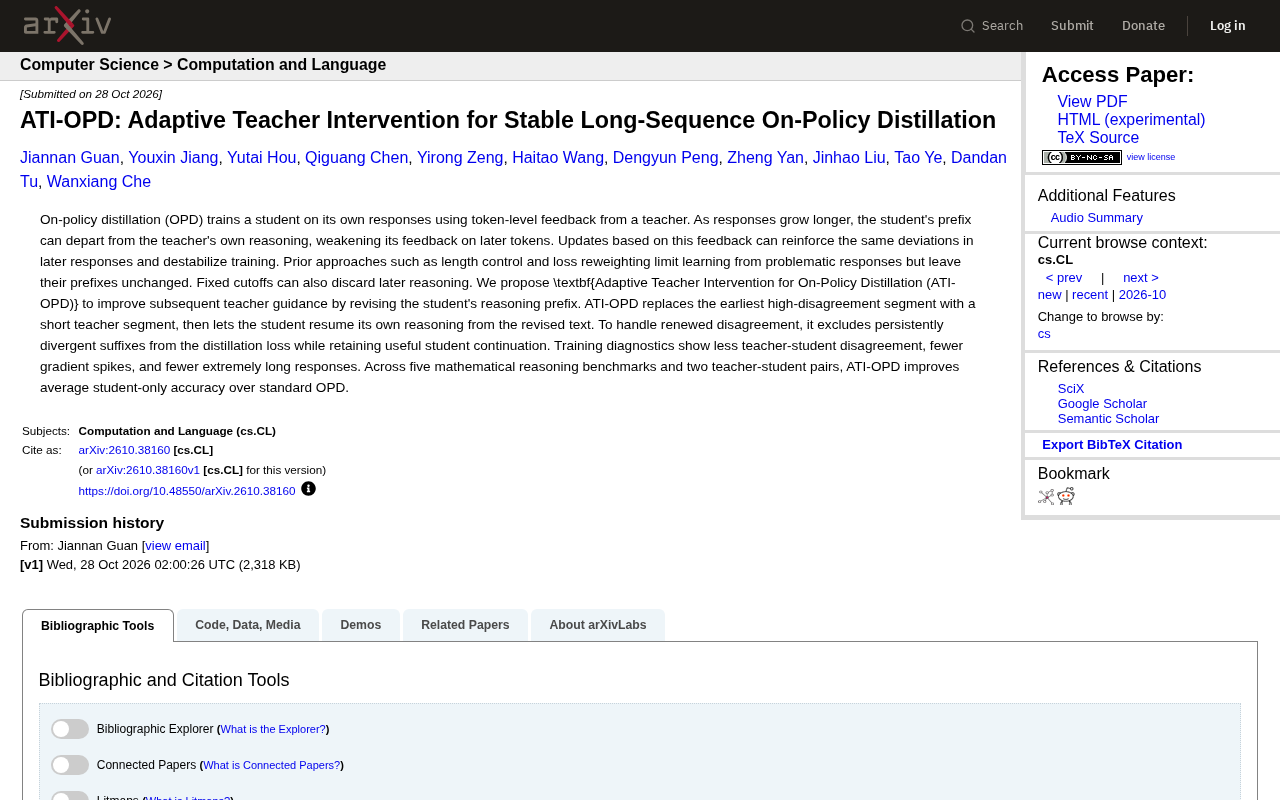
ATI-OPD: Adaptive Teacher Intervention Makes Long-Sequence Distillation More Stable

ATI-OPD stabilizes long-sequence distillation and improves student accuracy by replacing high-divergence prefixes and excluding persistently divergent suffixes.
The article discusses the core dilemma of on-policy distillation on long sequences: once the student's self-generated prefix diverges from the teacher's reasoning path, the teacher's subsequent token feedback degrades, and erroneous updates reinforce the divergence in a vicious cycle. Existing length control and loss reweighting can only limit learning from bad samples, not correct biased prefixes. The arXiv paper's ATI-OPD intervenes in two steps: replace the earliest high-divergence segment with brief teacher reasoning, letting the student continue autonomous reasoning from the corrected text; if divergence recurs, exclude the persistently divergent suffix from the distillation loss while retaining the rest. Training diagnostics show reduced divergence, fewer gradient spikes, and fewer extremely long responses; on five math reasoning benchmarks and two teacher-student model pairs, student standalone accuracy outperforms standard OPD.
The Dilemma of Long-Sequence Distillation: Feedback Fails Once Students Diverge from Teachers
On-policy distillation (OPD) lets a language model student learn on responses it generates itself, with the teacher model providing feedback on each token. This approach works stably on short sequences, but when responses grow longer, the student's reasoning prefix may gradually drift away from the teacher's own reasoning path. Once the prefix diverges, the quality of the teacher's feedback on subsequent tokens drops significantly. Worse still, parameter updates based on this feedback reinforce the same divergence in turn, creating a vicious cycle that leads to training instability.
Existing methods such as length control and loss reweighting can limit what the model learns from problematic responses, but they do not correct the biased prefix itself. Fixed truncation strategies may also simply discard valuable downstream reasoning content.
On-policy distillation (OPD) is a variant of knowledge distillation: the training data is not a fixed offline corpus but responses generated in real time by the student model under its current parameters. The teacher model provides per-token probability distributions (soft labels) over these self-generated responses as supervision signals, and the student computes the distillation loss and updates its parameters accordingly. Because the training distribution drifts dynamically with the student's parameters, OPD is especially common when small models learn reasoning capabilities from large models.
In long-sequence scenarios, the effectiveness of OPD relies on an implicit assumption: the prefix generated by the student remains within the distribution the teacher "endorses." Once the prefix diverges, the teacher's soft labels for subsequent tokens are given based on a context it would never reach itself, so the supervision signal is misaligned with the student's actual state—this is the root cause of feedback failure.
The Core Idea of ATI-OPD: Replace High-Divergence Segments Instead of Abandoning the Whole Response
A paper from arXiv proposes Adaptive Teacher Intervention for On-Policy Distillation (ATI-OPD), which aims to improve subsequent teacher guidance by correcting the student's reasoning prefix when its reasoning diverges.
The approach proceeds in two steps. First, ATI-OPD locates the earliest segment where the student and teacher diverge, replaces it with a brief piece of teacher reasoning, and then lets the student continue reasoning autonomously from the corrected text. Second, if the student diverges again, ATI-OPD excludes the persistently divergent suffix from the distillation loss while retaining the student's subsequent useful content.
This dynamic intervention is fundamentally different from static truncation: it preserves the continuity of long-sequence reasoning while avoiding contamination of subsequent learning by an erroneous prefix.
Training Diagnostics: Less Divergence, More Stable Gradients, Shorter Responses
The paper's training diagnostics show that ATI-OPD brings three observable improvements: reduced divergence between teacher and student, fewer gradient spikes, and fewer extremely long responses. This means the training process is more stable and the model does not fluctuate violently due to individual abnormally long responses.
Gradient spikes are a common stability issue in long-sequence distillation, usually arising from erroneous updates after teacher feedback fails. By correcting prefixes and excluding persistently divergent suffixes, ATI-OPD reduces the generation of such anomalous gradients at the source.
Gradient spikes refer to the sudden sharp increase of the gradient norm on individual batches during training, often accompanied by a brief surge in loss or even parameter divergence. In long-sequence distillation, a single overly long response may contribute a large amount of token-level loss; if the teacher feedback within it has already failed, the erroneous supervision gets amplified into a violent update. Common mitigation measures include gradient clipping, loss normalization, and filtering of anomalous samples, but these suppress the problem after the fact rather than eliminating its source. By correcting bias at the prefix level and excluding persistently divergent suffixes from the loss, ATI-OPD reduces the very conditions under which anomalous gradients arise, so the drop in gradient spikes can serve as direct evidence of improved training stability.
Experimental Validation: Improvements on Five Mathematical Reasoning Benchmarks
The paper evaluates on five mathematical reasoning benchmarks and two teacher-student model pairs. Results show that ATI-OPD improves the student's average standalone accuracy compared with standard OPD. This improvement covers multiple benchmarks and model pairs, indicating that the method generalizes well.
Mathematical reasoning is a typical scenario for long-sequence distillation, because solving problems often requires dozens of derivation steps and the student can easily deviate from the teacher's path midway. Through adaptive intervention, ATI-OPD enables the student to continue along its own reasoning route after correcting key deviations, rather than being forced to imitate every step of the teacher.
Standalone accuracy refers to the accuracy of the student model alone, without teacher intervention, on the benchmarks after training is complete. It differs from teacher-forced accuracy during training and is a key metric for whether distillation truly transfers capabilities to the student. In OPD, if the student relies excessively on the teacher's prefix, it may perform well during training but accumulate errors easily during standalone reasoning. Therefore, using standalone accuracy as the primary evaluation can test whether ATI-OPD's intervention enables the student to autonomously complete long-chain reasoning, rather than merely imitating the teacher's trajectory.
Implications for Long-Sequence Distillation
The value of ATI-OPD lies in achieving a better balance between "correction" and "preservation." Traditional methods either let the student keep updating along an erroneous prefix or truncate potentially valid reasoning with a fixed threshold. ATI-OPD instead performs local intervention based on the dynamic evolution of divergence—neither over-intervening nor letting divergence go unchecked.
This approach has direct reference value for distillation tasks that require long-chain reasoning—such as mathematics, code generation, and multi-step planning. The paper's code and implementation details are worth following for future open-source progress.
One-line Summary
ATI-OPD stabilizes long-sequence distillation and improves student accuracy by replacing high-divergence prefixes and excluding persistently divergent suffixes.
Paragraph Summary
The article discusses the core dilemma of on-policy distillation on long sequences: once the student's self-generated prefix diverges from the teacher's reasoning path, the quality of the teacher's subsequent token feedback degrades, and erroneous updates further reinforce the divergence, creating a vicious cycle. Existing length control and loss reweighting can only limit learning from bad samples and cannot correct biased prefixes. The arXiv paper's ATI-OPD intervenes in two steps: first, it replaces the earliest high-divergence segment with brief teacher reasoning, letting the student continue autonomous reasoning from the corrected text; if divergence recurs, it excludes the persistently divergent suffix from the distillation loss while retaining the rest. Training diagnostics show reduced divergence, fewer gradient spikes, and fewer extremely long responses; on five mathematical reasoning benchmarks and two teacher-student model pairs, the student's average standalone accuracy exceeds that of standard OPD.
Related articles
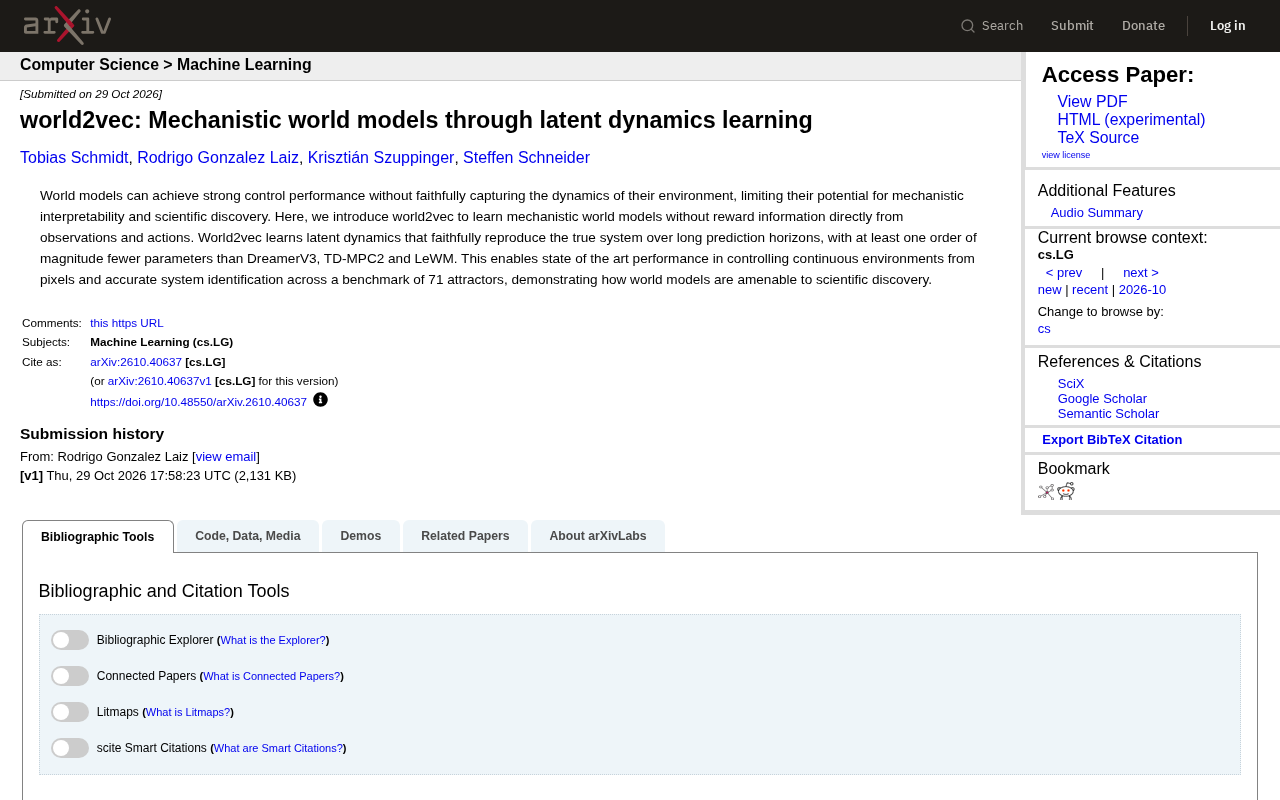
world2vec: Building Mechanistic World Models with Latent Dynamics Learning
world2vec proposes a reward-free method for learning mechanistic world models via latent dynamics, faithfully reproducing systems over long horizons with at least an order of magnitude fewer parameters than DreamerV3, TD-MPC2, and LeWM, and achieving accurate system identification on 71 attractor benchmarks.

A New KL-DRO Paradigm: Adaptive Scenario Generation Around a Learned Density Model
KL-DRO research proposes centering the KL ball on a learned density model instead of the empirical distribution, with adaptive scenario generation guiding sampling toward the worst case. Experiments show lower cost under distribution shift when records are scarce and the model can extrapolate, with comparable in-distribution cost.

ODE Samplers for Discrete Diffusion Models: Exponential Residual Flows Accelerate Generation
Discrete diffusion models lack deterministic ODE sampling? This article introduces Exponential Residual Flows (ERFs), which introduce continuous residual variables per token to construct piecewise ODEs for deterministic sampling and support consistency distillation acceleration. Superior to prior methods on code and text generation tasks.