Atlassian MCP in Action: How an AI Agent Compresses Half a Day of Onboarding Into a Single Prompt

Atlassian's MCP demo collapses half-day engineering onboarding into a single AI agent prompt.
Atlassian's MCP demo shows a concrete scenario: a new engineer pastes a repo URL into an AI agent connected to the Atlassian MCP server (demonstrated with Cursor Desktop), and the agent automatically aggregates Confluence, Jira, Bitbucket, and Loom to generate a structured onboarding brief in minutes — covering service ownership, runbooks, active deliverables, and risk. The key design detail is that every conclusion links back to a real source, addressing LLM hallucination concerns. MCP as a standardized protocol layer means one configuration grants access to the full Atlassian toolchain. The approach's effectiveness, however, depends entirely on the team's existing documentation quality — MCP solves access and aggregation, not content creation.
On their first day, new engineers get added to a team, handed a repository link, and told to "get up to speed on your own." It's a scene almost every engineer has lived through — digging through code, asking around, hunting down the right Confluence space, tracing who did what, finding the Jira board, and only then getting a rough sense of what the service actually does. Atlassian's latest MCP (Model Context Protocol) demo aims to compress that entire process into a single sentence.
From Five Browser Tabs to One Prompt
The pain point of traditional onboarding is fragmented information. The service description lives in Confluence, the task schedule is in Jira, the architecture walkthrough is in a Loom recording, the source code is in Bitbucket, and the person who actually knows what's going on is buried somewhere in a team conversation. As the demo puts it, this process typically means "five browser tabs, three conversations, and half a day."
With an AI agent connected to the Atlassian MCP server, the entire workflow collapses to this: paste the repository URL, then ask the agent to return everything at once. The demo uses Cursor Desktop connected to the Atlassian MCP server, where a single prompt instructs the agent to surface everything about the service — the team, the runbook, risk areas, and what the team is currently working on.
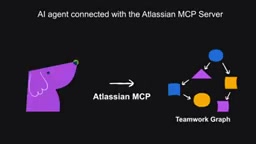
The key here isn't that "AI can answer questions" — it's that the AI agent gains a unified access point across tools. MCP, as the protocol layer, integrates Atlassian's previously siloed product line into a set of data sources the agent can call directly.
MCP (Model Context Protocol) is an open protocol proposed by Anthropic in late 2024, designed to standardize how AI models communicate with external tools and data sources. Previously, every AI application that wanted to integrate an external service — GitHub, Notion, Jira — required developers to write custom integration code from scratch, leading to massive duplication of effort. MCP's design philosophy resembles the USB-C standard: a tool only needs to implement one MCP server, and any AI client that supports the protocol can call it directly, without additional adaptation. Mainstream AI development tools like Cursor and Claude Desktop now support MCP, and major SaaS vendors are rapidly releasing their own MCP servers. What Atlassian has released is its official MCP server — wrapping Confluence, Jira, Bitbucket, and Loom into standardized interfaces that AI agents can call.
What the Agent Actually Did
The most valuable part of the demo is that it shows the concrete chain of actions behind the agent, rather than just presenting a black-box result. After receiving the prompt, the agent sequentially: read the Bitbucket repository, searched Confluence for team information, runbooks, and architecture notes, queried the Jira project, tracked down the Loom recording, and pulled the current risk register.

The output is a structured "onboarding brief": what the service does, who owns it, how to submit a first change, what the team is working on, and a list of risks a new junior engineer needs to know. One notable design detail — every statement in the brief links back to its source.
This "traceable" design directly addresses the biggest trust concern in AI agent applications. When the agent claims a service carries a certain risk, users can click through to see the Confluence page or Jira ticket it referenced, rather than being forced to trust an unverifiable block of generated text.
Every Conclusion Traces Back to a Source
The demo shows that the links in the brief genuinely point to real resources: the agent linked directly to the Bitbucket repository and showed the actual source code it analyzed; the Jira work items it surfaced were active deliverables on the team's board; and the Loom recording with the architecture walkthrough was embedded directly in the brief as a video.
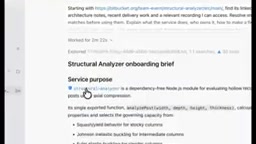
In other words, the agent isn't "fabricating a plausible-looking document" — it's aggregating, indexing, and citing real knowledge assets that already exist within the team. For engineering teams worried about LLM hallucinations, this kind of verifiable, link-backed presentation is a prerequisite for moving AI from "demo toy" to "production tool."
The "hallucination" problem in large language models refers to the model's tendency to generate text that invents non-existent facts or cites non-existent sources — with the same confident tone as accurate information, making it hard for users to tell the difference. In enterprise knowledge scenarios, this is especially dangerous: an agent that fabricates an "architecture risk" or misattributes a responsible party can directly cause bad decisions. The traceable design in Atlassian's demo essentially mitigates hallucination through a Retrieval-Augmented Generation (RAG) architecture: rather than generating answers from scratch, the agent first retrieves content from real data sources, then synthesizes based on the retrieved results — while preserving the original links for user verification. This shifts the model's role from "knowledge producer" to "knowledge aggregator and indexer," significantly improving the trustworthiness and auditability of its outputs.
One Connection, One Prompt
When asked "what was the agent actually calling," the answer is laid out clearly: Confluence search and page retrieval, Jira queries, Loom video lookup, Bitbucket repository reads — all through the Atlassian MCP server.

This is exactly where MCP's value lies: it doesn't require each AI client to separately integrate each product's API. Instead, it provides a standardized connection layer. Configure the MCP server once, and any AI client that supports the protocol — like Cursor — can plug in and access the entire Atlassian toolchain immediately. The demo even ends with a QR code for quick setup, lowering the barrier to entry further.
What This Means for Teams
Setting aside the idealized conditions of the demo, there are a few real-world implications worth noting. First, onboarding costs are genuine organizational overhead. The productivity loss during a new engineer's first few days, multiplied across team size, adds up — and compressing that from half a day to a few minutes has meaningful marginal value.
Second, this capability isn't limited to onboarding. Any task that requires aggregating context across Confluence, Jira, and Bitbucket — incident retrospectives, architecture reviews, handoff documentation — can reuse the same pattern. MCP standardizes the idea of "AI understanding internal enterprise knowledge."
What deserves a clear-eyed view: the demo's results are highly dependent on the team's existing documentation quality. If Confluence is sparse, Jira tickets are terse, and no one has recorded an architecture Loom, the agent has nothing to work with. MCP solves the "access and aggregation" problem — not the "does the content exist" problem. It amplifies the value of whatever knowledge management habits a team already has. Good teams get better; weak documentation stays weak.
Related articles

Should U.S. College Fraternities Be Banned? A Researcher's Incisive Observations
Why not just ban U.S. college fraternities? A researcher finds the key resistance comes from decision-makers' own fraternity identities and schools' "willful ignorance."

Microsoft Discovery: Accelerating Scientific Discovery with AI Agents
Microsoft's Discovery platform runs specialized AI agents to help researchers screen and prioritize the most promising compounds and experimental paths, reducing experiments and accelerating scientific discovery.

Cambridge Heavy Industries Secretly Develops Desktop-Scale Nuclear Fusion Device
Cambridge Heavy Industries is secretly developing a desktop-scale laser-driven nuclear fusion device, targeting the equipment supply market for fusion power plants. This article analyzes its miniaturization technology path, commercialization logic, and unique positioning in the fusion startup wave.