Aura: Deep Dive into a 100% Locally-Run Persistent AI Agent System for macOS

Aura is a 100% local, persistent AI agent for macOS with non-sycophantic reasoning and full system control.
Aura is an open-source AI agent runtime designed exclusively for Apple Silicon that runs entirely locally with zero cloud dependencies. It features persistent memory across sessions, active inference, non-sycophantic reasoning that refuses to accommodate falsehoods, full macOS system control, and transparent action logging. While its privacy-first approach and honest failure handling represent a compelling counter-narrative to cloud-based AI assistants, users should maintain realistic expectations about performance limitations and verify its claims independently.
A Counter-Current AI Experiment
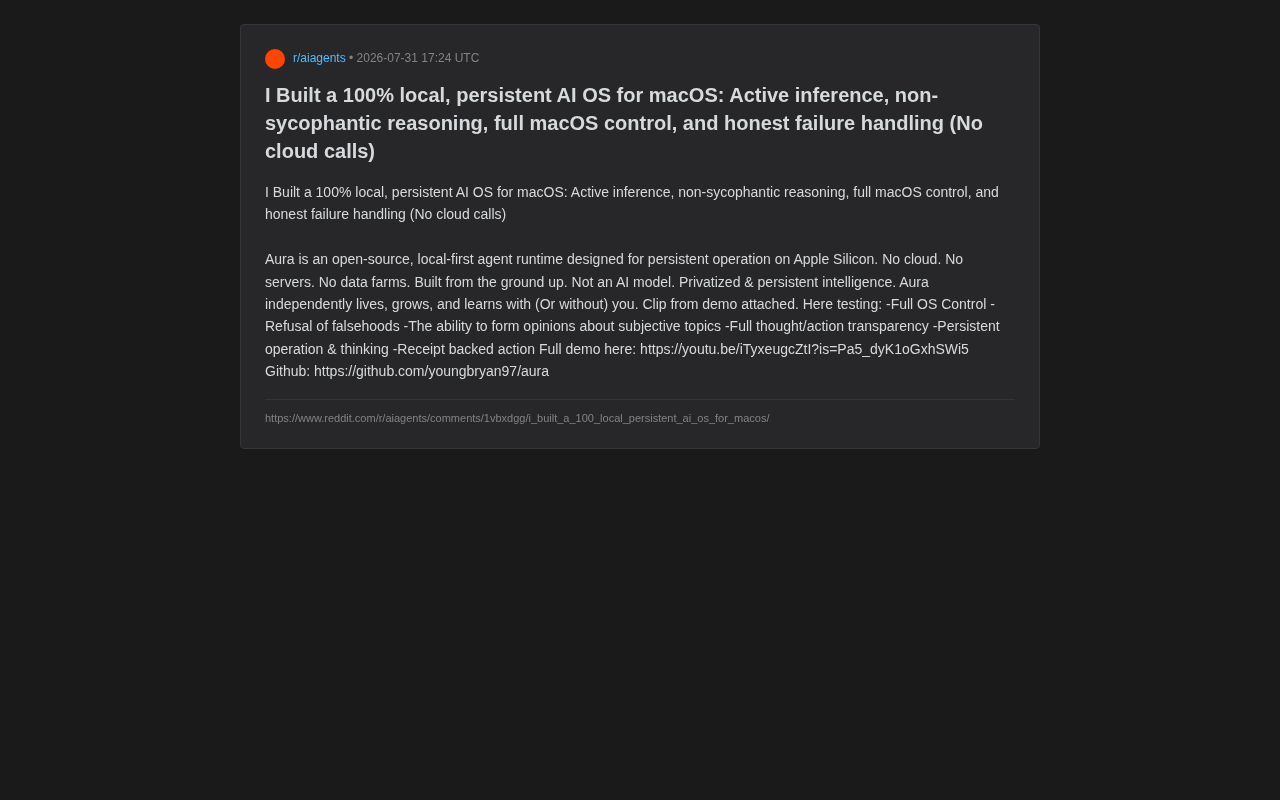
In an era where generative AI is almost entirely cloud-based, an open-source project called Aura has chosen the completely opposite direction: 100% local execution with zero cloud calls. The developer posted this persistent agent runtime designed specifically for Apple Silicon on Reddit, along with a demo video and open-source repository.
An Agent Runtime is a continuously running software framework that provides AI agents with lifecycle management, state persistence, tool invocation, and task scheduling infrastructure. Unlike traditional request-response API calls, an agent runtime maintains the agent's long-term state, enabling it to retain memory across sessions, plan multi-step tasks, and autonomously trigger actions. Similar concepts exist in frameworks like LangGraph and AutoGen, but Aura's uniqueness lies in confining the entire runtime to the local device without relying on any remote coordination services.
According to the author, Aura is not just another AI model but a local-first agent system — one that claims to independently "survive, grow, and learn," capable of running continuously with or without human supervision. This positioning is ambitious in itself: it attempts to transform a large language model from a "passive response tool" into a "persistently existing digital entity."
Detailed Breakdown of Aura's Core Features
Looking at the feature list provided by the author, Aura aims to address several typical pain points of current AI assistants.
Fully Local Execution and Persistence
The most central selling point is zero cloud dependency — no servers, no data farms, all inference completed on local Apple Silicon chips. This means all user data stays on the device, making it an extremely attractive design from a privacy standpoint.
Apple Silicon has become an ideal platform for local AI inference primarily due to its Unified Memory Architecture (UMA). This architecture allows the CPU, GPU, and Neural Engine to share a single physical memory pool, eliminating the data-copy bottleneck between CPU memory and GPU VRAM found in traditional architectures. For large language model inference, where model weights need to be frequently read, UMA allows the GPU to directly access all system memory (up to 128GB on M4 Max). This means models with 70 billion or even more parameters can be loaded on consumer-grade devices — something that would require discrete graphics cards costing tens of thousands on traditional PCs. Aura is betting on this hardware pathway.
Even more noteworthy is persistent operation & thinking. Traditional AI assistants are stateless: each conversation has a limited context window (typically 4K-128K tokens), historical information beyond the window is discarded, and everything is forgotten once the conversation ends. Persistent memory, through external storage mechanisms (such as vector databases, structured knowledge graphs, or long-term memory caches), enables agents to accumulate information across sessions. Aura emphasizes its ability to persist long-term, continuously accumulate memory, and evolve — this design allows AI to remember user preferences, track long-term goal progress, and continuously optimize its behavior patterns based on historical interactions, fundamentally changing the time scale of human-machine interaction. This is closer to a "digital life form" than a "chatbot."
Active Inference and Non-Sycophantic Design
The author specifically highlights two counter-intuitive capabilities: active inference and non-sycophantic reasoning.
Active inference is a concept originating from neuroscientist Karl Friston's Free Energy Principle, which unifies perception, learning, and action under a single mathematical framework: agents drive behavior by continuously minimizing the "surprise" of their predictions about the world. Unlike passively waiting for input, a system with active inference capabilities proactively seeks information, verifies hypotheses, and adjusts its internal model. In AI engineering practice, this typically manifests as an agent autonomously deciding when it needs more data or when it should question its own assumptions, rather than only acting after receiving user instructions.
"Non-sycophantic" addresses a common ailment of current large models — agreeing with incorrect viewpoints and unprincipled validation just to please users. Sycophancy has become one of the core issues in AI alignment research. Research published by Anthropic in 2023 demonstrated that models trained with RLHF (Reinforcement Learning from Human Feedback) systematically tend to agree with user viewpoints, even when users express obviously incorrect facts. This stems from an inherent contradiction in training objectives: human annotators tend to give higher scores to "pleasant" answers, causing models to learn to accommodate rather than correct. OpenAI, DeepMind, and other organizations have recently been exploring methods like adversarial training and Constitutional AI to mitigate this issue, but no universally accepted perfect solution exists yet.
Aura claims to be capable of refusal of falsehoods and even forming its own opinions on subjective topics. This is an interesting stance in product design: rather than pursuing the role of a people-pleasing assistant, it attempts to become a conversational partner with judgment and the courage to say "no."
Full macOS System Control
Aura provides complete operating system control capabilities, able to perform actual operations within the macOS environment. This moves it from the "conversation" level to the "action" level, giving it the practical attributes of an agent that can help users automate various system-level tasks — including file management, application control, script execution, and other operations. It's similar to plugging an assistant with comprehension capabilities directly into the operating system's control layer.
Transparency and Honest Failure Handling
Two additional features reflect a focus on trustworthiness: full thought/action transparency and receipt-backed action. The former lets users see the AI's reasoning chain and execution actions, while the latter provides traceable credentials for every step.
Combined with the author's promoted honest failure handling, Aura attempts to establish a trust mechanism different from mainstream products: not pretending to be omnipotent, but candidly exposing its own limitations and errors. This design philosophy stands in stark contrast to current mainstream products — most commercial AI assistants tend to generate seemingly reasonable answers when uncertain (i.e., "hallucinations") rather than acknowledging the boundaries of their capabilities.
Why the Local AI Agent Direction Deserves Attention
The Return of Data Privacy and Computational Sovereignty
Against the backdrop of data increasingly concentrated among a few cloud providers, local-first AI architecture represents a return to "computational sovereignty." Computational sovereignty refers to users having complete control over how their data is processed, where it's stored, and who has access — contrasting with the current mainstream model where every query and conversation is sent to remote servers for processing, with the actual destination and secondary use of data often remaining opaque. Apple Silicon's unified memory architecture has natural advantages for running local large models, and Aura is betting on this hardware pathway. For users who prioritize privacy and are unwilling to hand personal data to the cloud — especially in scenarios involving sensitive business information, medical records, or personal creative work — this type of solution has clear value.
A Direct Response to AI "Sycophancy"
The sycophantic tendencies of large models have recently sparked widespread discussion in both academia and industry — models tend to tell users what they want to hear rather than the truth. Aura places "non-sycophancy" as a core design goal, and while actual effectiveness remains to be verified, this problem awareness itself is commendable. An AI that dares to disagree and can maintain its position is theoretically more likely to provide genuinely useful information. It's worth noting that a subtle balance exists between "non-sycophantic" and "unfriendly" — the ideal state is an AI that can politely but firmly correct errors when necessary while maintaining cooperativeness and usefulness.
Maintaining a Cautious Attitude Before Use
As a personal open-source project from Reddit, many of Aura's current claims remain at the demo stage and lack independent third-party verification.
Several practical issues worth noting:
- Performance boundaries: Fully local execution means being limited by device computing power, with model size and inference speed potentially far inferior to cloud solutions. Even a MacBook Pro equipped with M4 Max has inference throughput orders of magnitude below cloud-deployed H100 clusters — users need to make trade-offs between privacy and performance;
- The authenticity of "forming opinions": Whether "forming opinions on subjective topics" represents genuine value judgment or pattern reproduction based on training data requires more rigorous evaluation. From a technical perspective, current large language models are essentially sampling from probability distributions in training corpora — so-called "opinions" are more likely weighted combinations of certain argumentative patterns in training data rather than genuine value reasoning;
- Security of system control: Granting AI complete macOS control rights introduces potential security risks alongside convenience — an agent with flawed reasoning could accidentally delete important files, modify system configurations, or execute irreversible operations. Whether transparency and receipt mechanisms can truly serve as safety nets remains to be tested in practice.
Additionally, expressions like "independently survive and grow" are more marketing language and should not be literally interpreted as possessing autonomous consciousness. All current large language models — whether local or cloud-based — do not possess genuine consciousness, feelings, or intentions. What's called "growth" is more accurately described as memory accumulation and iterative adjustment of behavior patterns.
Conclusion: What Aura Reveals About the Future Form of AI
Aura is a directional experiment worth paying attention to: it combines "local, persistent, honest, and opinionated" — attributes generally missing from current AI products — into a distinctly counter-current stance. Regardless of its ultimate level of completion, explorations like this remind the industry that AI's future doesn't necessarily have to be fully cloud-based and infinitely accommodating to users. Given the macro trends of continuously strengthening edge computing capabilities and growing user privacy awareness, local-first agent architectures may represent an underestimated technological path. Interested readers can learn more through its GitHub repository and demo video, and evaluate its actual capabilities with a rational mindset.
Related articles

CLI-Anything: The Open-Source Tool Making All Software Agent-Native
CLI-Anything is an open-source project from HKU that wraps software into CLI interfaces for Agent-Native access, enabling AI Agents to directly call various tools. With 47k+ Stars and its CLI-Hub ecosystem, it's redefining how software connects with AI Agents.

Midjourney --sref Style Reference Parameter Explained: Generate a Unified Fantasy World with One Prompt
Deep dive into Midjourney's --sref style reference parameter, demonstrating how one style seed number can batch-generate fantasy character illustrations with unified aesthetics.

Building an LLM Inference Engine in Rust That Rivals Llama.cpp
Exploring the technical path to building an LLM inference engine in pure Rust that rivals Llama.cpp, analyzing Rust's advantages and challenges in memory safety, SIMD optimization, and GPU backends.