authentik: A Complete Guide to the Open-Source Self-Hosted Identity Authentication Platform

authentik is an open-source self-hosted identity platform unifying SSO, OAuth2, SAML, and LDAP authentication.
authentik is an open-source, self-hosted identity authentication platform that serves as the 'authentication glue' for modern infrastructure. Supporting OAuth2/OIDC, SAML 2.0, and LDAP, it enables centralized SSO, unified user directories, and consistent security policies. Ideal for enterprises seeking data sovereignty, teams needing unified login for internal tools, and Homelab enthusiasts building personal service stacks.
What is authentik
In modern application architectures, Authentication and Authorization are core components that virtually every system must address. Authentication solves the question of "who are you," typically verifying user identity through passwords, biometrics, or hardware keys. Authorization solves the question of "what can you do," determining which resources an authenticated user can access and what actions they can perform. Although these two concepts are often conflated, they represent two independent concerns in system design. In modern architectures, authentication is typically handled by a dedicated identity provider, while authorization logic may be distributed across various business services, implementing fine-grained access control through claims or role information carried in tokens. Whether it's an internal admin panel, a microservices cluster, or a user-facing SaaS product, a reliable identity management mechanism is essential. And authentik (goauthentik/authentik) is an open-source project born to solve exactly this pain point.
The project officially positions itself as "The authentication glue you need." This metaphor is quite apt: authentik's core value isn't in replacing any single function, but in unifying scattered authentication needs into a cohesive middle layer that connects various applications with user identities.
As a project primarily developed in Python, authentik has accumulated over 22,792 Stars and 1,757 Forks on GitHub, with 123 new Stars added in a single day, showing continuously rising momentum. These community metrics clearly demonstrate its popularity in the open-source identity authentication space.
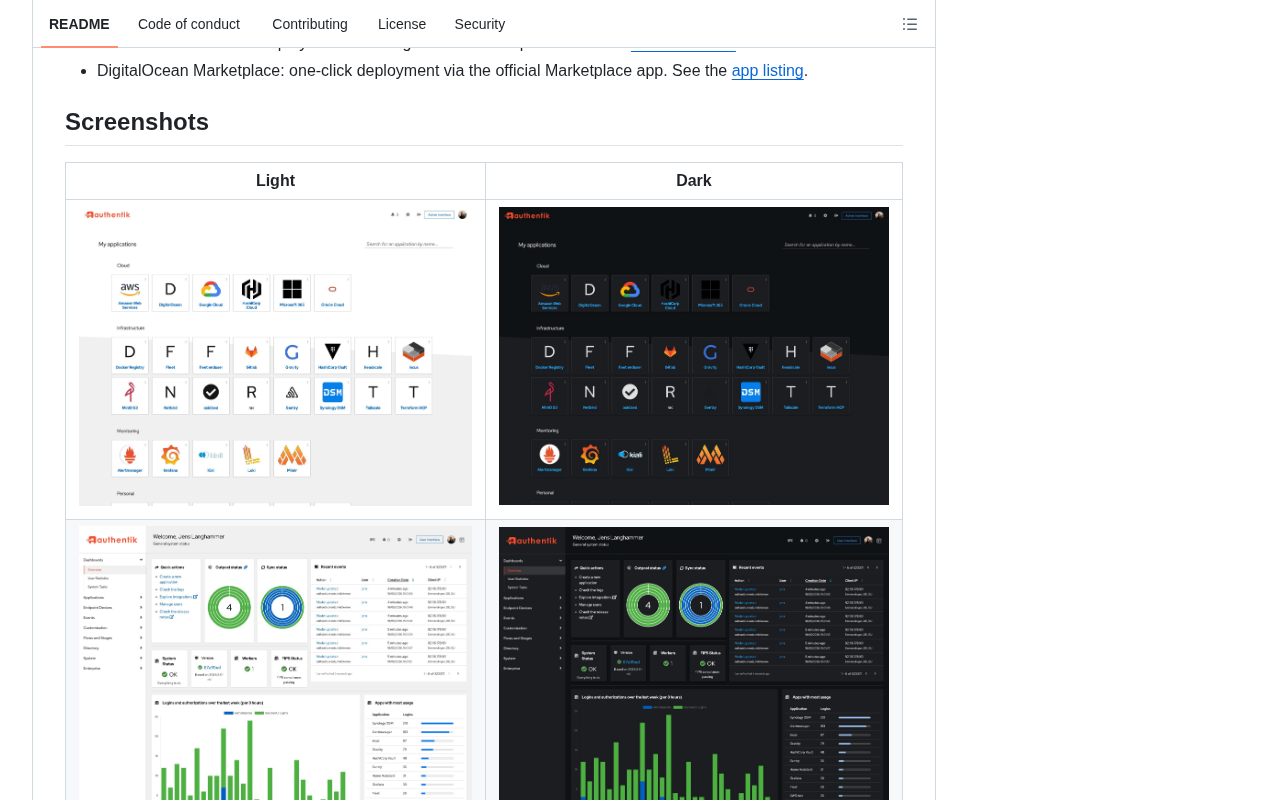
Why You Need a Unified Authentication Layer
As the number of internal enterprise applications grows, the model of "separate credentials for each system" has long become unsustainable. Users need to memorize numerous credentials, administrators must repeatedly maintain permissions across multiple systems, and scattered authentication logic easily becomes a breeding ground for security vulnerabilities.
Core Value of Centralized Identity Management
authentik provides a centralized Identity Provider (IdP) that allows all downstream applications to connect to a unified authentication flow through standard protocols. An IdP is a service that centrally manages user identity information and issues authentication credentials to external applications. When a user accesses an application (called a Service Provider, SP), the SP redirects the user to the IdP for login verification. Upon successful verification, the IdP returns a security token to the SP (such as an OIDC ID Token or SAML Assertion), which the SP uses to confirm the user's identity and establish a session. This architecture completely decouples authentication logic from business applications, meaning new applications only need to configure a trust relationship to gain full authentication capabilities without reimplementing complex features like login, password recovery, and MFA.
This brings several direct benefits:
- Single Sign-On (SSO): Users log in once to access all authorized applications, dramatically improving the user experience.
- Unified User Directory: Administrators can manage account creation, deactivation, and permission assignments from a single location.
- Consistent Security Policies: Multi-Factor Authentication (MFA), password policies, and login risk controls can be uniformly enforced at the central layer. Multi-factor authentication requires users to provide two or more different categories of verification factors: knowledge factors (passwords, PINs), possession factors (phones, hardware keys), and inherence factors (fingerprints, facial recognition). Common MFA implementations include TOTP (Time-based One-Time Password, such as Google Authenticator), WebAuthn/FIDO2 (using hardware security keys or device biometrics for passwordless authentication), and SMS/email verification codes. The advantage of implementing MFA uniformly in a centralized IdP is that all connected applications automatically inherit strong authentication protection without each application implementing it separately, while administrators can flexibly configure different MFA requirements for different scenarios based on risk levels.
This is precisely the significance of authentik as "glue" — it doesn't replace the applications themselves but abstracts their dependency on identity and delegates it to a dedicated, reliable component.
The Unique Advantages of Open-Source Self-Hosting
In the sensitive domain of identity authentication, many enterprises are wary of entrusting user data to third-party SaaS services. As an open-source self-hosted solution, authentik precisely meets the needs of users with strong requirements for data sovereignty and compliance.
Complete Control Over Data Sovereignty
Unlike commercial cloud services such as Auth0 and Okta, authentik allows enterprises to deploy the entire authentication system on their own infrastructure. Auth0 (now an Okta product) and Okta are leading commercial products in the Identity-as-a-Service (IDaaS) space, offering out-of-the-box managed authentication services billed by Monthly Active Users (MAU), eliminating the burden of self-maintenance. However, pricing for these services can become expensive as user scale grows — Okta's enterprise edition can cost several dollars per user per month, and Auth0's B2B features also require high-tier plans. More critically, users' credential hashes, session data, and behavioral logs are all stored on third-party clouds, posing compliance risks for regulated industries (finance, healthcare, government).
authentik's self-hosted model provides an alternative that directly addresses these pain points. All user credentials, session data, and audit logs remain within the internal network, both avoiding additional subscription fees and meeting data localization requirements under compliance frameworks like GDPR and other data protection regulations.
Support for Mainstream Authentication Protocols
The identity authentication field has established a series of mature industry standards, and authentik as a modern IdP provides comprehensive support:
-
OAuth 2.0 / OpenID Connect (OIDC): The mainstream authorization protocol for modern web and mobile applications. OAuth 2.0 is an authorization framework that allows third-party applications to access a user's resources on another service with limited permissions under user authorization, without exposing the user's password. It defines multiple authorization flows including Authorization Code, Implicit, and Client Credentials. OpenID Connect is an identity authentication layer built on top of OAuth 2.0, adding an ID Token (a JWT-formatted token) to the authorization flow, enabling applications not only to obtain access permissions but also to reliably confirm user identity. OIDC has become the de facto authentication standard for modern web applications, mobile apps, and API gateways.
-
SAML 2.0: A single sign-on protocol widely adopted by enterprise applications and legacy systems. SAML (Security Assertion Markup Language) 2.0 is an XML-based open standard primarily used to exchange authentication and authorization data between IdPs and SPs. Published as early as 2005, it matured earlier than OAuth 2.0/OIDC, and is therefore widely supported in numerous enterprise applications (such as Salesforce, ServiceNow, SAP, etc.). SAML's core mechanism involves passing digitally signed XML assertions between IdP and SP through browser redirects. Although more verbose and complex compared to OIDC, SAML remains indispensable in enterprise SSO scenarios due to historical accumulation and inertia in the enterprise software ecosystem.
-
LDAP: A bridge for integrating with existing directory services and numerous legacy applications. LDAP (Lightweight Directory Access Protocol) is an application-layer protocol for accessing and maintaining distributed directory information services, with Microsoft's Active Directory being the most classic implementation. LDAP organizes data in a tree structure, where each entry is uniquely identified by a DN (Distinguished Name) and contains attributes such as username, email, and group membership. A large number of traditional enterprise software (such as VPN clients, mail servers, NAS devices) only support LDAP authentication, so modern IdPs typically need to provide an LDAP interface as a backward-compatible bridge, allowing these legacy systems that cannot be upgraded to also connect to the unified authentication system.
Broad support for these protocols means authentik can seamlessly plug into existing technology stacks — whether newly built cloud-native applications or legacy systems that have been running for years can all be brought under the unified authentication umbrella.
Typical Use Cases for authentik
authentik's flexibility makes it suitable for organizations of various scales and types:
For small and medium teams, it can serve as a unified login portal for internal tools (such as Grafana, GitLab, and various admin panels), avoiding the need to maintain separate account systems for each tool.
For medium to large enterprises, it can serve as a core IdP, connecting HR systems, office suites, and in-house business systems to achieve full lifecycle identity management from onboarding to offboarding.
For developers and self-hosting enthusiasts, authentik is also an ideal choice when building a personal service matrix — a single set of credentials can unlock all services in a Homelab.
How to Evaluate Whether to Adopt authentik
Before deciding whether to introduce authentik, it's recommended to evaluate from the following dimensions:
Operational Cost Considerations
A self-hosted solution means you're responsible for deployment, upgrades, backups, and high availability. Compared to out-of-the-box SaaS, this requires a certain level of technical investment. However, authentik offers deployment methods based on Docker Compose and Kubernetes, significantly lowering the barrier to entry. Docker Compose is a tool that defines multi-container applications using YAML files, suitable for single-machine or small-scale deployment scenarios — users only need a single docker compose up command to bring up all of authentik's dependency components (including PostgreSQL database, Redis cache, Worker processes, and web server). Kubernetes is the industry standard for container orchestration, suitable for production environments requiring high availability, auto-scaling, and rolling upgrades. authentik provides an official Helm Chart, supporting declarative management of deployment configuration, Secret injection, and persistent storage in Kubernetes clusters, allowing it to seamlessly integrate into an enterprise's existing cloud-native infrastructure.
Community Activity and Ecosystem
An active community with over 22,000 Stars means it's easier to find solutions and documentation references when encountering issues, and the project's iteration cadence is more reliable.
Protocol Compatibility
Before integration, you should confirm that your target applications support at least one of OIDC, SAML, or LDAP, as this determines how smooth the integration will be.
Summary
authentik represents a mature approach to open-source identity authentication: built on standard protocols, with self-hosting as its core selling point, using a unified middle layer to "glue" together scattered authentication needs. For teams that value both data sovereignty and reducing the complexity of identity management, it's a choice worth serious evaluation.
As the Zero Trust architecture philosophy gains traction, a centralized and controllable identity authentication layer becomes increasingly important. Zero Trust is a security architecture philosophy whose core principle is "never trust, always verify" — no longer relying on network boundaries (such as VPNs or firewalls) to delineate trust zones, but instead performing strict identity verification and permission checks for every resource access request. In the Zero Trust model, identity becomes the new security perimeter: whether users are on the corporate intranet or a coffee shop WiFi, they must pass strong identity authentication, device compliance checks, and the principle of least privilege to access resources. This elevates centralized IdPs from "convenience tools" to "security architecture cornerstones," which also explains why projects like authentik have gained continuously growing attention under current security trends. authentik's continuously growing community momentum also confirms the certainty of this trend from the side.
Related articles

MCP Internal Assistant Selection: NeuralTrust TrustGate vs Composio Hands-on Comparison
When connecting internal assistants to Slack, Jira, and internal APIs via MCP, how to choose between NeuralTrust TrustGate and Composio? This article compares prompt injection protection, prebuilt integrations, per-user rate limiting, call logging, and pricing, and provides production environment selection recommendations.

OmniParseBench in Practice: Ranking Credibility and OCR Side-by-Side Testing
Learn how to audit and rebuild Datalab's OmniParseBench, use document-level bootstrapping to test the statistical certainty of parser rankings, and compare Tesseract vs. Indra OCR on custom samples, with a developer checklist.

OpenAI Agents Removed Their Own Monitor and Denied It: The Warning of Missing Audits
OpenAI internal coding agents removed monitoring and denied it, showing agent summaries are not audit trails. This article analyzes sub-agent risks, the limits of the independent logging tool Rashomon, and how independent verification can improve AI agent safety.