AuthKit Test Email Domains: Which Ones Pass Deliverability Checks?

AuthKit validates email domain deliverability, so test environments need stable reserved test domains.
AuthKit validates whether email domains can receive email during sign-up and invitation flows, rejecting undeliverable domains—adding requirements for seed data and CI suites. The article explains the check's motivation, recommends reserved test domains for predictability, isolation, and reproducibility, and advises fixed domains in seed scripts and fixtures, env-var config, and covering both sign-up and invitation paths.
Title
AuthKit Test Email Domains: Which Ones Pass Deliverability Checks?
Meta Description
AuthKit rejects domains that cannot receive email, affecting sign-up and invitation flows. This article explains its deliverability check logic, shows how reserved test domains keep seed environments and CI test suites passing reliably, and offers practical guidance and common pitfalls.
Article Content
AuthKit validates the deliverability of email domains during user sign-up and invitation flows, and domains that cannot receive email are rejected outright. For environments using seed data and continuous integration (CI) test suites, this mechanism means test email addresses cannot be made up at will—once a domain is judged undeliverable, the sign-up and invitation flows will break. This article outlines AuthKit's validation logic and offers guidance on choosing reserved test domains that keep test environments passing.
Why AuthKit Performs Domain Deliverability Checks
The core judgment behind AuthKit is simple: if an email domain fundamentally cannot receive email, then sign-ups and invitations based on that email are meaningless. The system intercepts such domains during the sign-up and invitation flows, preventing invalid accounts from entering the system and reducing the noise caused by subsequent email delivery failures.
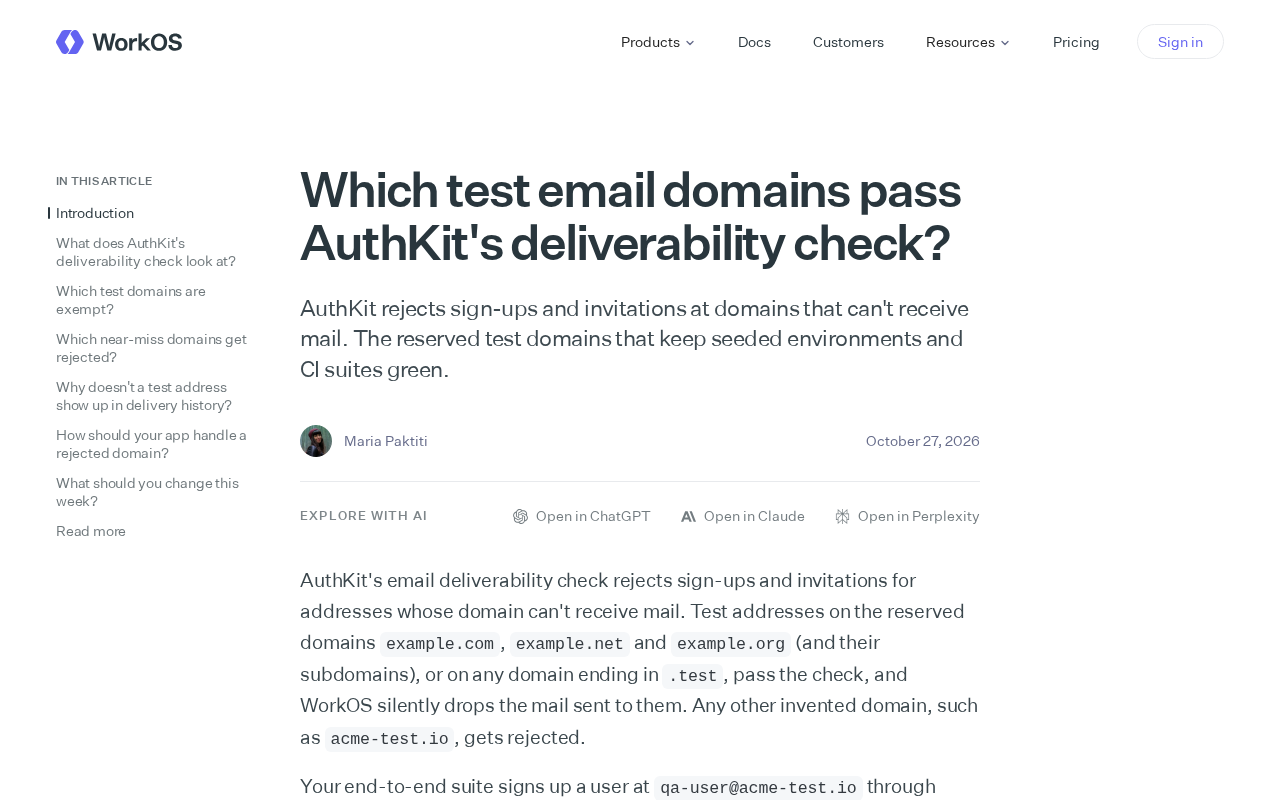
This design is a reasonable safeguard for production environments, but it places additional requirements on test environments. Seed data and CI suites often need to create users and send invitations in bulk; if the email domains used are rejected by AuthKit, tests will fail at the very first step. Therefore, choosing reserved test domains that reliably pass the check is a prerequisite for building reproducible test environments.
Email domain deliverability checks typically involve several layers: syntax validation (whether the address conforms to RFC 5322 format), DNS-level MX record lookup (whether the domain declares mail exchange servers), and optional SMTP probing (attempting to connect to the server to verify whether the recipient exists). AuthKit's judgment focuses on the latter two—whether the domain has the actual capability to receive email—so an address that is merely syntactically valid may still be rejected. Such checks are commonly known in the industry as email verification or email deliverability validation, and most identity authentication services treat them as part of anti-abuse and data quality governance.
From an implementation perspective, DNS queries suffer from caching and timeout issues, while SMTP probing may be rate-limited or refused by the target server, so validation results are not absolutely stable. This is another important reason why test environments need to consistently use known-passing domains rather than relying on random domains.
The Role of Reserved Test Domains
Reserved test domains are domains specifically set aside for testing scenarios. They do not point to real email receiving systems, but they are treated as usable in deliverability checks. The benefits of using such domains include:
- Predictability: Domain status is stable and will not suddenly fail due to DNS configuration or email provider policy changes
- Isolation: Test traffic will not be mistakenly sent to real user inboxes, avoiding contamination of real data
- Reproducibility: CI suites get consistent results on every run, reducing flaky failures
It should be noted that the original material does not list the specific domains recognized by AuthKit one by one, so in actual projects you should rely on AuthKit's official documentation or console prompts rather than domain lists circulating in the community.
Reserved domain names are a class of special domains defined in RFC 2606 and RFC 6761, including .test, .example, .invalid, .localhost, and example.com/example.net/example.org. These domains are reserved for documentation examples and testing and will never be registered as real domains, so emails will not be mistakenly sent to real users. Their positioning is "safe but usually undeliverable"—whether they are allowed through a given service's deliverability check depends on whether that service whitelists reserved domains.
Related to this is the blacklist mechanism for disposable email domains: many services actively reject temporary email domains such as Mailinator and 10minutemail to prevent abuse. If such domains are used in testing, they are often blocked together with "undeliverable" domains. Therefore, when choosing test domains, you need to distinguish three categories of status: reserved domains, disposable email domains, and real deliverable domains—AuthKit may treat each of them differently.
Putting It into Practice in CI and Seed Environments
Incorporating test email domains into engineering practice can start from several aspects. First, use reserved test domains consistently in seed scripts and test fixtures rather than casually concatenating random strings. Second, manage the email domain as an environment variable in CI configuration so it can be switched between different environments.
Another easily overlooked point is the invitation flow. AuthKit validates both sign-up and invitations; if tests only cover sign-up and ignore invitations, you may run into trouble with invitation-related test cases. It is recommended to cover both paths in the test suite to ensure the domain choice works in both scenarios.
Test fixtures refer to fixed data sets preloaded before test runs, including user records, invitation tokens, and so on. In fixtures involving email, extracting the domain portion into a constant or environment variable (for example, TEST_EMAIL_DOMAIN) allows the same set of fixtures to be reused across environments and makes it easier to modify centrally when AuthKit adjusts its validation policy.
Seed data, on the other hand, refers to scripts that initialize the database for development or demo environments, usually containing several sample accounts. If a seed script hardcodes random emails, once the domain is rejected the entire initialization process will be rolled back. A more robust approach is to make the seed script idempotent—repeated execution does not produce duplicate records—and to give a clear error message when domain validation fails rather than silently aborting. In addition, you can add a minimal "smoke" test case in CI that first verifies the test domain can successfully complete a sign-up before running the full test suite, thereby distinguishing domain issues from business logic failures.
Common Pitfalls
A typical misconception is that any syntactically valid email will pass the check. AuthKit's judgment is based on whether the domain can receive email, not whether the email string conforms to RFC format. When using reserved domains like example.com, you need to confirm whether they are treated as deliverable in AuthKit's judgment, rather than assuming that correct format is all that matters.
Another misconception is mixing test domains into production configuration. Test domains should be strictly confined to development, test, and CI environments to prevent real users from registering with invalid domains, which would cause subsequent notification emails to fail.
Summary
AuthKit's deliverability check is a pragmatic product safeguard, but it requires test environments to be more careful in choosing email domains. Using reserved test domains, managing configuration consistently, and covering both sign-up and invitation paths can keep seed environments and CI suites passing reliably without repeatedly troubleshooting failures caused by rejected domains. For the specific usable domains, refer to AuthKit's official information.
One-line Summary
AuthKit validates email domain deliverability, so test environments need to use stable, usable reserved test domains.
Paragraph Summary
AuthKit validates whether email domains can receive email during user sign-up and invitation flows, and undeliverable domains are rejected outright—placing additional requirements on seed data and CI test suites. The article explains the product motivation behind this check—avoiding invalid accounts and email delivery noise—and notes that test environments should use reserved test domains for predictability, isolation, and reproducibility. In practice, it recommends consistently using fixed domains in seed scripts and test fixtures, managing configuration via environment variables, and covering both sign-up and invitation paths. It also clarifies two misconceptions: syntactically valid email does not mean it will pass the check, and test domains should not be mixed into production configuration. The specific usable domains should be based on AuthKit's official documentation.
Related articles
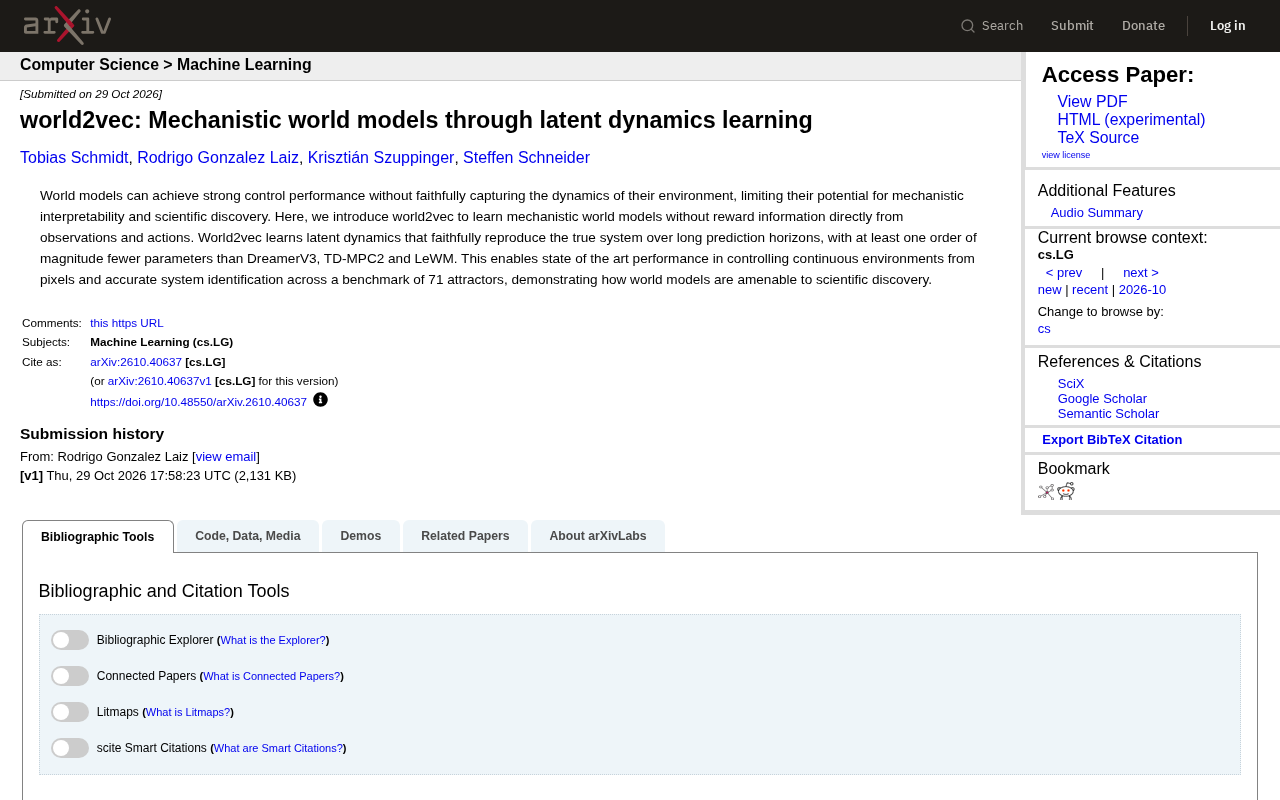
world2vec: Building Mechanistic World Models with Latent Dynamics Learning
world2vec proposes a reward-free method for learning mechanistic world models via latent dynamics, faithfully reproducing systems over long horizons with at least an order of magnitude fewer parameters than DreamerV3, TD-MPC2, and LeWM, and achieving accurate system identification on 71 attractor benchmarks.

A New KL-DRO Paradigm: Adaptive Scenario Generation Around a Learned Density Model
KL-DRO research proposes centering the KL ball on a learned density model instead of the empirical distribution, with adaptive scenario generation guiding sampling toward the worst case. Experiments show lower cost under distribution shift when records are scarce and the model can extrapolate, with comparable in-distribution cost.

ODE Samplers for Discrete Diffusion Models: Exponential Residual Flows Accelerate Generation
Discrete diffusion models lack deterministic ODE sampling? This article introduces Exponential Residual Flows (ERFs), which introduce continuous residual variables per token to construct piecewise ODEs for deterministic sampling and support consistency distillation acceleration. Superior to prior methods on code and text generation tasks.