autobrr Team Unveils Librrary: A Unified Sonarr/Radarr Alternative for Media Management

The autobrr team is building Librrary, a single app to replace the multi-instance Sonarr/Radarr setup.
The team behind autobrr and qui has announced Librrary — a unified "arr" alternative that consolidates movie and TV management into one app. The core problem it solves: maintaining both HD and 4K libraries currently requires running 4–6 separate arr instances. Librrary introduces a Plex-style multi-library model, supporting multiple quality variants per title, Torrent/Usenet dual protocols, OIDC login, and modular design. The roadmap also includes built-in media requests, Sonarr/Radarr migration import, private tracker nuke handling, and Plex/Jellyfin integration. No release date yet, but user testing is approaching.
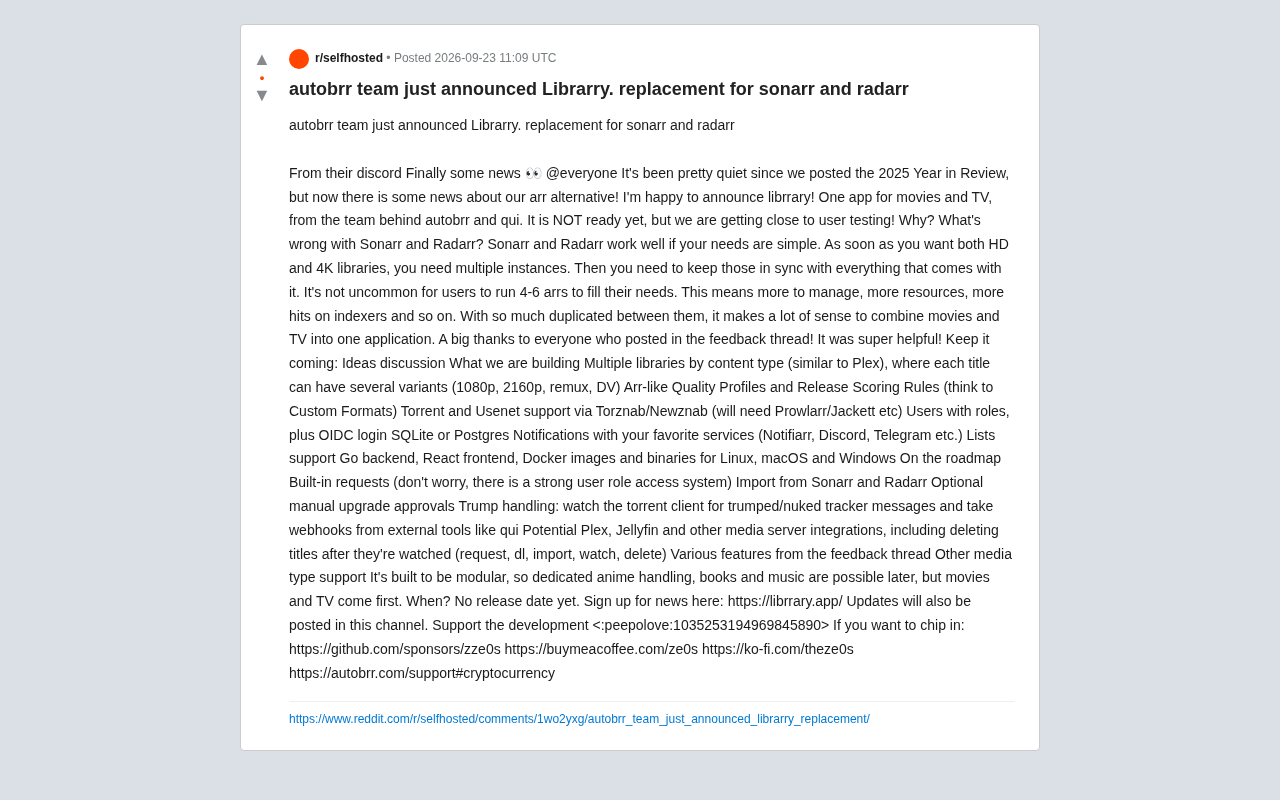
For those familiar with self-hosted media servers, Sonarr and Radarr may soon face a serious challenger. The team behind autobrr and qui recently announced a new project in their Discord — Librrary, an "arr" alternative that consolidates movie and TV show management into a single application. The project hasn't officially launched yet, but the team says it's approaching user testing.
Why Do We Need Another Media Management Tool?
Sonarr (for TV) and Radarr (for movies) have long been the de facto standard for automated media library management. But as the team notes, they "work fine when requirements are simple" — and that's precisely where the problems start.
The team identified a real pain point: the moment a user wants to maintain both an HD library and a 4K library, they need to run multiple instances and deal with syncing between them. In practice, many users end up running 4 to 6 arr instances simultaneously. That means more management overhead, higher resource consumption, and more frequent requests to indexers.
Given the massive overlap in functionality across those instances, merging movies and TV shows into a single app is a logical move. That's the core premise behind Librrary: one app for multiple content types, less redundancy.
For readers unfamiliar with this ecosystem: "arr" refers to a family of open-source automation tools named with the "-arr" suffix, originating with Sonarr (2014) and Radarr, and later expanding to include Lidarr (music), Readarr (books), Prowlarr (indexer management), and others. They work by monitoring a user-defined media wishlist, automatically searching Torrent or Usenet indexers for matching releases, scheduling download clients to fetch files, and organizing them into library directories. The workflow is highly automated, but each arr instance only handles a single content type with one set of quality rules. When a user wants to maintain both a "standard 1080p library" and a "4K HDR library," the only solution — since you can't differentiate storage paths and quality profiles within a single instance — is to run two separate instances, bringing all the associated configuration sync and resource overhead with it.
What Librrary Plans to Offer
Based on what the team has shared, Librrary's architecture draws clear inspiration from Plex's multi-library concept while preserving the workflows familiar to arr ecosystem users.
Core Features Confirmed to Be in Development
- Multi-library support by content type: Similar to Plex, each title can have multiple variants (1080p, 2160p, remux, Dolby Vision), fundamentally solving the multi-instance problem for HD/4K libraries.
- arr-style quality profiles and release scoring rules: Equivalent to Sonarr/Radarr's Custom Formats mechanism, familiar to existing users.
- Torrent and Usenet dual support: Integration via Torznab/Newznab protocols, still requiring indexer management tools like Prowlarr or Jackett.
- User roles and OIDC login: A fairly robust permission system.
- Database flexibility: Supports both SQLite and PostgreSQL.
- Notification integrations: Compatible with Notifiarr, Discord, Telegram, and other common services.
- Lists support.
On the tech stack side, Librrary uses a Go backend + React frontend, with Docker images and binaries available for Linux, macOS, and Windows — making cross-platform deployment straightforward.
Torznab and Newznab are two standardized indexer query protocols. Newznab was originally designed for Usenet NZB indexing sites, defining a common search API; Torznab was later developed by the Jackett project as an extension of that same interface adapted for BitTorrent indexers. These protocols mean download management tools don't need custom integrations for every individual indexing site — as long as a site or aggregator (like Prowlarr or Jackett) exposes a protocol-compliant endpoint, any compatible client can connect universally. Prowlarr serves as the "indexer hub" in the arr ecosystem: it centrally manages authentication and configuration for all indexers, then pushes that configuration to downstream tools like Sonarr and Radarr, so each arr instance doesn't have to maintain its own indexer list. Librrary continuing this architecture means existing Prowlarr users can reuse their indexer configurations seamlessly.
A Roadmap That Reveals Bigger Ambitions
Beyond the features currently in development, the team's published roadmap reveals how this project is positioned — not just as a "merged arr" tool, but as something aiming to cover a more complete media lifecycle.
Notable items on the roadmap:
- Built-in request functionality: Paired with a robust user role system, this could potentially replace tools like Overseerr/Jellyseerr.
- Import from Sonarr and Radarr: Lowering the migration barrier for existing users — a critical factor for success.
- Optional manual upgrade approval.
- "Trump handling" (trumped/nuked release management): Monitoring torrent client messages for trumped/nuked tracker statuses and receiving webhooks from external tools like qui — reflecting the team's experience in private tracker environments.
- Potential integration with Plex, Jellyfin, and other media servers, including a complete closed-loop workflow covering request, download, import, watch, and delete.
The team specifically emphasizes Librrary's modular design, with potential future expansions for dedicated anime handling, book support, and music — though the current phase is focused on movies and TV shows.
"Trump handling" is a concept unique to private tracker communities. When a released file is found to have quality issues — such as incorrect audio tracks, falsely labeled formats, or encoding defects — the tracker's staff will mark it as "trumped" or "nuked," indicating it has been superseded by a higher-quality release or flagged as non-compliant. Automated download tools that can't detect these status changes may end up retaining inferior files or missing the trigger to download a replacement. autobrr has deep expertise in integrating with private tracker IRC announce channels, and qui similarly focuses on tracker interaction automation — so Librrary including this feature on its roadmap reflects the team's differentiated positioning for power private tracker users.
Promising, But Worth Watching Carefully
Librrary's approach directly addresses real pain points that have built up in the arr ecosystem over the years, particularly around the complexity of managing multiple instances. Backed by the team's experience developing autobrr and qui, they have meaningful expertise in automated downloading and tracker interactions — making this a more credible attempt than the average "reinventing the wheel" project.
That said, a measured perspective is warranted. The project currently has no release date, and hasn't even entered public user testing yet. Sonarr and Radarr have years of iterative development behind them, massive communities, mature ecosystems, and handling for countless edge cases — displacing them won't be easy. Compatibility for importing from Sonarr/Radarr and the long-term sustainability of maintenance will be decisive factors.
Interested users can head to librrary.app to subscribe for updates. The project uses a sponsorship model to support development, which is a common approach in the self-hosted open-source software world. Whether it becomes the next standard for self-hosted media libraries remains to be seen — we'll need actual beta builds to find out.
Related articles

NVIDIA's 30,000 Developers Use Cursor, Code Commit Volume Triples
Cursor engineer Chris Diaz breaks down five organizational gaps blocking enterprise AI coding scale—strategy, risk tiering, governance, metrics, and operating model. NVIDIA's 30,000 developers use Cursor daily, tripling code commits while defect rates stay flat. The key: rewrite the SDLC, not add tools.

Ponytail: Giving AI Coding Agents a Senior Engineer's Mindset
Ponytail is a free GitHub tool that injects a senior engineer's mindset into AI coding agents, making them ask whether code is even necessary first. According to TamilDeck, it can compress 200 lines of AI-generated code to 30, cutting token costs, with support for Cursor rules and Claude Code skill integration—though security review still requires human oversight.

Complete Guide to Connecting Cursor AI to the GitHub MCP Server
A step-by-step guide to connecting Cursor AI to the GitHub MCP server: create a personal access token, configure mcp.json, store the token in the ENV block, and verify with a PR query.