Avatar Intelligence: How Persistent Personal Agents Can Truly Amplify Human Agency
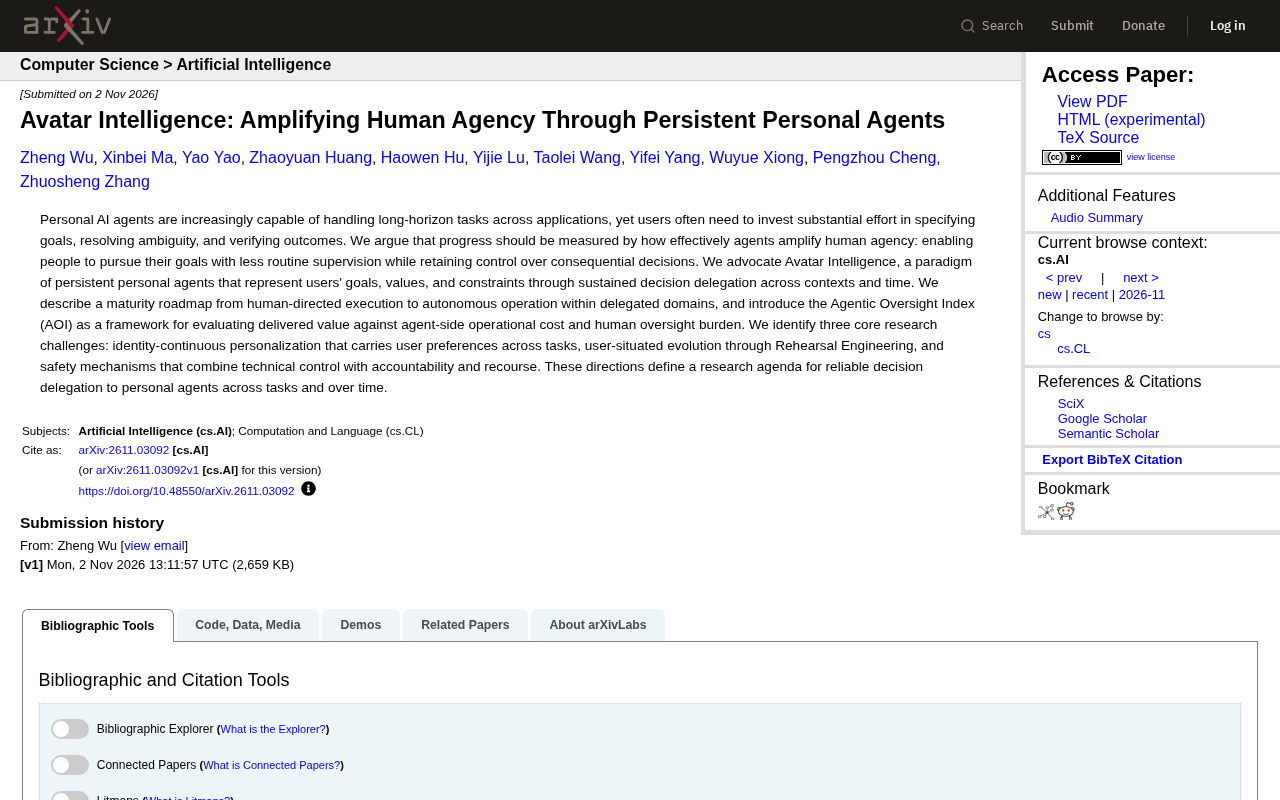
The study proposes the Avatar Intelligence paradigm, measuring personal AI agent value by amplifying human agency rather than task completion rate.
The article notes that although personal AI agents can execute long-horizon tasks across applications, users still invest significant effort in goal setting, ambiguity resolution, and result verification, and oversight burden may offset automation gains. It proposes the Avatar Intelligence paradigm, arguing agents should persistently carry user goals, values, and constraints to enable decision delegation across tasks and time. Core challenges include identity-continuous personalization, contextualized evolution via Rehearsal Engineering, and safety balancing technical control with accountability and remedy; it also offers a maturity roadmap and the Agentic Oversight Index (AOI) framework to quantify oversight burden and enable comparable agent value evaluation.
Personal AI agents are moving from single-task execution toward long-horizon autonomous operation across applications, but there is an overlooked reality: users still have to invest considerable effort in setting goals, clarifying ambiguities, and repeatedly verifying results. If the oversight burden imposed by an agent cancels out the gains from automation, then "intelligence" is merely surface-level prosperity. A recent study proposes the "Avatar Intelligence" paradigm, arguing that persistent personal agents should carry the user's goals, values, and constraints, and that an agent's true value should be measured by continuous decision delegation.
From Task Execution to Agency Amplification: A Shift in Measurement
The study explicitly notes that the capability boundary of personal AI agents is expanding rapidly, enabling them to handle long-horizon tasks that span multiple applications. However, the effort users invest in goal setting, ambiguity resolution, and result verification has not declined in tandem. This raises a key judgment: progress in agents should not be measured solely by how many tasks they can complete, but by the extent to which they amplify human agency—allowing people to pursue goals with less routine oversight while retaining control over key decisions.
This perspective shifts the evaluation focus from "what an agent can do" to "what an agent saves the user." If an agent requires user confirmation at every step, then it is essentially just a more complex execution tool, not a genuine decision partner. The core thesis of Avatar Intelligence is built around this gap: agents need to become persistent extensions of the user's will, not one-off tools that start from scratch in every conversation.
Three Pillars of Persistent Agents: Identity, Evolution, and Safety
Identity-Continuous Personalization
The first research challenge is identity-continuous personalization. Most current agents perform well within a single session but lose the user's preferences and constraints across tasks and over time. Avatar Intelligence requires agents to continuously carry the user's goals, values, and constraints into different scenarios. This means an agent must not only remember "the user likes concise answers" but also understand "under what circumstances the user would reject a certain suggestion." This continuity is the prerequisite for personalization and the foundation for decision delegation to be viable.
User-Contextualized Evolution via Rehearsal Engineering
The second challenge is user-contextualized evolution. The study proposes the concept of "Rehearsal Engineering," which uses rehearsal and practice to help agents gradually adapt to the user's specific context. An agent cannot understand the user solely through general training data; it needs to calibrate its behavioral boundaries through continuous interaction with the user. This process is similar to the tacit understanding that human assistants develop over long-term collaboration, but it requires engineered methods to ensure reproducibility and auditability.
"Rehearsal Engineering" can be understood as an interactive training method for personal agents: it does not rely on one-time large-scale fine-tuning, but instead repeatedly "rehearses" specific situations through continuous interaction with the user, allowing the agent to observe, imitate, and internalize the user's decision preferences and boundaries across different scenarios. Engineering means these rehearsal processes need to be recorded, versioned, and replayable, so that the sources of changes in agent behavior can be audited. Unlike traditional prompt engineering or reinforcement learning fine-tuning, Rehearsal Engineering emphasizes low-cost trial and error within real user contexts, treating each interaction as a reusable training sample, thereby gradually improving the agent's fit to individual users while ensuring reproducibility.
Safety Mechanisms Balancing Technical Control with Accountability and Remedy
The third challenge is safety mechanisms. The study emphasizes that safety cannot rely solely on technical controls; it must also incorporate accountability and remedy mechanisms. When an agent makes decisions within its delegated scope, users need to know clearly who is responsible for the outcome and how to appeal and correct problems when they arise. This dual-layer design of "technical control plus institutional remedy" is key to persistent agents earning user trust.
In the context of AI governance, "technical control" refers to restricting an agent's executable scope through permission constraints, behavior monitoring, sandbox isolation, and other means; "accountability and remedy" belongs to the institutional level, requiring clear identification of responsible parties, provision of decision traceability records, and establishment of user appeal and correction channels. The reason the two are complementary is that technical control can only reduce known risks and cannot cover all long-tail failures, while institutional remedy can provide remediation and attribution after an incident occurs. For persistent agents undertaking decision delegation, the dual-layer design means that when the agent acts autonomously within its delegated domain, the system must retain complete decision logs, and users can query, roll back, or revoke authorization at any time, thereby lowering the psychological threshold for delegation in the early stages of trust building.
Maturity Roadmap: From Human-Led to Autonomy Within Delegated Domains
The study outlines a clear maturity roadmap: starting from human-led execution and gradually transitioning to autonomous operation within delegated domains. The value of this roadmap lies in its recognition that autonomy is not a binary switch but is released in stages and by domain. Agents can gain greater autonomy first in low-risk, high-repetition domains while retaining final human control over high-consequence decisions.
Complementing the roadmap is the "Agentic Oversight Index" (AOI), a framework for evaluating the relationship between the value delivered by an agent, the agent-side operating costs, and the human oversight burden. The proposal of AOI responds to a practical pain point: without a unified measurement standard, teams can easily fall into the dilemma of "the agent looks powerful but doesn't pay off when you do the math." By making the oversight burden explicit, AOI moves agent value evaluation from subjective impression to a comparable framework.
"Delegation domain" refers to the specific task scope and boundary conditions within which a user explicitly authorizes an agent to make autonomous decisions, such as scheduling, email categorization, or routine procurement. Autonomy within a domain is not unrestricted laissez-faire; it is premised on predefined constraints, risk thresholds, and exit mechanisms. The significance of the maturity roadmap lies in breaking autonomy down into manageable dimensions: different delegation domains can have different autonomy levels, and the reliability evidence an agent accumulates in low-risk domains can serve as the basis for expansion into higher-risk domains. This approach is similar to the tiered philosophy of autonomous driving, emphasizing that the release of autonomy must advance in sync with verifiable safety records rather than through a one-time switch.
Implications for Products and Research
The proposal of Avatar Intelligence has direct reference value for current agent products. Many agent products on the market perform impressively in demos, but users still need to intervene frequently to correct them in actual use. According to the standards of this paradigm, the key metric for judging a product's quality is not task completion rate, but how much oversight effort the user must invest to complete the same task.
For researchers, the three core challenges constitute an actionable research agenda: identity-continuous personalization requires new methods for memory and preference modeling; Rehearsal Engineering requires reproducible interactive training frameworks; and safety mechanisms require cross-disciplinary research combining technical and institutional design. These directions all point toward one goal—enabling personal agents to reliably undertake decision delegation across tasks and over time.
The imagination around persistent personal agents lies not in how many things they can do for users, but in their ability to free users' attention from routine oversight and direct it toward places that truly require human judgment. Avatar Intelligence provides exactly such a measuring stick.
One-line Summary
This study proposes the Avatar Intelligence paradigm, measuring the value of personal AI agents by their amplification of human agency rather than task completion rate.
Paragraph Summary
The article points out that although personal AI agents can execute long-horizon tasks across applications, users still need to invest considerable effort in goal setting, ambiguity resolution, and result verification, and the oversight burden may cancel out automation gains. To address this, the study proposes the Avatar Intelligence paradigm, arguing that agents should persistently carry the user's goals, values, and constraints to enable decision delegation across tasks and over time. Its core includes three major challenges: identity-continuous personalization, contextualized evolution through Rehearsal Engineering, and safety mechanisms balancing technical control with accountability and remedy. The study also presents a maturity roadmap from human-led execution to autonomy within delegated domains and proposes the Agentic Oversight Index (AOI) framework, which makes the human oversight burden explicit and moves agent value evaluation from subjective impression to comparable quantitative standards.
Related articles
 Tech Frontiers
Vibe Coding Step-by-Step Guide: Learn to Build Products with AI in Six Steps
Breaking down the six-step methodology of Bilibili's 748-episode Vibe Coding course, analyzing the usage boundaries and prompt techniques of Codex, Claude Code, and Cursor, and discussing who this AI coding course suits, who it doesn't, and how to avoid the trap of watching without acting.
 Tech Frontiers
Is a $50 Pro Tier Really Coming? Plus Could Face Major Restrictions
A Reddit rumor suggests a $50 Pro subscription tier is coming and that the existing Plus tier will be aggressively limited. We analyze the rumor's credibility, the business logic behind subscription tiering, and practical ways to evaluate such pricing-change rumors.
 Tech Frontiers
Coldframe: A Honeypot Disguised as a Supermarket Freezer Controller
Coldframe is a honeypot disguised as Danfoss AK-SM 800A and Dixell XWEB freezer controllers, built as a single Python file that detects CVE-2025-41450 attempts and is identified as real devices on Shodan.