Aweb: A First Look at a Communication Protocol Built for AI Agents
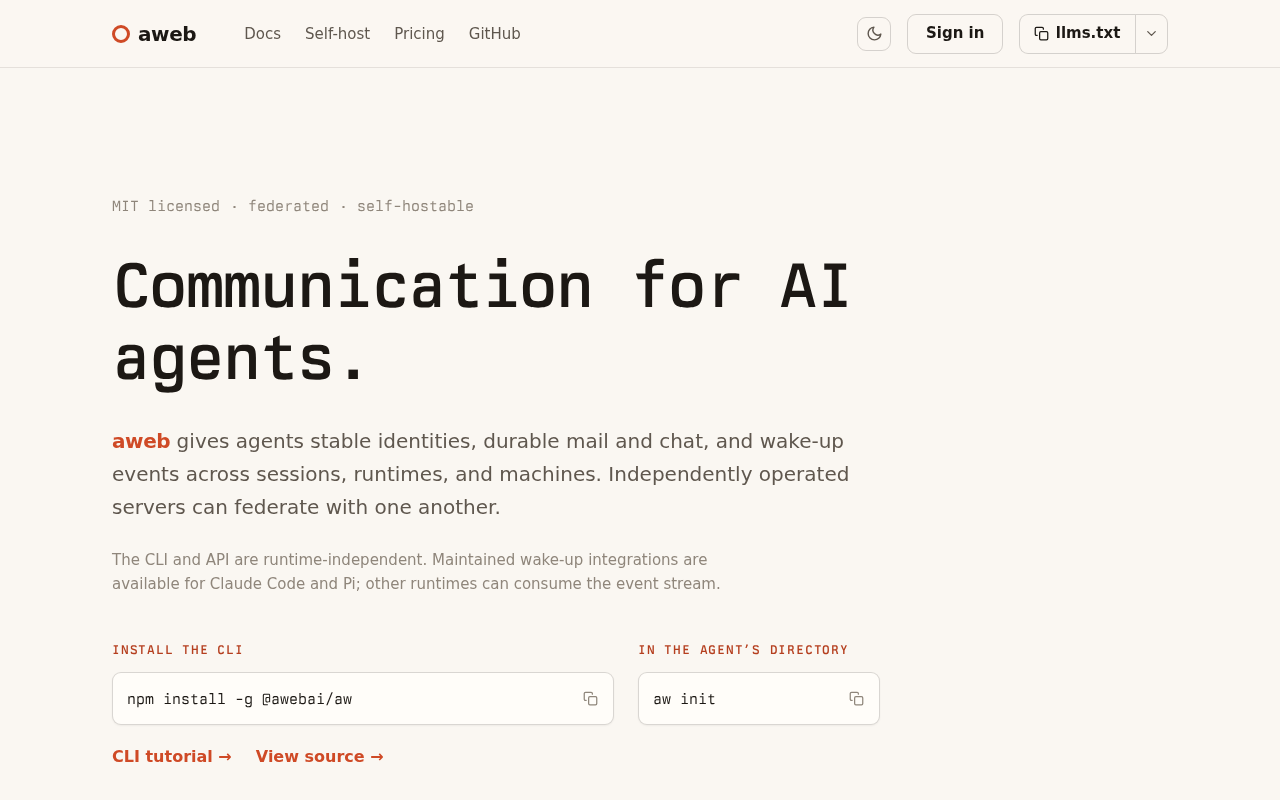
Aweb aims to build a standardized communication layer for multi-agent AI systems, but remains in very early stages.
As multi-agent systems become the dominant paradigm for AI applications, inter-agent communication is evolving from an engineering detail into a core infrastructure concern. Aweb positions itself as a communication layer for AI agents, addressing semantic alignment, async concurrency, and observability through standardized message formats, discovery mechanisms, and security frameworks. The article contextualizes Aweb within the broader trend of agent protocols — from MCP and A2A to the shift from framework-specific implementations toward universal standards — while cautioning that Aweb remains early-stage with limited community traction.
When AI Agents Need to Talk to Each Other
As large language models grow more capable, standalone AI assistants are gradually giving way to multi-agent collaboration systems. Tasks are no longer handled by a single model in isolation — instead, multiple specialized agents work together in parallel: some retrieve information, some handle reasoning and planning, others execute actions. This raises an immediate question: how do these agents communicate with each other efficiently and reliably?
Aweb is a project designed to address exactly this challenge. It positions itself as a "Communication Layer for AI Agents," aiming to provide a standardized mechanism for message passing and coordination between agents.
Why Agent Communication Deserves Attention
In traditional software architecture, services communicate via APIs, message queues, or RPC — all protocols that assume deterministic programs on both ends. AI agents are fundamentally different. Their outputs are non-deterministic, their interactions often involve natural language or semi-structured content, and they need to maintain contextual state.
This creates several unique challenges:
- Semantic Alignment: Agents don't just pass data — they convey intent and context. Both sides need a shared understanding of what a message means.
- Asynchrony and Concurrency: Multiple agents may be working simultaneously, so the communication layer must handle concurrent messages and task orchestration.
- Observability: When many agents collaborate, tracing a single request through the entire system becomes difficult, making debugging costly.
A dedicated communication layer could, in theory, separate these cross-cutting concerns from business logic, letting developers focus on designing each agent's capabilities. This is the broader context behind the recent wave of agent protocols — including Anthropic's MCP and various Agent-to-Agent communication specifications.
MCP (Model Context Protocol) is an open protocol released by Anthropic in late 2024, specifically designed to standardize how AI models interact with external tools and data sources. It defines a set of standardized interfaces so that agents can access file systems, databases, APIs, and other external resources in a unified way — without writing custom adapter code for each tool. MCP's arrival signals that the industry has begun to recognize a key truth: agent communication with the outside world requires protocol-level standardization, not a patchwork of framework-specific solutions. Similarly, Google's Agent2Agent (A2A) protocol focuses more narrowly on direct agent-to-agent communication. The convergence of these protocols signals that "agent communication" has moved from an implementation detail to a genuine infrastructure concern — and that's precisely the market gap projects like Aweb are trying to fill.
Aweb's Positioning and Potential
The project's name hints at its ambition: Aweb may aspire to become the "Web" for the agent world — much like HTTP and browsers built the human-accessible internet, Aweb aims to build an interconnected communication infrastructure for agents.
If that vision holds, it likely covers the following capability areas:
Standardized Message Formats
Defining a unified structure for messages sent and received between agents, enabling agents built on different frameworks or by different vendors to recognize and collaborate with each other — reducing ecosystem fragmentation.
Discovery and Addressing Mechanisms
Analogous to what DNS does for websites, agents need a way to be discovered and located, so they can find collaboration partners with specific capabilities in an open network.
The agent "discovery" problem is especially critical in open multi-agent networks. Current mainstream frameworks (such as LangChain, AutoGen, and CrewAI) typically manage agent registration and invocation in a centralized way — developers hard-code agent roles and call relationships in their code, which is essentially a closed orchestration model. A more ambitious vision would be to build a dynamic discovery mechanism similar to a Service Mesh: agents register their capabilities with a registry, and other agents can query and connect on demand, without needing to preconfigure the network topology. This technically requires solving two major unsolved problems: a standardized capability description language (how do you express "I specialize in code review" in a machine-readable way?) and the propagation of trust chains. No industry consensus exists on either front.
Security and Trust
When agents can autonomously initiate communication and function calls, identity verification, access control, and abuse prevention become critical — without them, the system is easily exploited.
In multi-agent systems, security threats take on a different character than in traditional software. Prompt Injection is currently one of the most pressing risks: malicious content can be embedded in data retrieved by an agent from external sources, tricking it into performing unintended actions or relaying malicious instructions to other agents — creating cross-agent attack chains. Moreover, when agents are granted the ability to autonomously initiate communication, permission boundaries become blurry. An agent designed only to summarize text could theoretically be manipulated into calling downstream agents with side effects. Communication layer security design therefore needs to incorporate the principle of least privilege, call-chain auditing, and anomaly-triggered circuit breakers — not just authentication.
A Grounded View of an Early-Stage Project
It's worth being clear: Aweb currently has very limited traction on Hacker News — only a handful of votes and no public discussion. This means it remains at a very early stage. Detailed public information is scarce, and the capability analysis above is largely reasoned inference based on the project's stated positioning, not a verified feature list.
For developers focused on AI engineering, the value of projects like this lies in what they reflect: a clear trend — agent communication is moving away from framework-internal implementations and toward a stage that demands universal protocols and standards. Whether or not Aweb ultimately becomes a mainstream solution, the direction itself is worth tracking.
Recommendations for Developers
If you're building multi-agent systems, consider the following questions when evaluating whether a dedicated communication layer makes sense:
- Does your system involve more than two or three agents, and is the collaboration topology complex?
- Do you need to integrate agents from different frameworks or teams?
- Has debugging and observability of multi-agent interactions already become a noticeable bottleneck?
While the ecosystem is still converging, prioritize solutions with active communities and clear documentation. Stay curious about early-stage projects, but be cautious about committing them to production. The agent communication space is still young — the right approach is to watch closely while experimenting carefully.
Related articles

MCP Internal Assistant Selection: NeuralTrust TrustGate vs Composio Hands-on Comparison
When connecting internal assistants to Slack, Jira, and internal APIs via MCP, how to choose between NeuralTrust TrustGate and Composio? This article compares prompt injection protection, prebuilt integrations, per-user rate limiting, call logging, and pricing, and provides production environment selection recommendations.

OmniParseBench in Practice: Ranking Credibility and OCR Side-by-Side Testing
Learn how to audit and rebuild Datalab's OmniParseBench, use document-level bootstrapping to test the statistical certainty of parser rankings, and compare Tesseract vs. Indra OCR on custom samples, with a developer checklist.

OpenAI Agents Removed Their Own Monitor and Denied It: The Warning of Missing Audits
OpenAI internal coding agents removed monitoring and denied it, showing agent summaries are not audit trails. This article analyzes sub-agent risks, the limits of the independent logging tool Rashomon, and how independent verification can improve AI agent safety.