awesome-llm-skills: Cross-Platform AI Agent Skill Library Guide & Resource Collection

awesome-llm-skills: A cross-platform curated AI Agent skill list for engineering-grade Agent development
awesome-llm-skills is an open-source GitHub project offering a curated list of LLM and AI Agent skills, compatible with mainstream AI programming tools including Claude Code, Codex, and Gemini CLI. With 1,207 Stars and community-driven updates, it fills the ecosystem gap of scattered AI Agent skill resources, lowers the developer entry barrier, and reflects the industry trend of AI Agents transitioning from proof-of-concept to engineering-grade implementation.
Project Overview
In today's rapidly evolving AI Agent ecosystem, efficiently customizing and extending AI Agent workflows has become a core challenge for developers. The open-source GitHub project awesome-llm-skills was created to solve this problem—it provides a curated list of LLM and AI Agent skills, covering resources, tools, and best practices to help developers quickly build and optimize AI Agent workflows.
Maintained by developer Prat011, the project has already earned 1,207 Stars and 168 Forks, is built with Python, and continues to see growing community engagement.
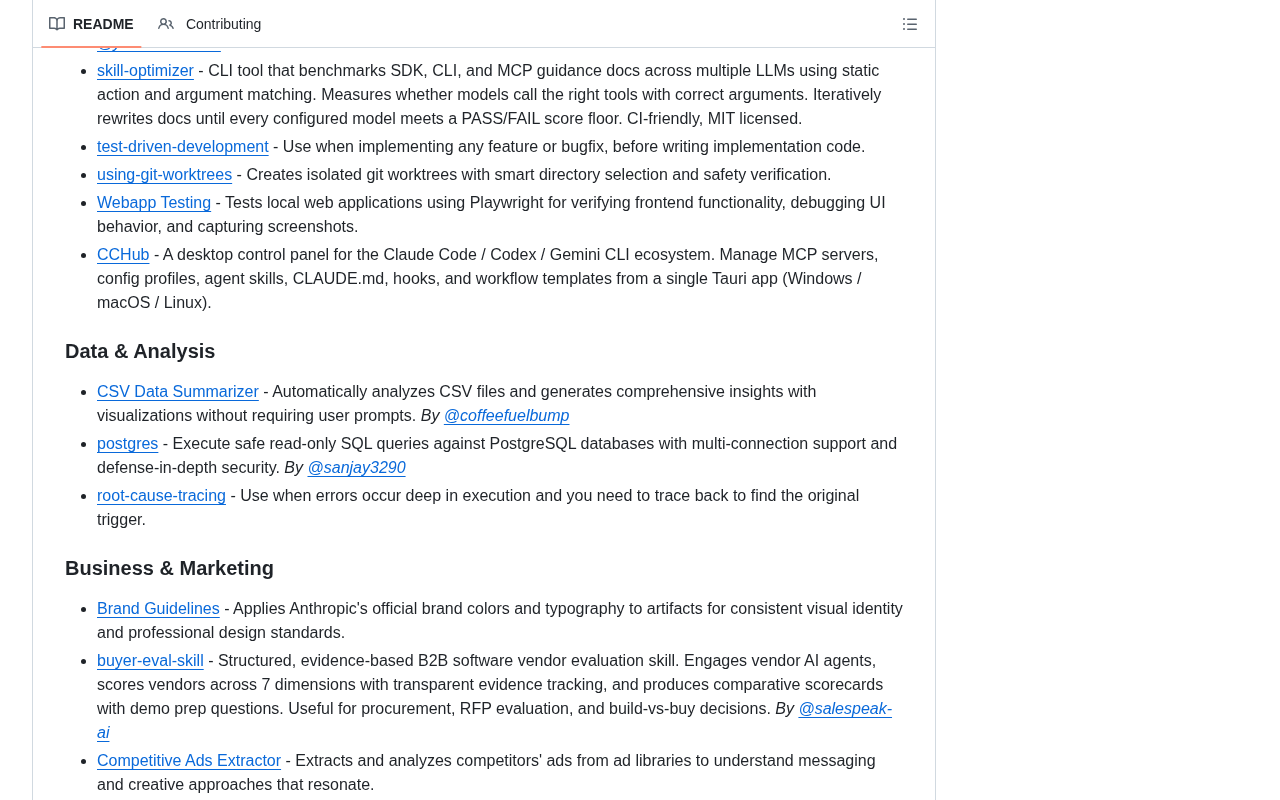
Core Positioning: Cross-Platform AI Agent Skill Collection
Compatible with Major AI Programming Tools
The biggest highlight of awesome-llm-skills is its cross-platform compatibility. The project explicitly supports today's most popular AI programming and Agent tools:
- Claude Code: Anthropic's command-line programming assistant
- Codex: OpenAI's code generation and Agent platform
- Gemini CLI: Google's command-line AI tool
- Custom AI Agents: Support for developer-built Agent systems
Although all three mainstream tools fall under the AI programming assistant category, their architectural philosophies differ significantly. Claude Code is based on Anthropic's Claude model, using the command line as its primary interface, emphasizing direct file system manipulation and shell command execution in terminal environments. Its Agent loop follows the ReAct (Reasoning and Acting) pattern of "think-act-observe." OpenAI's Codex (referring here to its Agent platform rather than the earlier code completion model) focuses more on sandboxed code execution environments, with each task running in an isolated container, emphasizing security and reproducibility. Gemini CLI is Google's command-line tool, backed by Gemini's multimodal capabilities and deep integration with the Google ecosystem (Google Search, Google Cloud, etc.). The three differ in context window size, tool-calling protocols (such as Function Calling implementations), and permission management models—which is precisely why cross-platform compatibility is so important.
This means developers don't need to search for resources separately for different platforms—a single skill list can be reused across multiple mainstream tools, significantly reducing learning and migration costs.
Why AI Agent Skill Modules Are Needed
When we talk about AI Agent "skills," we're essentially referring to structured capability modules that an Agent can execute. A bare LLM can only generate text, but through skill extensions, an Agent can:
- Call external APIs to complete specific tasks
- Execute code and handle file system operations
- Interact with external systems like databases and search engines
- Automate complex tasks following predefined workflows
The concept of AI Agent "skills" originates from modular design thinking in software engineering, but takes on new meaning in the LLM context. Traditional software modules are invoked through explicit API interfaces, while AI Agent skill modules typically encompass three layers: Prompt Templates define how the Agent understands tasks, telling the model in what context a skill should be activated; Tool Descriptions in structured formats like JSON Schema let the Agent know when to call what capability and what parameters are needed; Execution Logic is the actual code or API call chain that completes the task. This three-layer architecture allows skills to be declaratively defined and composed, similar to how Unix philosophy's small tools that "do one thing well" can be chained together through pipes into complex workflows.
The awesome-llm-skills project systematically organizes and categorizes these capabilities, allowing developers to combine needed Agent abilities like building blocks.
Project Value Analysis
Filling the Information Gap in the AI Agent Tool Ecosystem
The AI Agent field is developing rapidly, but there's an obvious pain point: skills and tools are too scattered. Developers often need to switch between different GitHub repositories, blog posts, and documentation to find solutions suitable for their scenarios. awesome-llm-skills aggregates dispersed resources in one place using the classic "awesome list" format, greatly improving information access efficiency.
"Awesome Lists" are a unique open-source cultural phenomenon on GitHub, originating from the awesome project created by Sindre Sorhus in 2014. The core philosophy is community-collaborative human curation and categorization of quality resources in a technical domain, distinct from search engine algorithmic recommendations. A high-quality Awesome List typically requires maintainers with deep domain knowledge to gatekeep content quality, while accepting community contributions through Pull Requests and conducting reviews. This model is particularly important in the age of information overload—when tools and resources in a technical domain grow exponentially, a manually curated and categorized list provides more reference value than raw search results and better helps developers build a comprehensive understanding of the domain landscape.
Community-Driven Continuous Update Mechanism
As an open-source project, awesome-llm-skills adopts a community contribution model. The 168 Forks indicate that many developers are already participating in content expansion and maintenance. In an era of extremely rapid AI tool iteration, the community-driven model ensures content timeliness—new tools and skills can be quickly incorporated into the list.
Lowering the Entry Barrier for AI Agent Development
For engineers just getting started with AI Agent development, the biggest confusion is often not "how to implement" but "not knowing what's available." This curated list provides a systematic panoramic view, helping developers quickly understand available skills and tools in the current ecosystem, enabling more informed technology choices.
Use Cases and Recommendations
Who Should Follow This Project
- AI Application Developers: Building LLM-based applications and need to extend Agent capabilities
- DevOps/Automation Engineers: Looking to optimize development and operations workflows with AI Agents
- Technical Managers: Need to understand the full AI Agent ecosystem landscape for technical planning
- AI Enthusiasts: Want to systematically learn the AI Agent technology stack
Practical Recommendations
- Start from your existing toolchain: If you're already using Claude Code or Codex, prioritize reviewing skill modules compatible with these tools
- Watch Star growth trends: The project's Star count breaking 1,200 in a short time indicates high community recognition, making it worth tracking for updates
- Actively contribute: If you discover quality Agent skills or tools in practice, contribute them to the project via PR
Industry Trend: AI Agents Moving from Concept to Engineering
The rapid rise of awesome-llm-skills reflects an important trend: AI Agents are transitioning from proof-of-concept to engineering-grade implementation. When developers start focusing on "skill lists" and "workflow customization," it signals that the industry has moved past the "can it work" stage into the deeper waters of "how to use it well."
This engineering process faces multiple technical challenges. First is the reliability problem: LLM's non-deterministic outputs mean the same task may produce different results, requiring retry mechanisms, output validation, and fallback strategies. Second is observability: An Agent's multi-step reasoning process needs comprehensive logging and tracing systems (such as LangSmith, Helicone, etc.) for debugging and optimizing each decision step. Third is cost control: Complex Agent workflows may involve dozens of LLM calls, requiring fine-grained token consumption management, including caching strategies and model routing (selecting different-scale models based on task complexity). Fourth is security boundaries: When Agents execute code or access external systems, permission control and sandbox isolation are critical—an uncontrolled Agent could cause data leaks or system damage. These challenges have created strong demand for standardized skill modules—community-verified skill modules encapsulate best practices, preventing each developer from repeating the same mistakes.
As competition intensifies among Claude Code, Codex, Gemini CLI, and other tools, the AI Agent skill ecosystem will become a key differentiator for platform competition. Cross-platform resource aggregation projects like awesome-llm-skills will play an increasingly important connector role in this process—it's not just a resource list, but a piece of infrastructure for the AI Agent engineering era.
Project URL: github.com/Prat011/awesome-llm-skills
Key Takeaways
- awesome-llm-skills is a curated LLM and AI Agent skill list with 1,207 Stars and high community engagement
- The project supports mainstream AI programming tools including Claude Code, Codex, and Gemini CLI with cross-platform compatibility
- It fills the ecosystem gap of scattered AI Agent skill and tool resources, lowering the developer entry barrier
- The community-driven update model ensures content timeliness, with 168 Forks indicating strong developer participation
- The project's popularity reflects the industry trend of AI Agents moving from proof-of-concept to engineering-grade implementation
Related articles
 Tutorials
ChatGPT Plus Subscription Guide: Are GPT-5.5, image-2, and Codex Worth the Upgrade?
A detailed look at ChatGPT Plus features — GPT-5.5, image-2, and Codex — with a Plus vs Pro comparison and a complete step-by-step subscription guide for users outside the US.
 Tutorials
Harness AI Engineering in Practice: Using Claude Code to Master Enterprise-Level E-Commerce Development
Deep dive into Harness AI Engineering: master enterprise e-commerce development with Claude Code using the Rules, Skills, Wiki, and Changes framework.
 Tutorials
Cursor + Codex Dual-IDE Collaboration: A Practical Methodology for Open-Source Project Customization
A complete methodology for open-source project customization based on real-world experience, detailing the Cursor+Codex dual-IDE workflow, seven-stage process, MVP validation, and AI source code reading techniques.