AWS MCP Server Expands to Six New Regions: Shorter Paths for Agent Calls

AWS MCP Server expands to 8 regions, letting AI agents call AWS services locally for lower latency and data compliance.
AWS MCP Server has expanded its execution regions to a total of 8, spanning the US, Asia Pacific, and Europe. The core value is enabling AI agents to connect to nearby local endpoints, reducing round-trip latency while keeping request data within required geographic boundaries. Using London as an example, the article shows how agents can provision, inspect, and debug workloads entirely within a local region. Notably, the expansion provides request-level data residency — not automatic workload migration. Teams must verify endpoint availability and quotas in the target region, and factor in both team location and compliance requirements before switching. Agent-side integration is lightweight, but architectural decisions on endpoint selection and data residency strategy remain essential.
What AWS MCP Server's Regional Expansion Really Means
AWS's MCP Server just added several new execution regions in one go — and for development teams, this is far more than a few extra dots on a map. The real shift is this: AI agents can now connect to nearby local endpoints, without routing requests the long way around when calling AWS services.
MCP Server is part of AWS's agent toolset and operates as a managed service. It lets code agents interact with AWS through a single interface, removing the burden of teams having to maintain an entire integration stack themselves. In other words, developers no longer need to pour effort into the glue logic between agents and AWS — that responsibility moves to the managed service.
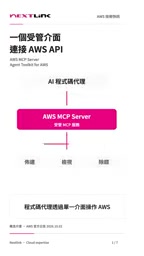
The expansion spans three major geographies: the United States, Asia Pacific, and Europe. One detail worth noting: the official announcement lists 8 execution regions — that's the new total, not the number of regions added in this release. Getting this right matters when planning your architecture so you don't misjudge the coverage footprint.
MCP (Model Context Protocol) is an open protocol introduced by Anthropic in 2024, designed to standardize communication between large language models and external tools and data sources. Think of it as the "USB port" of the AI agent world — as long as a tool or service implements the MCP spec, an agent can discover and invoke it through a unified interface, without writing custom adapter logic for every integration. AWS's hosted MCP Server builds on this protocol by wrapping AWS service calls, so agents can issue commands to services like EC2, S3, and Lambda without dealing with AWS SDK authentication, request signing, or error retries directly. The value of this abstraction: development teams can focus on the agent's business logic rather than maintaining "glue code" for cloud platform integration.
Local Execution: Balancing Latency and Data Residency
The most immediate benefit of regional expansion is reduced latency through local execution. When an agent connects to a closer endpoint, round-trip time shrinks and the overall response experience improves.

There's a commonly misread point here: data residency is about request data — don't interpret it as all workloads automatically migrating to the new region. The new regions provide the capability to keep request data within a specific geographic boundary; they don't migrate your existing workloads for you. This distinction is especially important for teams with compliance requirements — data sovereignty and latency optimization are two separate concerns that need to be evaluated independently.
Data Residency and Data Sovereignty are related but distinct compliance concepts. Data residency requires that certain types of data be stored or processed within a defined geographic boundary (such as within the EU), typically driven by regulations like GDPR, China's Data Security Law, or industry-specific mandates. Data sovereignty goes further, asserting that data is subject to the laws of the country where it resides, and that governments may legally demand access. For requests made through MCP Server, "request data" refers to the input parameters, context, and other content an agent carries when calling AWS APIs — whichever regional endpoint processes these requests directly determines whether that data crosses a border during transit and processing. When evaluating compliance requirements, teams need to clarify whether regulations constrain the storage location or the processing location — the implications for endpoint selection differ significantly.
The London Example: How Local Endpoints Work
The official London example makes the point clearly: by connecting to a local endpoint, an agent can handle provisioning, inspect workloads, and debug — all without routing requests to another geographic region.

For teams operating in Europe under data compliance constraints, this means debugging and operations workflows can run entirely within the local region. Request data stays in-country, satisfying residency requirements while also reducing the latency of cross-region calls. It's a textbook case of combining compliance needs with performance gains.
Implementation: Don't Just Swap a Region Name and Call It Done
The first step for customers is to check endpoint availability and service quotas, then follow the official getting-started documentation to connect your agent.

One important reminder: don't treat a region name swap as the finish line. When selecting an endpoint, consider both your team's location and your request data residency requirements together — these two factors jointly determine which region is the right choice.
From a responsibility standpoint, the agent-side changes are relatively lightweight and can be handled with minor integration work. But the architect's decision-making here is non-negotiable. Endpoint selection, quota planning, and data residency strategy are decisions that directly affect your system's compliance posture and performance. Regional expansion gives you more options — using those options correctly still depends on sound architectural judgment.
Quota (Service Limit) refers to the upper bounds AWS sets on resources or API call rates per account within a specific region, covering dimensions like concurrent requests, calls per second, and resource instance counts. Default quota values vary by service and region, and newer regions tend to have more conservative defaults than mature ones. When teams migrate agents to a new endpoint without requesting quota increases in advance, agents may hit throttling under high load, causing call failures or response timeouts. Before making the switch, check current limits for the target region through the AWS Service Quotas console, compare them against your actual peak usage, and determine whether you need to submit an increase request — this process can take anywhere from several hours to several business days for approval, so don't leave it to the night before go-live.
Summary
AWS MCP Server's new execution regions deliver core value by letting AI agents connect to nearby endpoints, balancing latency optimization with data residency compliance. But expansion doesn't mean automatic workload migration — data residency applies to request data, not your entire workload. Teams implementing this need to verify endpoints and quotas, and choose regions carefully based on their own location and compliance requirements. The agent side can be handled with relatively light integration work, but the architect's decisions cannot be skipped.
Related articles

Gemini 4 Argon Hands-On: AI Builds Board Games, Constructs Temples, and Trains Robots Autonomously
Gemini 4 Argon hands-on roundup: AI autonomously builds a desk racetrack and temple in Blender, writes a ray tracing engine, trains a humanoid robot to sink 7 shots, plus API pricing and developer access.

The Magic Octagonal Coin: Why Only 9% of People Can Predict Its Flip?
Only 9% of people can correctly predict the Magic Octagon coin flip. This article explains its spatial rotation mechanism, common cognitive pitfalls, and a new hypothesis based on Relevance Theory, exploring the limits of human spatial reasoning.

Sam Altman: AI Is Entering the Era of Scientific Discovery — Math Breakthroughs Will Replicate in Biology and Energy
Sam Altman says AI is entering the era of scientific discovery — math breakthroughs will replicate in biology, materials science, and energy to help develop new drugs and energy sources.