Axonnic Muscle-Sensing Sleeve: Training Robots with EMG Data

Axonnic uses a muscle-sensing sleeve to collect EMG and fingertip force for robot training datasets.
Axonnic is a wearable muscle-sensing sleeve on Product Hunt that collects forearm EMG to track finger movement and estimate fingertip force, fusing it with video and hand pose into training datasets for robotic tasks. It addresses the gap that visual learning from demonstration cannot capture force control needed for assembly and sewing. Positioned as a data supplier, it faces challenges in EMG cross-user generalization and wearing consistency.
From Human Muscles to Robot Actions: A New Approach to Data Collection
Robot training has long relied on teleoperation, motion capture, or simulation environments, but these methods often struggle to capture the mechanical details of fine manipulation by human hands. Axonnic, showcased on Product Hunt, proposes a different path: using a wearable muscle-sensing sleeve to directly record electromyography (EMG) signals from the human forearm, combined with video and hand pose data, to build training datasets for robotic tasks.
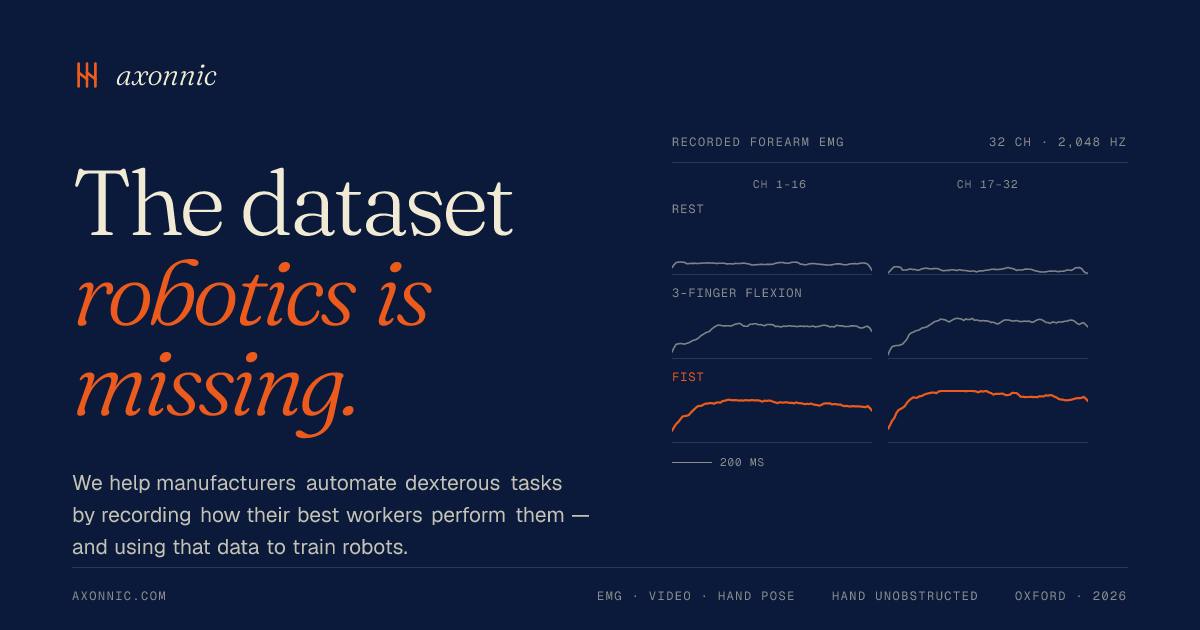
According to its product page, Axonnic's sleeve can track finger movement and estimate fingertip force, covering scenarios with high force-control demands such as sewing, tool operation, and precision assembly. The project was launched by Maxim Williams and received 68 upvotes on Product Hunt, ranking around #18 for the day, categorized under robotics, hardware, and artificial intelligence.
Why EMG Deserves a Place in Robot Training
Traditional visual learning from demonstration excels at imitating "motion trajectories" but struggles to express "how much force was used." Yet the core of tasks like assembly and sewing lies precisely in force control—gripping a needle, turning a tool, placing fragile parts—where a slight deviation in torque leads to failure.
Axonnic's approach uses muscle electrical signals as a proxy for force. The activation patterns of forearm muscles correspond to finger flexion/extension and grip force. By collecting these signals via the sleeve and aligning them with video and hand pose, it can theoretically provide richer supervisory information to robots than vision alone. This multimodal data fusion is a direction repeatedly validated as effective in current robot learning research.
Basic Principles of Electromyography (EMG): When muscles contract, electrical impulses from motor neurons cause muscle fiber depolarization, creating weak potential changes on the skin surface (typically in the microvolt to millivolt range). Surface EMG (sEMG) non-invasively collects these signals through electrode arrays attached to the forearm. After amplification, filtering, and feature extraction, it can infer the muscle groups involved in a movement and their activation intensity. Since the forearm contains most of the muscles controlling fingers and wrist, sEMG can reflect finger flexion/extension and grip force to some extent—which is why it is called a "force proxy."
Limitations of Visual Learning from Demonstration: Such methods typically extract trajectories or keypoints from human demonstration videos and have robots imitate them. However, video only records kinematic information (position, velocity, pose) and does not include dynamic quantities like contact force or torque. For tasks like assembly and sewing, the same trajectory with different forces can lead to success or failure, so visual supervision alone is often insufficient to learn usable policies—this is precisely the motivation for introducing force-related signals.
Product Form and Data Pipeline
Based on public descriptions, Axonnic's product logic can be divided into three layers:
- Collection layer: The forearm sleeve records muscle signals while estimating fingertip force;
- Fusion layer: EMG, video, and hand pose are merged into a unified dataset;
- Application layer: Training data is output for specific robotic tasks such as sewing, tool use, and precision assembly.
You might not have noticed: what it sells is not the robot itself, nor a general foundation model, but the intermediate product—a "training dataset." This positioning targets a real pain point in embodied intelligence: high-quality real-world manipulation data with force annotations is scarce and expensive to collect.
Multimodal Data Alignment: Merging EMG, video, and hand pose into a unified dataset hinges on time synchronization and spatial calibration. The three signal types have different sampling rates (EMG often reaches thousands of hertz, video typically 30–60 frames per second), requiring unified timestamps and interpolation alignment. Meanwhile, mapping EMG channels to specific finger joints is necessary for downstream models to learn "which muscle activation corresponds to which finger movement and how much force." The quality of this alignment directly determines whether the dataset can be effectively used by robot learning algorithms.
Realistic Challenges of the Commercialization Path
The data business is not easy. EMG signals vary greatly between individuals and are susceptible to sweat and electrode placement; cross-user generalization requires extensive calibration. The consistency of sleeve wearing and comfort during long collection sessions also directly affect data quality. Moreover, whether customers are willing to pay for a "dataset" rather than a "plug-and-play model" depends on the R&D maturity of downstream robot manufacturers.
However, commodifying human manipulation data itself aligns with the trend of robot learning moving from simulation to real data. If Axonnic can accumulate large-scale, high-quality data in specific vertical tasks, its value may extend beyond selling data to becoming an upstream supplier of robot skill libraries.
Cross-User Generalization and Calibration: EMG signals are highly dependent on individual anatomy, skin impedance, and electrode placement; the same movement produces noticeably different waveforms across people. In practice, each new user typically needs a calibration session (e.g., performing several standard gestures to establish a baseline), otherwise model performance degrades significantly. Sweat changes the contact impedance between electrodes and skin, and prolonged wear can cause electrode displacement—making consistency and reproducibility of data collection an engineering challenge.
Conclusion
With a muscle-sensing sleeve, Axonnic attempts to bridge the data channel between "human manipulation intent" and "robot motion policies." The product is still early-stage, with limited votes and discussion, but the direction it points to—using biological signals to fill the force-sensing data gap—deserves continued attention in the robot training field.
One-line Summary
Axonnic uses a muscle-sensing sleeve to collect EMG and fingertip force, building robot training datasets.
Paragraph Summary
Axonnic is a wearable muscle-sensing sleeve showcased on Product Hunt that collects forearm EMG signals to track finger movement and estimate fingertip force, then fuses them with video and hand pose to create training datasets for robotic tasks. Its core insight: traditional visual learning from demonstration can only imitate motion trajectories and struggles to express the force control required for tasks like assembly and sewing, while EMG signals can serve as a force proxy to fill the force-supervision gap. The product positions itself as a data supplier rather than a robot hardware or model vendor, targeting the pain point of scarce high-quality data with force annotations. However, EMG varies greatly between individuals and is susceptible to sweat and electrode placement; cross-user generalization and wearing consistency remain major challenges.
Related articles

A New Paradigm for Text Editing in Compose: TextFieldState Replaces the Old API
Jetpack Compose introduces the TextFieldState API to fix dropped characters and cursor jumps from async input. The old value/onValueChange callbacks will be deprecated in 1.13. This article covers InputTransformation, OutputTransformation, four state hoisting patterns, and new formatted text editing capabilities.

Remote Compose: A New Document-Driven Paradigm for Cross-Platform UI on Android
Remote Compose transmits compact binary documents instead of screen pixels, enabling efficient UI rendering on remote surfaces like Wear OS and widgets. This article covers its document creation API, expression animations, size optimization techniques, and Wear OS progress.

How Crashlytics Eliminates Android Memory and Responsiveness Issues
Through the Chroma Clip case study, this article explains how Firebase Crashlytics uses Application Exit Info, Profiling Manager, GWP ASAN, and ARM MTE to pinpoint ANRs, OOMs, memory limit terminations, and native memory corruption—solving the challenge of stack traces that don't point to the real culprit.