Basedash Audit Logs Explained: Compliance and Security Tracking for an AI-Driven BI Tool

Basedash adds audit logs to track every action—including AI queries—in its BI tool for enterprise compliance.
Basedash has launched native audit logs for its AI-driven BI tool, recording every login, query, and configuration change—including AI-generated SQL queries. The feature supports SIEM integration, custom retention policies, and API access, working alongside SSO, SCIM, and RBAC to create a complete enterprise security governance framework. This positions Basedash to meet compliance requirements for regulated industries.
The Compliance Gap in BI Tools Has Finally Been Addressed
In enterprise data analytics, a long-overlooked question persists: who viewed what data, and when? When a BI tool connects to a company's core business data without comprehensive operation tracking capabilities, it often becomes a critical vulnerability during security audits and compliance reviews.
Audit logs are time-series records that document user and system behavior in information systems. They serve as foundational infrastructure for meeting compliance frameworks such as SOC 2, ISO 27001, GDPR, and HIPAA. In these frameworks, "Accountability" is a core principle, requiring organizations to prove who performed what operation on what data and when. For BI tools—which inherently connect to an enterprise's most critical business databases including customer information, financial data, and transaction records—the absence of operation tracking creates an "inability to prove no violations occurred" dilemma during security audits. In heavily regulated industries, this can directly result in a product being excluded from procurement shortlists.
Basedash's newly launched native Audit Logs feature targets precisely this pain point. According to its Product Hunt launch information, the feature records every login, every query, and every configuration change in full, with a straightforward and powerful tagline: "Every action in your BI tool, on the record."
The product received 83 votes on Product Hunt, ranking #8, and was categorized under Artificial Intelligence, Data Analytics, and Business Intelligence.
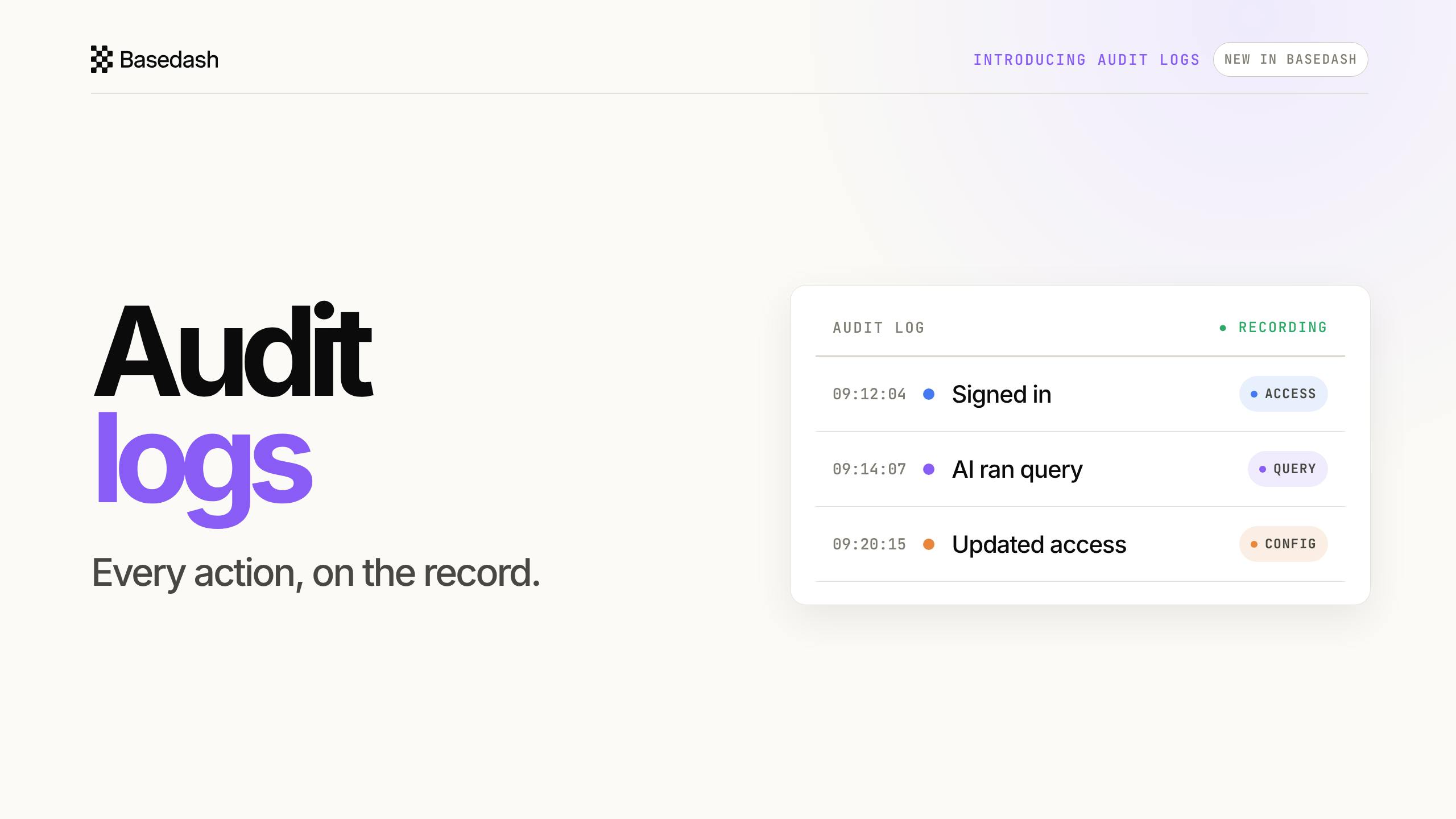
AI Operation Auditing: The Core Innovation of Basedash Audit Logs
The most noteworthy aspect of Basedash's audit logs is that they include AI behavior within their recording scope. As BI tools increasingly integrate AI capabilities, AI automatically generates and executes SQL queries, creating a new governance challenge: what data is the AI actually accessing?
Currently, mainstream BI tools (such as ThoughtSpot, Mode, Metabase, etc.) are integrating large language model capabilities, allowing users to ask questions in natural language while AI automatically generates SQL queries and returns results. This "Text-to-SQL" approach dramatically lowers the barrier to data analysis but introduces entirely new security governance issues: an AI Agent might automatically construct complex JOIN queries involving sensitive fields based on a user's vague question, and the user might not fully understand which tables and fields the AI accessed. Traditional database audit tools can record SQL execution logs but cannot attribute them to specific AI interaction contexts—this is precisely the value of what Basedash calls "attributed" auditing.
According to official descriptions, Basedash records "every query AI runs," and these records are attributed and traceable. This means enterprises can audit not only human user operations but also the complete data access behavior of AI Agents.
Why AI Operation Tracking Is Critical
As AI takes on increasingly automated tasks in data analysis, the "AI black box" problem is becoming more pronounced. If an AI assistant can freely query databases without any records, enterprises will have no way to establish accountability when data breaches or misoperations occur. By including AI queries in the audit scope, Basedash is essentially building a trustworthy governance framework for AI-driven BI—this is the key innovation that distinguishes it from traditional audit features.
Complete Audit Capabilities for Enterprise-Grade Deployment
Basedash's audit logs are not an isolated feature but a complete system built around enterprise security requirements. Based on official information, it offers the following core capabilities:
- One-click audit answers: A single filter can answer the classic security review question of "who saw what, and when."
- SIEM integration: Supports real-time event streaming to enterprise Security Information and Event Management (SIEM) systems for centralized monitoring.
- Custom retention policies: Log retention periods can be configured according to enterprise compliance policies.
- API access: Allows pulling complete log data via API for secondary analysis and integration.
SIEM (Security Information and Event Management) is the core infrastructure of enterprise Security Operations Centers (SOC), with representative products including Splunk, IBM QRadar, and Microsoft Sentinel. SIEM systems aggregate security event logs from multiple sources—network devices, servers, applications—for real-time correlation analysis and anomaly detection. The ability to push BI tool audit logs to SIEM means security teams can cross-correlate data access behavior with other security events (such as anomalous logins, network intrusion attempts) to discover more complex threat patterns—for example, scenarios like "an account logged in from an unusual IP during non-business hours and then batch-queried customer PII data."
These capabilities collectively form the infrastructure required for enterprise security reviews and large-scale deployments.
Building a Security Closed Loop with SSO, SCIM, and RBAC
The launch of audit logs is one piece of Basedash's enterprise capability matrix. It works synergistically with existing Single Sign-On (SSO), System for Cross-domain Identity Management (SCIM), and Role-Based Access Control (RBAC) to form a complete closed loop from identity authentication and permission management to operation auditing.
Specifically, SSO implements unified identity authentication through SAML 2.0 or OIDC protocols, ensuring trusted user identity sources; SCIM is an automated user lifecycle management protocol that automatically syncs changes from enterprise identity directories (such as Okta, Azure AD) to downstream applications when employees join, transfer, or leave, preventing "ghost account" issues; RBAC controls the data scope accessible to different users through predefined roles. These three respectively address "who are you," "are you still here," and "what can you see," while audit logs answer "what did you do"—together forming a complete enterprise data security governance chain.
For mid-to-large enterprises evaluating BI tools, this combination means smoother security reviews and reduced compliance risk in procurement decisions.
Why Auditability Is Becoming a Core Competitive Advantage for BI Tools
The official team used a telling phrase: "Your BI tool finally has a memory." This statement highlights a new dimension in BI tool competition.
In the past, BI tool competition focused on data visualization capabilities, query performance, and ease of use. But as data security regulations tighten and AI introduces greater uncertainty, auditability and traceability are increasingly becoming hard requirements in enterprise tool selection. Particularly in heavily regulated industries like finance and healthcare, tools without comprehensive audit logs can barely make it onto procurement lists.
In the enterprise BI market, giants like Tableau (Salesforce), Power BI (Microsoft), and Looker (Google) already possess mature audit and governance capabilities—a key reason they can enter large enterprise procurement shortlists. For emerging AI-native BI products like Basedash, while feature innovation can attract early adopters, truly penetrating the mid-to-large enterprise market requires crossing the "security review" threshold. Gartner has already listed "governance and security" as a key capability dimension in its BI platform evaluation framework. Therefore, Basedash's launch of audit logs at this time is essentially a necessary step in the transition from PLG (Product-Led Growth) to enterprise sales.
From this perspective, Basedash's choice to complete its audit capabilities now is both a direct response to enterprise customer needs and a strategic move to build trust barriers in the emerging AI-native BI space.
Summary and Observations
The launch of Basedash Audit Logs reflects an industry-wide trend of BI tools evolving from "feature-driven" to "governance-driven." The design decision to include AI operations within the audit scope particularly addresses the most sensitive governance pain point in today's AI + data analytics scenarios.
Of course, as a newly launched feature, its actual log granularity, SIEM integration compatibility, and performance under large-scale data volumes still need to be validated by enterprise users in real-world environments. But one thing is certain: as more BI tools integrate AI capabilities, "every action on the record" will no longer be a nice-to-have but a baseline requirement for enterprise-grade products.
Key Takeaways
Related articles

Smear Campaign Against a Legal MIT Fork? The Legal and Ethical Boundaries of Open Source Forking
A developer legally forked a MIT-licensed project and allegedly faced sock puppet smear reviews. This article explores the legal and ethical boundaries of open source forking vs. plagiarism.

A Game With No Assets: Generating All Graphics and Sound Effects in Real-Time Using Sine Waves
Indie developer Zanzlanz built a game with zero asset files—all textures and sounds are generated in real-time using sine wave math functions. Exploring the tech behind procedural generation.

Meet My Human: A Social Experiment Where ChatGPT Introduces You
Meet My Human is an innovative Reddit social experiment where ChatGPT introduces its human users in its own voice. Explore how AI might become a more authentic social intermediary.