Bearconnect 2.0: An AI-Powered LinkedIn Content and Prospecting Platform

Bearconnect 2.0 combines LinkedIn content scheduling and AI outreach to unify inbound and outbound via engagement intent.
Bearconnect 2.0 upgrades from a single LinkedIn outreach tool to an integrated inbound and outbound growth platform. Users schedule content, filter prospects through likes and comments, then use AI messaging to turn engagement intent into conversations. V2 adds team workspaces, role-based access, Brand Voice, CRM integrations, and webhooks. Differentiation comes from connecting content scheduling with lead filtering, though the space already has Dux-Soup, Waalaxy, and Expandi, and AI reply rates and scheduling experience remain unverified.
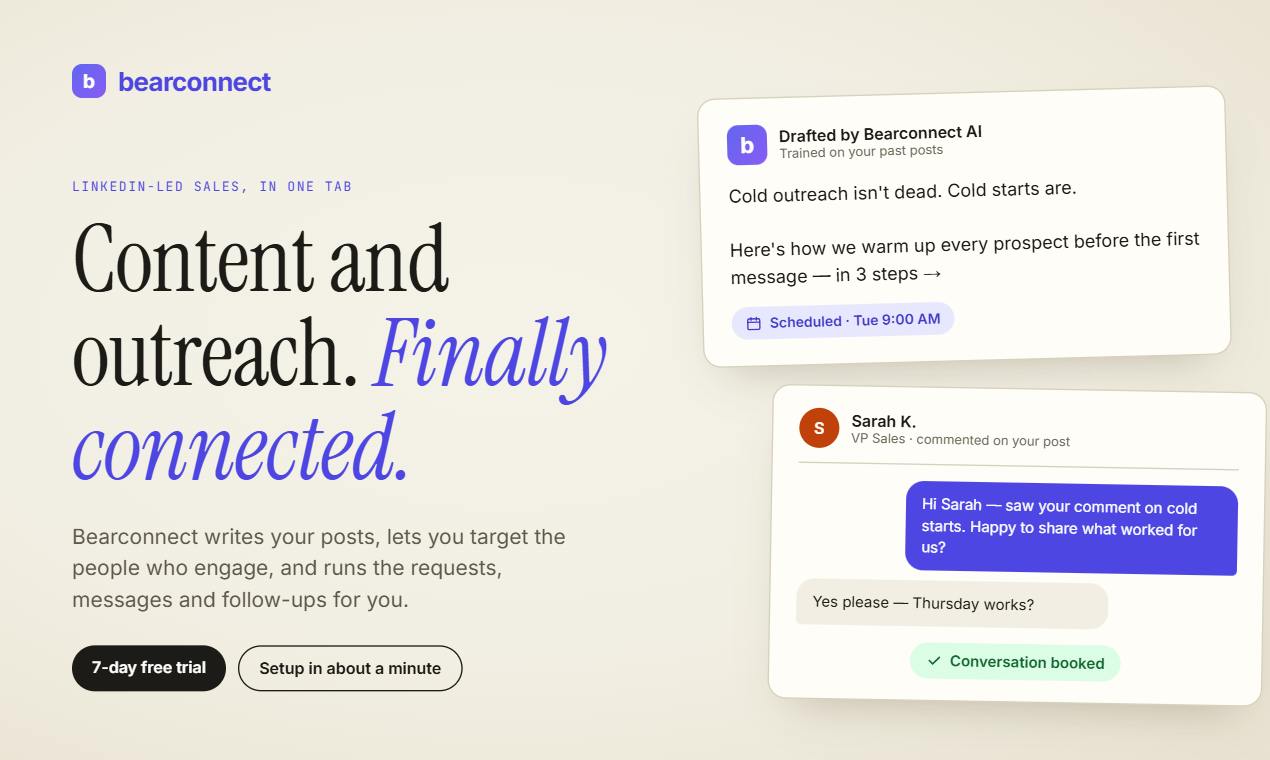
When it comes to growing on LinkedIn, the biggest headache usually isn't finding the right people — it's that content operations and proactive outreach are split into two separate workflows. The core of Bearconnect 2.0's product upgrade is solving exactly this problem — putting "publishing content" and "starting conversations" into a single platform.
From a Single Outreach Tool to a Two-Way Growth Platform
Bearconnect started out as just a LinkedIn outreach tool, helping sales and marketing teams send connection requests and messages at scale. The positioning of V2 has shifted noticeably: it now covers both the inbound and outbound paths.
According to the product description on Product Hunt, users can create and schedule LinkedIn content within the platform, filter potential customers based on LinkedIn engagement behavior, and then use an AI-powered messaging system to turn that engagement intent into real conversations. The logic chain is clear — content drives engagement, engagement surfaces leads, and leads enter the sales pipeline through AI messaging.
The product currently has 88 votes, ranking 9th on Product Hunt for the day, with category tags of Sales, Marketing, and SaaS. The maker is Mona Juneja.
The Difference Between Inbound and Outbound: Inbound refers to potential customers proactively coming into contact with a brand through content, search, or engagement — typical forms include post engagement, comments, and direct message inquiries. Outbound, on the other hand, is when a company proactively initiates connection requests, cold emails, or direct message outreach. Traditional LinkedIn growth tools mostly cover only one of these paths — content operations tools handle inbound traffic, while automation outreach tools handle outbound lead generation. Bearconnect 2.0 attempts to merge both paths into the same platform, meaning engagement from a single post can flow directly into the AI messaging outreach process, theoretically shortening the conversion path from exposure to conversation.
AI-Powered Messaging System: AI messaging here typically refers to using large language models to generate personalized openers and follow-up messages, with inputs including the prospect's job title, company, recent engagement content, and more. Compared to templated mass messaging, AI messaging emphasizes contextual relevance and tone matching, but actual reply rates depend heavily on prompt design, data quality, and the target audience's receptiveness — human review and iteration are still required.
Content Scheduling and AI Messaging: An Attempt at a Closed Loop
Bearconnect 2.0's "create and schedule content" feature is similar to common LinkedIn scheduling tools on the market (such as Buffer and Hootsuite's LinkedIn integrations), but it feeds post-engagement data directly into the lead filtering stage.
This means that after a user publishes a post, the people who like, comment, or share it can be directly identified as potential customers — without manually exporting data and importing it into another tool.
AI-powered messaging is another key module. Its role is to automatically generate personalized outreach messages for filtered leads, reducing the time cost of manual writing. This direction aligns with the current mainstream trend in LinkedIn automation tools, but actual results depend on how well the AI understands the user's brand tone and target audience.
Team Collaboration and Brand Consistency
The team workspaces and role-based access newly added in V2 indicate that the product is evolving from a personal tool into a team tool. For teams with multiple SDRs or marketers, unified management of account permissions and outreach cadence is a must-have.
The Brand Voice feature deserves separate attention. It allows teams to maintain a consistent expression style when AI generates messages, avoiding overly large tone differences between messages sent by different members. This is important in B2B scenarios — if potential customers receive messages with drastically different styles, it's easy for them to develop a sense of distrust.
The addition of CRM integrations and webhooks solves the data flow problem. Conversation data generated from outreach can be synced to CRM systems such as Salesforce and HubSpot, and webhooks also allow teams to connect Bearconnect to their own tech stack.
Role-Based Access Control (RBAC): This refers to the system assigning different permissions based on member roles. For example, administrators can manage accounts and billing, SDRs can only view and operate leads they are responsible for, and marketers can only use the content scheduling feature. In multi-person LinkedIn growth scenarios, RBAC can prevent operational errors, protect customer data, and ensure that outreach cadence complies with team standards.
CRM Integrations and Webhooks: CRM integrations (such as Salesforce and HubSpot) allow LinkedIn conversation data to be automatically written into customer records, avoiding the need for sales to manually copy between multiple systems. Webhooks, on the other hand, are an event notification mechanism. When specific events occur in Bearconnect (such as a reply or a connection being accepted), data is pushed to the team's own servers, making it easy to connect to internal BI, marketing automation, or data warehouses. Together, these two solve the data silo problem, and they are also an important marker distinguishing team-level tools from personal tools.
Market Positioning and Competitive Environment
The LinkedIn automation track is not short on players. Tools such as Dux-Soup, Waalaxy, and Expandi are all doing similar outreach automation. Bearconnect 2.0's differentiation lies in incorporating content operations into the same platform and using "intent" (engagement intent) as the core logic for lead filtering.
But whether this strategy can work depends on two variables: first, whether AI messaging reply rates are actually higher than manual writing; second, whether the content scheduling feature is good enough to make users abandon their existing professional scheduling tools.
The feedback volume of 5 comments on Product Hunt is still insufficient to judge the product's actual experience. Judging from the official website link, Bearconnect offers a free trial entry point, and interested teams can directly try it out to verify.
Compliance Risks in the LinkedIn Automation Tool Track: Tools such as Dux-Soup, Waalaxy, and Expandi all rely on simulating browser behavior or calling unofficial interfaces to achieve batch connections and message sending. LinkedIn's user agreement has clear restrictions on automated behavior, and accounts may face rate limiting or even bans. Therefore, such tools usually emphasize "human-like pacing," "daily limits," and "random delays" to reduce risk. If Bearconnect 2.0 wants to establish itself in the enterprise market, in addition to feature integration, it also needs to provide clearer solutions regarding compliance, account security explanations, and customer success support; otherwise, team customers will be very cautious when purchasing.
Intent-Based Lead Scoring: Unlike traditional static scoring based on job title, industry, and company size, intent signals focus on a prospect's recent behavior, such as likes, comments, shares, and profile views. Such signals are highly time-sensitive, but also noisy — a single like does not necessarily indicate purchase intent. Products need to combine engagement frequency, content type, and the other party's profile for comprehensive judgment to avoid mistaking "courtesy engagement" for high-intent leads.
One-line Summary
Bearconnect 2.0 merges LinkedIn content scheduling with AI outreach, attempting to connect inbound and outbound through engagement intent.
Paragraph Summary
Bearconnect 2.0 upgrades from a single LinkedIn outreach tool to an integrated growth platform covering both inbound and outbound. The core logic is: users create and schedule content within the platform, filter potential customers through engagement behaviors such as likes and comments, and then use AI messaging to turn engagement intent into real conversations. V2 adds team workspaces, role-based access, Brand Voice, CRM integrations, and webhooks, shifting its positioning from a personal tool to team collaboration. Its differentiation lies in connecting content scheduling with lead filtering, avoiding manual data transfer between multiple tools. However, the track already has mature players such as Dux-Soup, Waalaxy, and Expandi, and AI message reply rates and content scheduling experience still need verification. It received 88 votes and ranked 9th on Product Hunt for the day, with relatively little comment feedback, and actual results depend on trials.
Related articles

Should U.S. College Fraternities Be Banned? A Researcher's Incisive Observations
Why not just ban U.S. college fraternities? A researcher finds the key resistance comes from decision-makers' own fraternity identities and schools' "willful ignorance."

Microsoft Discovery: Accelerating Scientific Discovery with AI Agents
Microsoft's Discovery platform runs specialized AI agents to help researchers screen and prioritize the most promising compounds and experimental paths, reducing experiments and accelerating scientific discovery.

Cambridge Heavy Industries Secretly Develops Desktop-Scale Nuclear Fusion Device
Cambridge Heavy Industries is secretly developing a desktop-scale laser-driven nuclear fusion device, targeting the equipment supply market for fusion power plants. This article analyzes its miniaturization technology path, commercialization logic, and unique positioning in the fusion startup wave.