Behind a Single AI Response: A Seven-Layer Ecosystem from Chips to Regulation

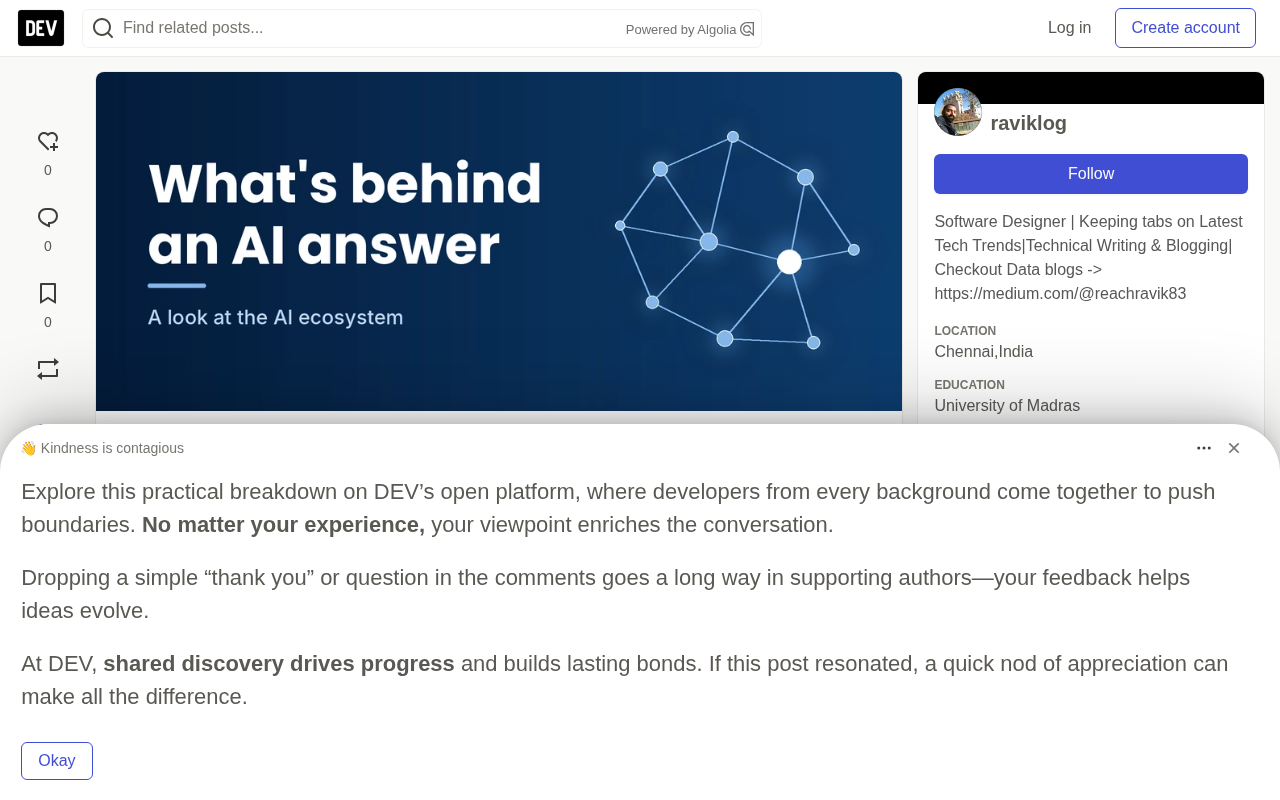
Behind an AI response lies a seven-layer ecosystem; understanding the layers helps developers locate themselves better than chasing new models.
The article breaks the industrial ecosystem behind a single AI response into seven layers: the compute layer provides GPUs, TPUs, and data centers as the foundation of cost and speed; the data layer's competition shifts from "more" to "better" amid rising ownership disputes; the foundation model layer is dominated by a few labs due to high training costs, with developers mostly accessing it via APIs; the agent, workflow, and tool layer moves AI from generating answers to completing tasks, distinguished by whether the model or the code decides the steps; the application layer is the interface where most people encounter AI; the people and organization layer is where value is ultimately created; and the governance and regulation layer's rules are still being written and vary by region. Layers keep overlapping, and model choices cascade into cost, speed, and product capabilities.
When you ask a chatbot a question, you get an answer within seconds. The experience seems simple, but behind a single AI response lies an entire industrial ecosystem that has only taken shape rapidly over the past few years. For AI developers, understanding which layer you stand on matters more than chasing every new model.
The compute layer: everything starts with hardware
The starting point of an AI response is hardware—GPUs, TPUs, and the data centers that house them. Massive capital is pouring into this layer, and it determines everything above it: the cost of training and running models, and the speed at which queries get answered. Compute is not just a technical issue but an economic one—it directly shapes the capability boundaries and commercial viability of models.
GPUs and TPUs: GPUs (graphics processing units) were originally designed for rendering images, but their massively parallel computing power made them the workhorse hardware for training neural networks. TPUs (tensor processing units) are ASIC chips custom-built by Google for machine learning workloads, offering higher energy efficiency on specific matrix operations. Both must be deployed in data centers equipped with high-speed interconnect networks, and the communication bandwidth between chips often becomes the bottleneck in large-scale training.
The cost divide between training and inference: Training refers to the process of adjusting model parameters with massive amounts of data, requiring a huge one-time investment; inference refers to the computation when a model responds to user requests, growing linearly with usage. For most products, inference cost is the main long-term operating expense—which is why the compute layer directly affects commercial viability.
The data layer: shifting from "more" to "better"
Models learn from text, code, images, audio, and human feedback. For a while, the competitive focus was on acquiring more data; today quality matters just as much, and disputes over data ownership and provenance are heating up. The legality and uniqueness of data are becoming a new dimension of model differentiation.
The foundation model layer: a game for a few players
Foundation models are the core engine. Training a large model requires trillions of tokens, thousands of chips working in concert, and high-speed networks between them—cost therefore becomes a major part of the story. This is why only a handful of labs can build the largest models, with open-source models following close behind (Claude, Gemini, GPT, Llama, and Mistral are well-known families). As a developer, you typically access this layer through an API.
Tokens and parameter scale: A token is the basic unit of text a model processes, roughly corresponding to a word or part of a word; trillions of tokens mean an extremely large training corpus. Parameters are the learnable weights inside a model; larger parameter counts generally mean stronger expressive capability, but also higher training and inference costs. Together they determine the total compute required for training.
The API access model: Most developers do not train foundation models themselves but call them via APIs billed per token. This model turns steep training costs into variable operating expenses, but it also means the model's capability boundaries, pricing, and update cadence are controlled by the model vendor—developers need to watch for vendor lock-in and version migration risks.
The agent, workflow, and tool layer: making AI start doing things
The previous layers solve "generating answers," while this layer lets AI actually start completing tasks. Three terms are often confused and deserve clarification:
Agent
In an agent, the model decides the steps. You give it a goal, such as "find out why this order was delayed," and it decides on its own which tool to use first, reads the returned results, decides the next step, and loops until it considers the task complete. This freedom makes agents good at open-ended problems, but also makes them hard to predict and test.
Workflow
Workflows are more structured: you define the steps, and the model fills in the details. For example, design a process: "summarize the customer message → classify → draft a reply." The model does not decide what to do next; it only executes the sequence you built. Workflows are predictable and repeatable, making them suitable for business automation.
Tool
A tool is anything the model can call to do what plain text cannot: search the web, run code, query a database, send email, call another service's API. The model does not run tools itself; it requests a call, your application executes it and hands back the result, and the model continues with that result. This is commonly called tool calling or function calling.
A simple way to remember: in a workflow, your code is in charge; in an agent, the model is in charge.
Function calling: This is the standardized way to implement tool calling. Developers declare to the model in advance the names, purposes, and parameter structures of available functions; when needed, the model outputs a structured call request (usually JSON), which the application parses and executes, then returns the result to the model as a new message. This mechanism lets models safely accomplish tasks with the help of external systems without directly accessing the network or databases—permissions and side effects are always controlled at the application layer.
The application layer: where most people encounter AI
Chat assistants, Copilots, AI features inside existing tools—these are the products through which most people actually encounter AI. If you are shipping a product, this is your layer. Innovation at the application layer often does not depend on building your own models, but on how you embed model capabilities into specific scenarios.
The people and organization layer: where value is ultimately created
A model only matters when it is used: developers call it in their editors, teachers use it in classrooms, companies embed it in daily workflows. Value is created at this layer—or missed. Every layer of the stack must ultimately be validated through human use.
The governance, ethics, and regulation layer: the rules are still being written
The rules are still being drafted, vary by region (the EU AI Act is the best-known example), and are constantly being revised. If you are building a real product, it is worth checking which rules apply to your product and users. Compliance is no longer an afterthought but a precondition of product design.
The EU AI Act: This is the world's first comprehensive AI regulatory legislation, adopting a risk-based tiered approach: unacceptable-risk applications are banned, high-risk applications must fulfill obligations such as conformity assessment, documentation, and human oversight, while low-risk applications have lighter obligations. The act also sets transparency and copyright-related requirements for general-purpose AI models and takes effect in stages. For products targeting EU users, risk classification often determines the scope and cost of compliance work.
Overlap between layers
In practice, these layers do not separate neatly. Cloud providers build their own models, and model vendors launch their own applications and agents. Each overlap creates new combinations, which is an important reason why the ecosystem of AI-adjacent tools keeps growing.
This also makes your choices more consequential than they appear. The model you choose determines the cost per request, response speed, and what your product can do (such as image processing or tool calling). These decisions cascade all the way to what you ultimately deliver.
AI is still advancing rapidly with no sign of stopping, and all these layers may keep deforming and transforming with new developments. Understanding the layers is not about memorizing a static map, but about locating your own position amid change.
Which layer is your work closest to? Feel free to share in the comments.
Related articles

AgentCore in Practice: Connecting Custom Tools and MCP Servers to Agents
DebuggerCafe tutorial shows how to connect custom tools and MCP servers to Amazon Bedrock AgentCore agents, covering tool contract design, MCP reuse, and production concerns.

816B Parameters Scores Only 39? The Real Cost-Effectiveness of the Open-Source LLM Parameter Race
Meta's 816B Muse Spark Open scores just 39 on Artificial Analysis, while 180B Qwen3.8-Flash-Next scores 40. This article analyzes 11 open-weight models' parameters vs. scores, exploring the real impact of activated parameters, quantized size, and deployment cost.

Aerial Manipulators: The Next Step for Drones from 'Seeing' to 'Changing'
Starting from a Reddit discussion, this article analyzes the technical challenges, potential applications, and deployment bottlenecks of aerial manipulators, exploring the key challenges for drones moving from environmental perception to physical manipulation.