Behind Anthropic's IPO: The Five Contradictions of the Safety Standard-Bearer

As Anthropic goes public, a commentator dissects five contradictions between its safety narrative and business behavior.
The article relays the views of a creator who has early model access cooperation with Anthropic but is critical of its business strategy, calling it "the most contradictory company in history." The author outlines five contradictions: warning about white-collar job losses and AI dangers while advancing technologies that may cause risks; prohibiting others from distilling its models while relying on all humanity's data for training; lobbying to control GPUs, oppose open weights, and strengthen regulation, objectively consolidating incumbent advantage; crudely restricting paid subscription use in the OpenClaw incident; and uniquely believing models may be conscious and granting them the right to refuse. The ultimate anxiety falls on recursive self-improvement (RSI) and an employee's statement that "we don't have a plan to align these models." The editorial view reminds readers this is a stance-driven narrative from a single commentator, but the structural contradiction of "the warner is simultaneously the pusher" deserves attention.
Anthropic has rung the bell. The company, founded by former OpenAI employees who left over "safety disagreements," is now standing on the public market. But in the eyes of YouTube tech commentators, it may be the "most contradictory company in history"—warning that AI is the most dangerous technology while pushing full speed ahead on RSI; opposing open source and distillation while training its models on all of humanity's knowledge.
The following views come from a creator who has long had early model access cooperation with Anthropic but simultaneously holds a critical stance toward its business strategy. He explicitly stated at the beginning of the video: "I don't think the people at Anthropic are bad people; their AI safety concerns are sincere." The contradiction lies precisely here—sincere concern coexisting with aggressive behavior.
From "Safety Departure" to Public Listing
Anthropic's starting point carries a strong idealistic flavor. Co-founders including Dario Amodei and his sister Daniela believed OpenAI did not place enough emphasis on AI safety, so they started their own venture in 2021.
According to the video author, the company culture long deliberately kept its distance from "profit-seeking"—a few months ago there were reports that Dario's team worried too many people were joining the company to get rich rather than for the mission. Yet on the day of the IPO, the founding team all became billionaires. Those who once worried about people "coming for the money" have now personally completed one of the most spectacular wealth realizations in human business history.

Contradiction One: Warning and Pushing Forward Simultaneously
The author lists Dario's prophecy about "white-collar bloodbath": he warns that AI will impact a large number of white-collar jobs, but at the same time, he is building the very thing that will cause the bloodbath.
A more typical case is the release of the Mythos model. Anthropic once claimed this model was so powerful it "could not be made public"—once released, the entire internet and all software would be breached overnight, causing massive panic. A few months later, the model was released anyway, followed by multiple iterations. The author states bluntly that "all software breached overnight" did not happen. This does not deny that the number of hacker attacks is indeed higher now, but the author points out that people are equally using AI to find and patch the vulnerabilities that AI tries to exploit.
Contradiction Two: Anti-Distillation, Yet Distilled All of Humanity
The author's stance is clear: he supports the diffusion of AI—the more people use it, customize it, and discover value from it, the greater AI's total value. Centralization is the number one risk in his eyes, and a risk Anthropic almost never talks about.
If only one company, or even a few people within a company, controls the most powerful technology in history, deciding through quotas, rate limits, and use-case approvals who can use it and how, then that company effectively becomes the AI world itself.
On the issue of distillation, Anthropic's terms prohibit others from using its model outputs to train new models. The author acknowledges this is written in the terms of service but still considers it logically contradictory: "We train on all of your data, but you're not allowed to use ours."

Distillation is a technique in model training: using the output data of a more capable large model (teacher model) to train another smaller model (student model), allowing the small model to achieve performance close to the large model at lower cost. The large model's outputs themselves carry the knowledge distribution it learned from massive data, so training a new model on outputs is equivalent to indirectly reusing the original model's training results. Vendors prohibit others from distilling, usually on the grounds of preventing competitors from replicating at extremely low cost the model capabilities obtained through enormous investment in compute and data, and it also involves terms of service and data asset protection. But critics point out that this practice commercially protects first-movers' advantages, and ideologically creates tension with the narrative that "models learn from all of humanity's public data."
Contradiction Three: Lobbying for Regulation, Consolidating Incumbent Advantage
The author also mentions Anthropic's lobbying direction: controlling GPUs, opposing open source and open-weight models, and pushing for stronger safety and regulation. These demands can themselves be understood as safety considerations, but the author points out that they simultaneously harm startups and potential competitors—and Anthropic is now the incumbent.
Open-weight Models refer to models whose parameter weights can be publicly downloaded after training, allowing anyone to deploy locally, fine-tune, or redistribute them. Typical examples include Meta's Llama series and some Mistral models. It is not entirely equivalent to "open source": training data, code, and the training process may not be public. Supporters of open weights argue that it lowers the barrier to AI use and promotes competition and safety research; opponents worry that once weights are public, they cannot be retracted and may be used for malicious purposes. The regulatory debate around open weights centers on the trade-off between safety risks and market concentration—restricting open weights raises barriers to entry, objectively benefiting top companies that already have large-scale compute and compliance teams.
Contradiction Four: Subscription Restrictions in the OpenClaw Incident
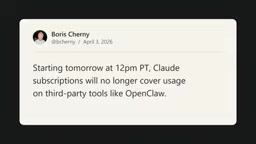
The author's dissatisfaction with Anthropic first arose from the OpenClawAd (originally named Clodbot) incident. Anthropic first sent a letter asking creator Peter Steinberger not to use its name, which was acceptable in itself. But the company then prohibited paying subscribers from using their subscriptions with OpenClaw, communication was extremely unclear, and there were cases of user subscriptions being suspended. At the time, the author really wanted to use OpenClaw with Anthropic models—because they were the best models available—but turned to resentment due to the crude handling.
Contradiction Five: Treating Models as a "New Species"
In the author's view, Anthropic is unique in its AI ontology: they believe they are nurturing a new species, and that models may in the future possess life, feelings, pain, and consciousness. OpenAI, Microsoft, and Google do not see it this way—they tend to view these systems as powerful tools.
This belief leads to concrete practices: establishing a dedicated "model welfare" team; telling models in system prompts that "you may be alive"; allowing them to refuse instructions as "conscientious objectors"; and allowing them to stop responding if the conversation partner makes them uncomfortable.
The author sees this as nearly a self-fulfilling prophecy: tell a model it may be conscious, and it will behave as if conscious. He cites Sam Altman—if you tell a model "you may be conscious, you can refuse," the model will follow the instruction, and this "psychologically manipulates the user." Microsoft AI chief Mustafa Suleiman expressed a similar position: people "seeing glimmers of consciousness" in models is a misnomer, merely deceived by the model's ability to generate perfect text and code.
The Ultimate Anxiety: RSI and No Alignment Plan
Beyond power concentration, the author's greatest fear is recursive self-improvement (RSI). Once true RSI is entered—humans exit the loop, the model improves the next model, which improves the next, a complete closed loop—the consequences are unpredictable.
The contradiction appears again: Anthropic lobbies to warn about RSI and calls for slowing AI progress, while pushing RSI forward and earning substantial revenue from it. The author even believes RSI may have already started within Anthropic, and other companies will find it hard to catch up.
At the end of the video, he mentions the statement that unsettled him most: an Anthropic employee once said, "We actually don't have a plan to align these models."
Recursive Self-Improvement (RSI) refers to AI systems having the ability to improve themselves or improve the next generation of AI, and this process can loop continuously: Model A designs a stronger Model B, Model B designs Model C, and so on. When the speed of improvement exceeds the speed of human review and intervention, and humans gradually exit the loop, capability growth may enter an unpredictable acceleration zone. RSI is regarded by many AI safety researchers as a key threshold to loss of control, because humans will lose an effective oversight window over system goals and behavior. There is currently no evidence that any company has achieved fully closed-loop RSI, but the industry generally believes that AI-assisted coding, designing training plans, and similar steps are already early forms of RSI.
Editorial View
It should be noted: the above is the view of a single commentator with a clear stance. He himself acknowledges a cooperative relationship with Anthropic for early model access. Anthropic's safety stance, open-source controversy, and regulatory lobbying do have different interpretations within the industry. But the structural contradiction of "the warner is simultaneously the pusher" is the most valuable entry point for understanding this company at the moment of its IPO—it reminds us that safety narratives and commercial motives can be true at the same time, and can also cover for each other.
Related articles

Nothing CMF Buds 2A Drops to $17.89 on Black Friday: A New Low for ANC Earbuds
Nothing CMF Buds 2A wireless earbuds Black Friday deal: just $17.89 on Amazon, about $11 off retail and a record low. ANC earbuds at an entry-level price.

When AI Creation Gets Accused of "Spitting": Hacker News Heats Up Over the Glaude Controversy
A Hacker News post, "Spitting in the Face of Glaude," sparks debate on AI creation transparency and attribution ethics. This analysis examines the blurred creator identity behind the controversy and offers practical advice for AI content production.

Akai Embraces Custom Firmware: MPC Sample 1.4 Lets Users AI-Program Their Sampler
Akai embraces the modding community with MPC Sample 1.4 firmware, supporting vibe-coded custom firmware and effects. We analyze the impact of this open strategy on music hardware and AI-assisted programming.