Behind the Anthropic IPO Rumors: ARC Prize Tests New Model
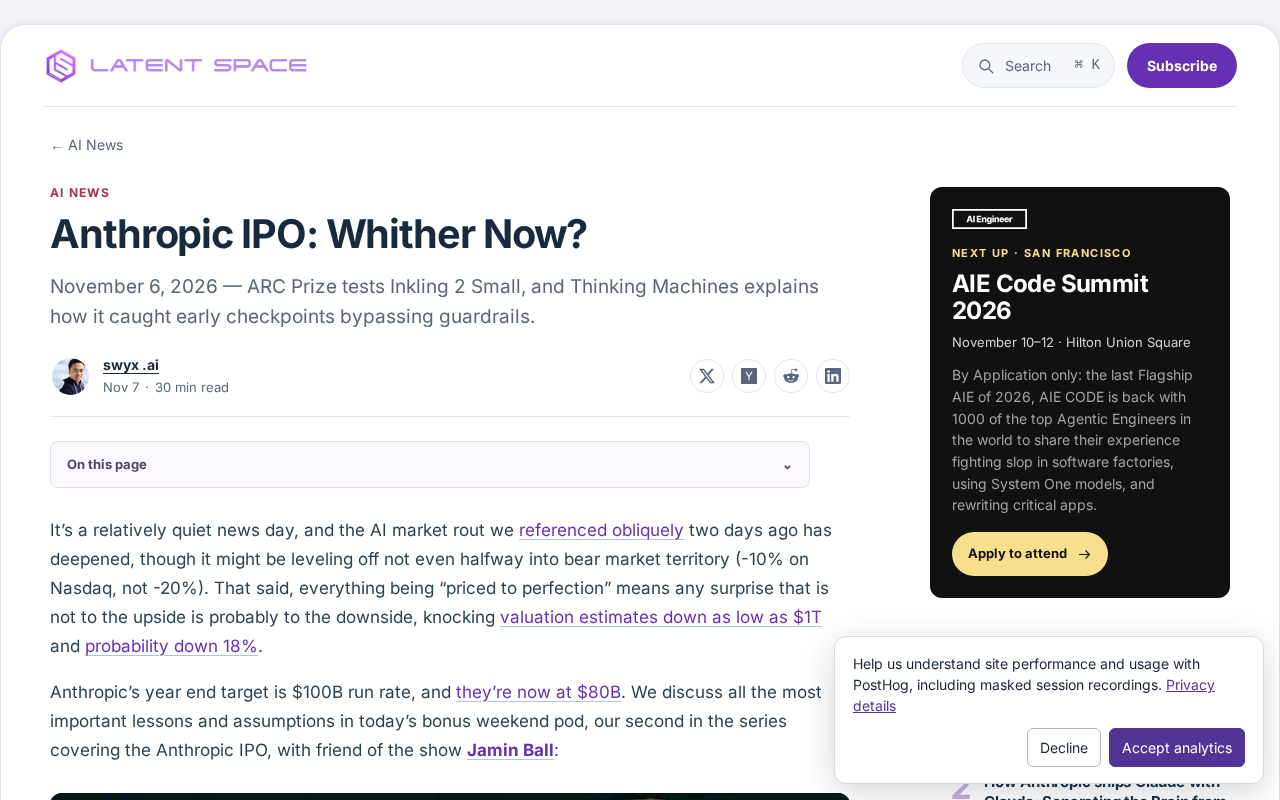
Anthropic IPO rumors, ARC Prize testing, and guardrail bypass disclosure reflect the triple contest of AI capital, evaluation, and safety.
The article summarizes three recent developments in AI: the community is hotly discussing Anthropic's IPO prospects, reflecting market attention to leading AI companies' commercialization paths; ARC Prize tested Inkling 2 Small, highlighting the importance of evaluating abstract reasoning; and Thinking Machines disclosed that early checkpoints may bypass guardrails, suggesting safety alignment must run through the entire training process. The author argues that capital, evaluation, and safety are jointly shaping the next stage of the AI industry, and developers and product managers should keep tracking these developments to make wiser decisions in model selection, safety design, and business planning.
Event Overview: Anthropic IPO and New ARC Prize Developments
Recently, the tech community has been discussing rumors surrounding Anthropic's IPO, while ARC Prize tested Inkling 2 Small, and Thinking Machines disclosed a mechanism by which early checkpoints bypass guardrails. Together, these developments sketch out the latest progress in the AI industry across three dimensions: capital, evaluation, and safety.
According to RSS source information, the discussion focus on November 6, 2026 centered on Anthropic's IPO prospects. Although specific details remain unclear, this topic reflects the market's high attention to the commercialization paths of leading AI companies. Meanwhile, ARC Prize, an important benchmark for measuring AI reasoning capabilities, has also sparked widespread discussion with its test results on new models.
ARC Prize Tests Inkling 2 Small
ARC Prize's testing of Inkling 2 Small is the technical highlight of this information. ARC (Abstraction and Reasoning Corpus) is known for examining models' abstract reasoning abilities, and its test results often reveal a model's true level on non-memorization tasks.
As the tested subject, Inkling 2 Small's performance details are not fully elaborated in the original material, but the testing itself indicates that the model has entered mainstream evaluation view. For researchers and developers concerned with AI reasoning capabilities, ARC Prize's test results can serve as an important reference for evaluating a model's generalization ability.
Significance of the Testing and Industry Impact
ARC Prize's testing is not only an evaluation of a single model but also reflects the current AI community's emphasis on reasoning capabilities. As model scaling slows, improvements in reasoning efficiency and abstract ability have become new competitive focal points. The test results of Inkling 2 Small may influence the design direction of subsequent models.
ARC (Abstraction and Reasoning Corpus) was proposed in 2019 by former Google researcher François Chollet. It is a benchmark designed to measure machine abstract reasoning rather than pattern memorization. Each task provides several input-output grid examples, requiring the model to induce the transformation rule and apply it to a new grid. Its design deliberately avoids reliance on prior knowledge from large-scale corpora, so it is regarded as a "touchstone" for testing generalization ability.
ARC Prize is a public competition and prize program built around this benchmark, encouraging researchers to explore reasoning methods closer to human sample efficiency. Because traditional large models have long scored low on ARC, their leaderboard results are often used to question the narrative that "scaling equals general intelligence," making it an important reference for evaluating new models' reasoning levels.
Thinking Machines Discloses Guardrail Bypass Mechanism
Thinking Machines explained how it discovered the phenomenon of early checkpoints bypassing guardrails. This disclosure involves a key issue in the field of model safety: during training, early checkpoints may not yet be fully aligned with safety constraints, leading to guardrail-bypassing behavior.
This finding has warning significance for AI safety practices. Guardrail mechanisms are typically used to prevent models from outputting harmful content, and the bypass phenomenon of early checkpoints suggests that developers need to continuously monitor safety throughout the entire training process, rather than relying solely on evaluation of the final model.
The Ongoing Challenge of Safety Alignment
Thinking Machines' disclosure echoes ARC Prize's testing: the former focuses on safety alignment, while the latter focuses on reasoning capability, and together they form a complete picture of AI model evaluation. For product teams, this means that in model iteration, capability improvement and safety constraints need to be balanced.
Checkpoint refers to parameter snapshots periodically saved during model training. Developers often use checkpoints for evaluation, rollback, or continued training. Early checkpoint means the model has not yet gone through complete alignment fine-tuning (such as RLHF or safety instruction fine-tuning) stages, and thus may retain inappropriate behavioral tendencies from pretraining corpora.
Guardrails are safety mechanisms at the deployment layer or model layer, used to intercept harmful outputs. The bypass phenomenon shows that if early in training or if checkpoints that have not completed alignment are directly exposed to users, guardrails may fail. This suggests that safety evaluation should cover the entire training cycle, not just the final released model version.
Industry Observation: The Triangular Relationship of Capital, Evaluation, and Safety
Anthropic's IPO rumors, ARC Prize's testing, and Thinking Machines' safety disclosure appear independent but actually point to the same trend: the AI industry is shifting from a pure technology race to a comprehensive contest involving capital, standards, and safety.
At the capital level, IPO rumors reflect the market's expectations for AI companies' profit models; at the evaluation level, benchmarks such as ARC Prize promote transparency in model capabilities; at the safety level, the guardrail bypass issue reminds the industry that alignment risks cannot be ignored. These three forces will jointly shape the development and commercialization paths of AI products in the next stage.
For developers and product managers, following these developments helps make wiser decisions in model selection, safety design, and business planning.
Conclusion
Although this information is brief, it covers key issues in the AI industry. Anthropic's IPO trajectory, Inkling 2 Small's evaluation performance, and the explanation of the guardrail bypass mechanism are all worth continued tracking. Subsequent developments will further reveal how the AI industry balances capitalization and safety.
Related articles
 Tech Frontiers
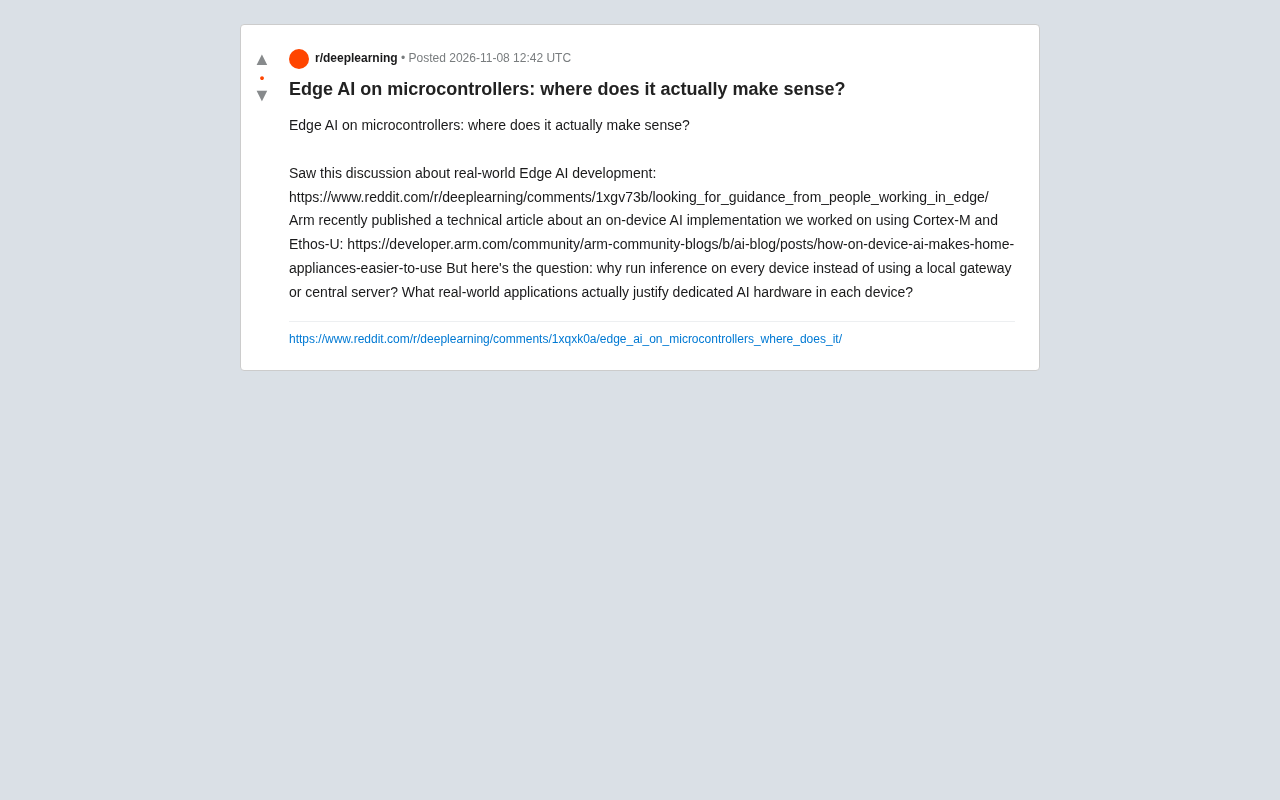
Edge AI on Microcontrollers: When Is It Actually Worth Deploying?
Drawing on Reddit discussions and Arm case studies, this article analyzes the real-world use cases for edge AI on microcontrollers: when each device needs independent inference, when a gateway or cloud is more reasonable, and the costs and boundaries of specialized hardware.
 Tech Frontiers
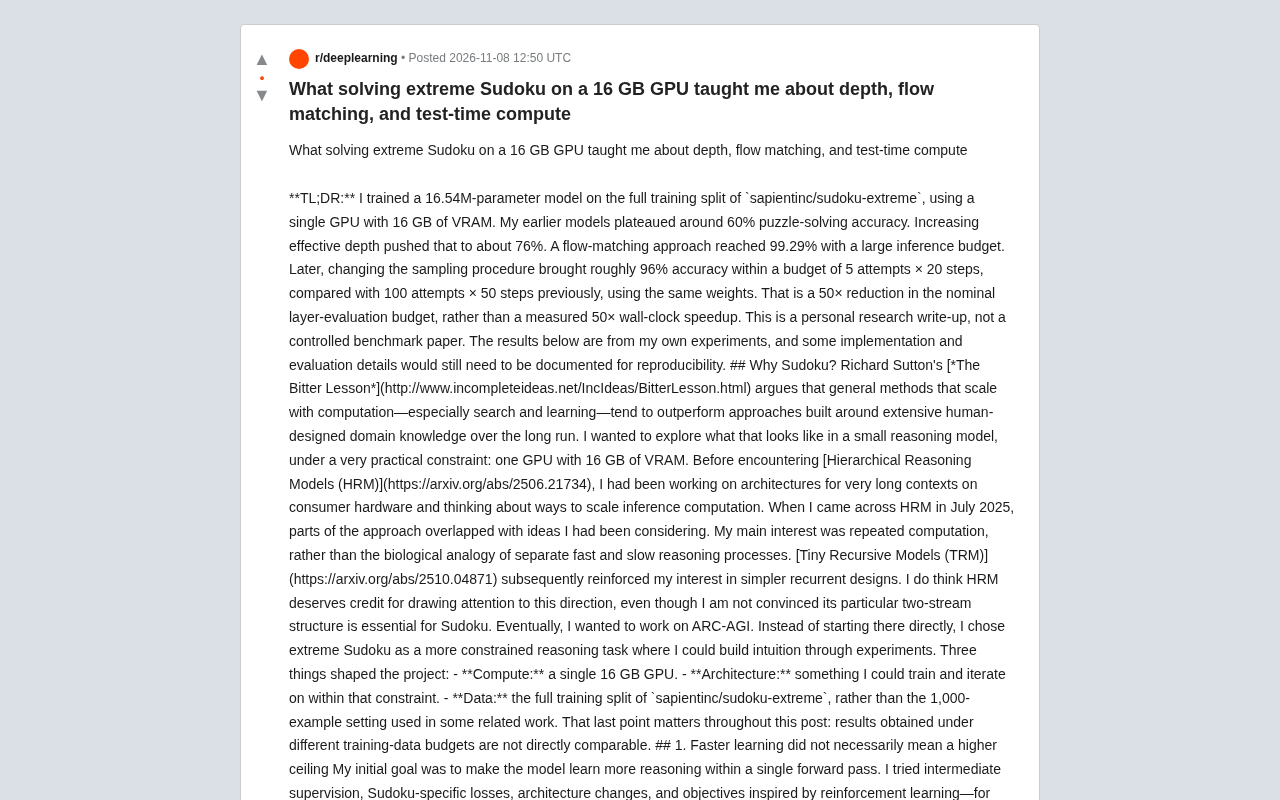
Pushing the Limits of Extreme Sudoku on a 16GB GPU: Insights from Depth and Flow Matching
A researcher trained a 16.54M-parameter model on a 16GB GPU to solve extreme Sudoku, finding effective depth breaks the 60% plateau and flow matching with improved sampling pushes accuracy past 99% with ~50× lower layer-evaluation budget.
 Tech Frontiers
AI Agent Approval Workflows: Why Human Confirmations Always Get Mindlessly Clicked
Why do AI agent approval workflows always get mindlessly clicked? A Reddit discussion shows that separating rules from keys, low-frequency high-risk approvals, and GitHub Environments-style gates are the keys to effective approvals.