Behind Unitree's Oilfield Joint Venture: A Second, Slower Demand Curve for Humanoid Robots
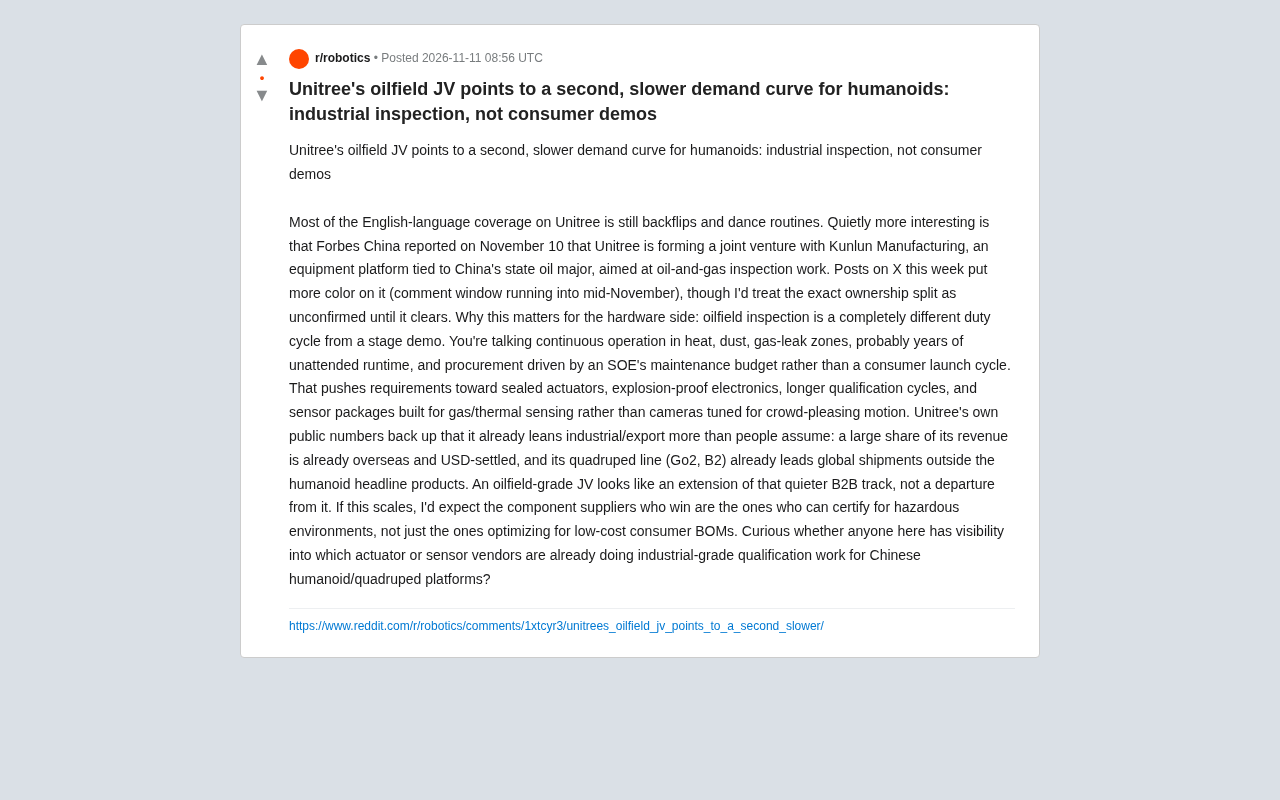
Unitree's oilfield JV with Kunlun Manufacturing reveals a second, slower industrial demand curve for humanoid robots.
The article argues that Unitree's joint venture with Kunlun Manufacturing targeting oil and gas inspection matters not as another memorandum but as evidence of a demand curve distinct from consumer demos: slower, heavier, and industrial. Oilfield scenarios require sealed actuators, explosion-proof electronics, long certification cycles, and specialized sensors, with procurement driven by state-owned enterprise maintenance budgets. Unitree already earns substantial overseas USD revenue and leads in quadruped shipments, making industrial B2B an existing track. If scaled, suppliers certified for hazardous environments will outperform low-cost BOM players. Equity details remain unconfirmed.
While most English-language coverage is still focused on Unitree robots' backflips and dance videos, a quieter but potentially more significant piece of news has gone unnoticed. According to a November 10 report by Forbes China, Unitree is forming a joint venture with Kunlun Manufacturing—an equipment platform tied to a Chinese state-owned oil giant—targeting oil and gas inspection operations. Discussions on X this week added more details, though specifics such as equity stakes should still be treated with caution pending official confirmation.
The significance of this isn't that yet another robotics company signed a memorandum of cooperation—it's that it reveals a demand curve entirely different from consumer-grade demos: slower, heavier, and more oriented toward industrial inspection.
Oilfield Inspection: A Completely Different Duty Cycle from Stage Demos
The requirements that oilfield inspection places on humanoid and quadruped robots are radically different from executing a choreographed routine on stage. According to the analysis in the original post, this means continuous operation in high-temperature, dust-laden, and gas-leak zones, potentially requiring years of unattended runtime, with procurement decisions driven by state-owned enterprises' maintenance budgets rather than consumer product launch cycles.
This scenario pushes hardware requirements in several clear directions: sealed actuators, explosion-proof electronics, longer qualification and certification cycles, and sensor packages designed for gas and thermal detection—rather than camera arrays tuned to flatter the lens. In other words, demo robots optimize for "looking agile," while oilfield robots optimize for "not failing in hazardous environments."
This distinction is often overlooked. The iteration logic of consumer-grade demos is rapid trial and error, visual impact, and social spread; the logic of industrial inspection is certification, redundancy, maintainability, and total lifecycle cost. The supply chains, testing standards, and customer relationships of the two barely overlap.
Duty cycle originally refers to the proportion of time a device is in an operating state within a work cycle. In the context of industrial inspection, it determines the robot's thermal management, seal lifespan, and maintenance interval design. Stage demos are typically short-duration, intermittent, high-dynamic movements in controlled environments, whereas oilfield inspection requires robots to operate continuously for extended periods or in shifts while maintaining a low failure rate in high-temperature, dusty, and corrosive atmospheres. The difference in duty cycle directly leads to divergent hardware choices: the former pursues instantaneous power density and motion performance, while the latter pursues thermal redundancy, sealing reliability, and maintainability under sustained operation—which is also why industrial models often appear "bulky" yet are more durable.
Unitree's B2B Foundation Is Stronger Than Outsiders Realize
The original post mentions an easily overlooked fact: Unitree's public data shows that a considerable proportion of its revenue already comes from overseas and is settled in US dollars, while its quadruped product line (Go2, B2) already leads global shipments over the humanoid products that grab headlines.
This means the oilfield joint venture is more an extension of Unitree's existing B2B track than an abrupt pivot. Humanoid robots are the front stage of brand narrative; quadrupeds and industrial applications are the backstage of cash flow. Directing resources toward scenarios like oil and gas inspection aligns with the natural choice of a company that has already established channels among overseas industrial customers.
From a demand-structure perspective, this also explains why the "second curve" is slower: state-owned enterprise procurement requires qualification review, on-site validation, and long-term maintenance agreements, with cycles measured in years—but once a company enters the supplier roster, high replacement costs and strong order continuity follow.
BOM (Bill of Materials) is a structured list of all components and their costs for a complete robot, often used as a core metric for hardware cost competitiveness. Consumer robotics companies excel at driving down BOM through economies of scale in procurement, simplified design, and rapid iteration, but this logic doesn't fully apply in industrial scenarios: explosion-proof certification, redundancy design, and long-cycle reliability validation significantly raise per-unit costs, yet customers are willing to pay a premium for "not failing." As a result, the competitive dimension for industrial inspection robots shifts from "lowest unit cost" to "optimal total lifecycle cost and compliance qualifications," and suppliers' moats shift from supply chain efficiency to accumulated certifications and on-site service capabilities.
Who Wins: Explosion-Proof Certification Matters More Than Low-Cost BOM
One judgment from the original post is worth expanding on: if this type of joint venture model scales up, the component suppliers that win will be those capable of certifying for hazardous environments, not merely those adept at driving down consumer-grade bill-of-materials costs.
Explosion-proof certification, sealed actuators, and gas and thermal sensors—the technical barriers and validation cycles in these areas are far higher than for consumer-grade products. For upstream suppliers, this is a long-term race around accumulated qualifications, not a price war. The original author also asks: does anyone know which actuator or sensor suppliers are already working on industrial-grade qualification certification for China's humanoid/quadruped platforms?
There's currently no public answer to this question, but it points to a broader trend: competition in the robotics industry is shifting from "whose moves are flashier" to "who can pass more rigorous scenario validation."
Explosion-proof certification typically refers to type testing and certification of electrical equipment used in explosive gas or dust environments according to the IEC 60079 series or China's GB 3836 series standards, classifying protection types such as Ex d (flameproof), Ex e (increased safety), and Ex ia (intrinsic safety). For humanoid/quadruped robots, the core difficulty lies in how high-energy components such as batteries, motor drives, and joint actuators can avoid generating ignition sources under fault conditions, often requiring dedicated flameproof enclosures, current-limiting circuits, and temperature monitoring. Certification cycles are typically measured in years, and each model and each operating environment must be re-evaluated—this is precisely the fundamental threshold that distinguishes industrial inspection robots from consumer-grade products.
Cautious Judgment Amid Multiple Information Sources
Current information sources for this news include the Forbes China report and discussions on X. Both are consistent in describing the direction of the joint venture, but the specific equity structure has not been confirmed. The original author also explicitly states that shareholding ratios should be treated as unverified information until official details are clarified.
For readers following the robotics industry chain, the more prudent angle is not to fixate on the details of any single collaboration, but to watch whether this kind of industrial inspection demand forms a stable procurement rhythm. If state-owned enterprise maintenance budgets begin to systematically incorporate robotic inspection, that will be the real signal that the demand curve has taken hold.
In the short term, this won't change Unitree's image on social media; in the long term, it may change the revenue structure of this company and even the entire industry.
One-line Summary
Unitree's joint venture with Kunlun Manufacturing targeting oil and gas inspection reveals a second, slower industrial demand curve for humanoid robots.
Paragraph Summary
The article notes that Unitree's joint venture with Kunlun Manufacturing targeting oil and gas inspection matters not as yet another memorandum of cooperation, but because it reveals a demand curve entirely different from consumer-grade demos: slower, heavier, and more oriented toward industrial inspection. Oilfield scenarios demand sealed actuators, explosion-proof electronics, long certification cycles, and specialized sensor packages, with procurement driven by state-owned enterprise maintenance budgets rather than product launch rhythms. A considerable share of Unitree's revenue already comes from overseas US-dollar income, and its quadruped line leads global shipments—industrial B2B is an existing track, not an abrupt pivot. If the model scales, component suppliers capable of certifying for hazardous environments will have an edge over low-cost BOM manufacturers. Information such as JV equity ratios remains unconfirmed and should defer to official disclosure.
Related articles

S&P Weighs Downgrading Nvidia's Credit Rating: Governance and Key Man Risk in Focus
S&P is considering downgrading Nvidia's credit rating to AA-, citing corporate governance and key man risk rather than financial performance. We analyze the drivers, potential impact, and the broader trend of governance scrutiny for large tech companies in the AI era.

Generating a 3D Stacking Game from a Few Prompts: Hands-on with the Playground Experimental Platform
Playground lets users generate the 3D stacking game One More Pie from a few text prompts. This article examines the capabilities and limits of prompt-based web game generation.
AI Math Proofs Are Exploding: Humans Can't Read Fast Enough
AI math proof output now outpaces human reading speed. AINews roundup covers Erdős problems, new matrix multiplication bounds, and Fourier transform bounds—verification is the new bottleneck.