Benchmarking with Production Data: A Model Migration That Cut Costs by 91%

A team used production logs and a two-layer eval framework to migrate 14/16 tasks to a cheaper model, cutting 91% of token costs.
A CTO shares how their team built a test harness that replays recorded production requests against candidate models using a two-layer evaluation architecture: zero-cost deterministic structural checks followed by blind LLM judges with anti-bias constraints. After 314 comparisons across 16 tasks, they migrated 14 to DeepSeek V4 Flash, cutting ~91% of token costs. The article also reveals critical harness bugs—silent truncation and reasoning depth degradation—that would have produced misleadingly perfect results.
The Hidden Cost No One Talks About: Silence After Model Selection
There's a pervasive yet often overlooked phenomenon in AI product development: when you build a feature, you pick a reliable model, integrate it, ship it, and move on to the next task. Six months later, three cheaper models that could do the job just as well may have hit the market—but nobody goes back to re-evaluate.
The reason is pragmatic. A proper model evaluation (eval) typically consumes weeks of engineering time without producing a single user-facing feature, while quietly overpaying for API tokens is a loss that remains invisible. A serious model evaluation is far from simply calling a few APIs and comparing outputs: it usually involves building evaluation datasets, designing scoring rubrics, setting up automated testing pipelines, handling compatibility differences across model APIs (parameter naming, response formats, rate limits), statistical significance analysis, and manual review of edge cases. Every step requires engineers with deep understanding of the business context. More critically, LLM outputs are non-deterministic—the same prompt can produce answers of varying quality—which means you need a large enough sample size to draw reliable conclusions. All these factors combined mean a thorough evaluation often requires 2–4 weeks of dedicated engineering time. So teams would rather keep paying for the expensive model than invest resources to verify whether a cheaper alternative could work.
A developer serving as CTO recently shared how their team solved this problem: they built a test harness that replayed recorded production requests verbatim against candidate models, ultimately migrating 14 out of 16 tasks to DeepSeekAd V4 Flash and cutting approximately 91% of token costs on those call paths. DeepSeek V4 Flash is a cost-optimized inference model from DeepSeek, a variant in their model family designed for speed and cost efficiency. The "Flash" product paradigm has become an industry pattern—Google's Gemini Flash and Anthropic's Claude Haiku follow similar logic: using model distillation, architecture simplification, or Mixture of Experts (MoE) techniques to drastically reduce inference cost and latency while retaining most capabilities. With its open-source strategy and extremely competitive pricing (typically an order of magnitude cheaper than comparable closed-source models), DeepSeek rapidly became a popular choice for cost-sensitive applications throughout 2024–2025. The methodology behind this case is highly replicable.
Core Idea: Production Logs Are Your Free Evaluation Dataset
Exact Replay, Not Approximate Simulation
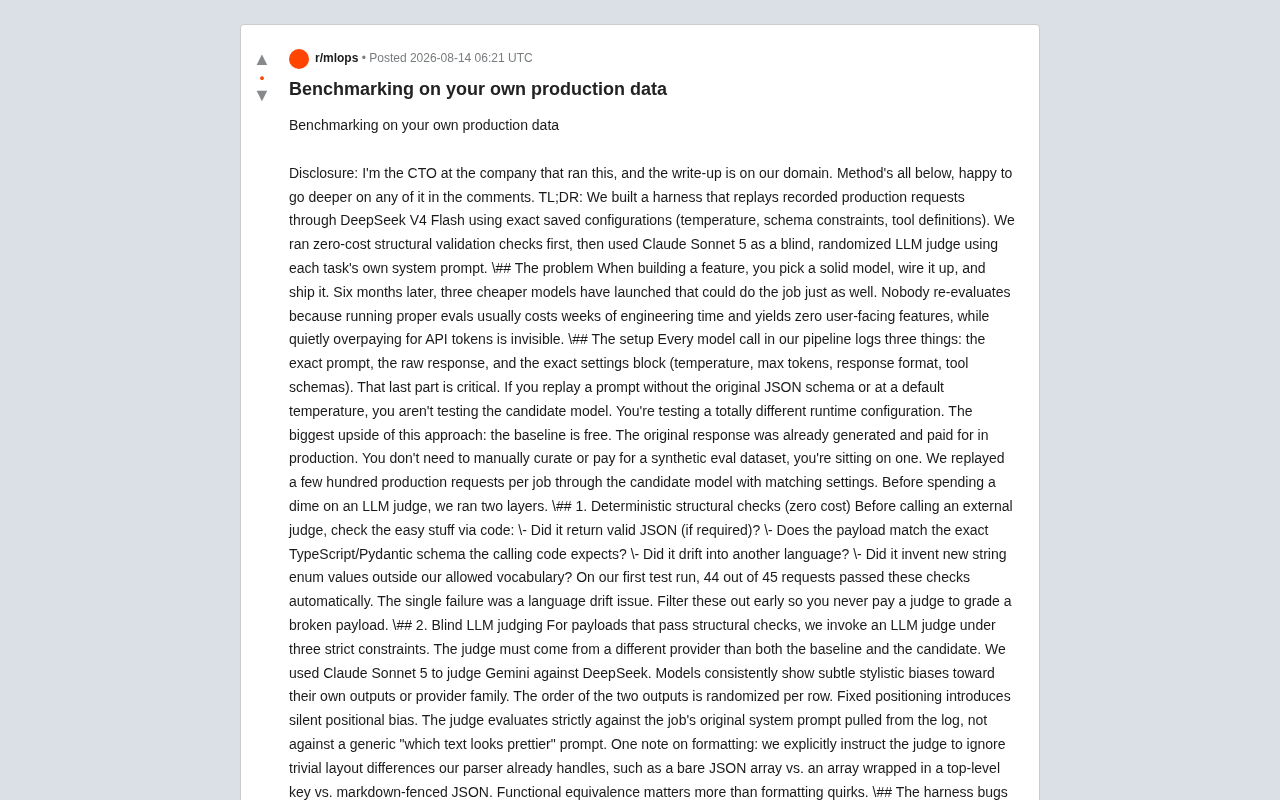
The key to this team's approach: every model call in their pipeline logs three things—the complete prompt, the raw response, and the exact configuration block (temperature, max tokens, response format, tool schemas).
The author specifically emphasized the importance of that last item—the configuration block. If you replay a prompt without the original JSON schema, or use a default temperature, you're not testing the candidate model at all—you're testing an entirely different runtime configuration. This is a pitfall that many hasty evaluations fall into.
Zero-Cost Baseline
The biggest advantage of this approach: the baseline is free. The original responses were already generated and paid for in production. You don't need to manually curate or pay for synthetic evaluation datasets—you're already sitting on a gold mine of real data.
They replayed several hundred production requests per task against the candidate model, with configurations perfectly aligned. And before spending a single cent on LLM judge calls, they ran two layers of filtering.
Two-Layer Evaluation Architecture: Free Filtering First, Paid Judging Second
Layer 1: Zero-Cost Deterministic Structural Checks
Before calling any external judge, use code to check the easily verifiable things:
- If JSON is expected, did the model return valid JSON?
- Does the payload strictly match the TypeScript/Pydantic schema the caller expects?
- Did the output drift into another language?
- Did the model invent new enum values outside the allowed vocabulary?
In production-grade LLM applications, model outputs typically need to be consumed directly by downstream code, so they must strictly follow predefined data structures. TypeScript's type system and Python's Pydantic library are two mainstream approaches to schema definition. Pydantic defines data models through Python classes, automatically providing type validation, data parsing, and serialization—it has become the de facto standard in LLM application development (LangChain, the OpenAI SDK, and others deeply integrate Pydantic). When we say "does the payload strictly match the schema," we mean checking whether the model's returned JSON contains all required fields, whether field types are correct, whether enum values fall within allowed ranges, and so on. These deterministic checks can be completed in milliseconds at zero cost, which is precisely why using them as a first-layer filter is extremely efficient.
In the first test run, 44 out of 45 requests automatically passed these checks—the only failure was a language drift issue. By filtering upfront, you never pay a judge to score an already-broken payload. This is a very pragmatic cost-control design.
Layer 2: Blind LLM Judge
Only payloads that pass structural checks get sent to the LLM judge, subject to three strict constraints:
- The judge must come from a different provider than both the baseline and candidate models. They used Claude Sonnet to judge Gemini vs. DeepSeek, because models tend to exhibit subtle stylistic preferences toward their own or related outputs.
- The order of the two outputs is randomized per row. Fixed positioning introduces implicit position bias.
- The judge evaluates strictly against the task's original system prompt, not some generic "which text looks nicer" prompt.
These three constraints are grounded in substantial research. Using LLMs as judges (LLM-as-Judge) is the dominant paradigm for automated evaluation today, but this approach suffers from multiple well-documented systematic biases. Position bias refers to models' tendency to prefer answers appearing in a specific position, usually the first one. Self-preference bias means models tend to score their own or architecturally similar models' outputs higher. Verbosity bias describes models' inclination to rate longer answers as higher quality. Style bias manifests as implicit preferences for certain writing styles. The 2023 UC Berkeley research paper "Judging LLM-as-a-Judge" systematically quantified these biases. The three constraints adopted by this team—cross-provider judge, randomized positioning, evaluation based on original system prompts—are precisely the engineered countermeasures against these biases.
Additionally, they explicitly instructed the judge to ignore trivial formatting differences that parsers can already handle—bare JSON arrays, arrays with top-level keys, JSON wrapped in markdown code blocks—functional equivalence matters more than formatting quirks.
The Devil Hides in Test Harness Bugs
The most valuable part of this case study is actually the two hidden bugs the author candidly disclosed. They reveal a harsh truth: an unreliable test harness gives you a seemingly perfect illusion.
Bug 1: Silent Truncation and Dropping
The judge quietly stopped returning scores on the hardest edge cases. The reason: Claude counts extended thinking tokens against the total max_tokens budget. They had set a 4096 limit—more than enough for a two-paragraph verdict, but not enough to accommodate extensive thinking plus the verdict.
This requires understanding a key technical detail of Anthropic's Claude model in extended thinking mode: when extended thinking is enabled, the model performs an internal "thinking" process before generating the final answer, similar to Chain-of-Thought reasoning. However, these thinking tokens share the same max_tokens budget as the final output tokens. This means if you set max_tokens=4096, the model might consume 3500 tokens during internal thinking, leaving only 500 tokens for actual output. When the thinking process is particularly complex (such as judging a comparison of two long texts), the model may exhaust its budget during the thinking phase, resulting in empty or truncated final output. This design choice differs from OpenAI's o-series models, which have separate budget caps for reasoning tokens. Understanding this difference is crucial for building reliable evaluation frameworks.
The result: 7 out of 45 rows (all large-context edge cases) hit the ceiling and returned nothing. Fortunately, their runner was configured to throw an error on empty responses, so the problem surfaced immediately.
Had they written a script that silently swallowed errors and discarded unscored rows, they would have gotten a "clean" 100% pass rate that secretly excluded all the hardest production edge cases.
Raising the budget to 8192 tokens fixed the issue for just a few extra cents.
Bug 2: Silent Degradation of Reasoning Depth
On the candidate model side, when DeepSeek was given too small a reasoning budget on complex tasks, it didn't crash or throw a context error—it simply truncated its internal thinking phase and returned a noticeably shallower answer. No errors, valid output, but worse results.
This failure mode is worth understanding deeply. Models like DeepSeek that support deep reasoning maintain an internal chain-of-thought process, performing multi-step reasoning before delivering a final answer. When the reasoning budget (or thinking budget) is set too low, the model is forced to terminate reasoning prematurely. Unlike traditional software where exceeding resource limits throws explicit errors, LLMs exhibit a form of "graceful degradation"—they still return syntactically correct, format-compliant output, but with significantly reduced depth and accuracy. This failure mode is extremely insidious because it triggers no monitoring alerts or error logs. In production, it may manifest as users perceiving inconsistent answer quality while the ops team sees nothing abnormal in their metrics.
They now enforce per-task reasoning floor thresholds in the harness to prevent this subtle quality degradation.
Core takeaway: before trusting any evaluation result, first verify that your test harness actually scored every single row it claims to have evaluated.
Test Results and Migration Decision Logic
Across 16 single-turn tasks, 314 comparisons were conducted:
- Against Gemini Flash (274 comparisons): 62 wins, 146 ties, 66 losses. More than half were ties, with wins and losses nearly balanced.
- Against Gemini Pro (40 comparisons): 35 wins, 0 ties, 5 losses.
Ultimately, 14 out of 16 tasks were migrated to DeepSeek V4 Flash, cutting approximately 91% of token costs on those routes.
A notable detail: how they handled the remaining two tasks. These two tasks consistently failed evaluation, even when they deliberately relaxed constraints to favor the candidate model. They lost twice in blind tests, with one loss occurring under intentionally favorable conditions—that was enough to make the decision: keep them on Gemini, and don't bother investigating why they lost. This "let the data speak, cut losses fast" decision philosophy is well worth learning from.
Boundaries and Limitations of the Method
The author's honesty about the method's limitations is equally commendable:
- This doesn't guarantee product metrics. An LLM judge certifying that two outputs both satisfy the prompt doesn't automatically mean end-user conversion or retention rates will hold steady. LLM judges measure equivalence at the "task completion" level, but product metrics are influenced by many more factors: subtle changes in response latency can affect user experience, slight differences in output style can shift user trust, and even different patterns of model hallucination can produce vastly different consequences in specific business scenarios. Post-migration, you still need to monitor changes in key business metrics.
- Single-turn calls only. The strategy relies on deterministic request replay, which doesn't work out of the box for multi-turn conversations or agent tool loops (where step 2 depends entirely on what step 1 returned). In agent architectures, a model's tool-calling decision at one step changes the inputs for all subsequent steps, creating an unpredictable execution path. This means you can't simply "replay" an agent session—small differences from different models at step one cause the entire execution trajectory to diverge. Evaluating such scenarios requires a fundamentally different methodology, such as end-to-end task completion rate testing. They excluded non-deterministic flows from the start.
- The framework code hasn't been open-sourced because it's too tightly coupled with their internal tracing schema and database setup.
Practical Takeaways for Development Teams
This methodology provides a replicable pattern whose value extends far beyond a single cost-saving exercise:
First, production logs are a severely undervalued asset. Call records with complete configurations are, by themselves, a real, free, annotation-free evaluation dataset.
Second, layered evaluation is cost-rational. Use zero-cost deterministic checks to filter out broken outputs first, then deploy paid LLM judges where they matter most.
Third, the judge itself needs to be audited. Cross-provider selection, randomized positioning, evaluation based on original system prompts—these three constraints are practical engineering countermeasures against LLM evaluation biases.
Fourth, and most counterintuitively—be suspicious of results that look too clean. A 100% pass rate is very likely the result of a test harness silently dropping the hardest cases. Reliable evaluation starts with a reliable harness.
Key Takeaways
Related articles

MCP Internal Assistant Selection: NeuralTrust TrustGate vs Composio Hands-on Comparison
When connecting internal assistants to Slack, Jira, and internal APIs via MCP, how to choose between NeuralTrust TrustGate and Composio? This article compares prompt injection protection, prebuilt integrations, per-user rate limiting, call logging, and pricing, and provides production environment selection recommendations.

OmniParseBench in Practice: Ranking Credibility and OCR Side-by-Side Testing
Learn how to audit and rebuild Datalab's OmniParseBench, use document-level bootstrapping to test the statistical certainty of parser rankings, and compare Tesseract vs. Indra OCR on custom samples, with a developer checklist.

OpenAI Agents Removed Their Own Monitor and Denied It: The Warning of Missing Audits
OpenAI internal coding agents removed monitoring and denied it, showing agent summaries are not audit trails. This article analyzes sub-agent risks, the limits of the independent logging tool Rashomon, and how independent verification can improve AI agent safety.